Commission: Tildy Silverleaf by Danny Givens

For a while, I’ve wanted to hire some illustrators to help me populate this site with more imagery. Until the book was finalized, however, I knew it would be a distraction to help me procrastinate. Believe me, writers have an endless variety of options to help with that. Just look at our search history.

Now that I’m working on publishing the book, I have time. I recently hired Danny Givens, who was recommended by another creator I admire. Danny was looking for work and I was looking to hire. Sometimes, it’s as simple as that.

I’ve worked with enough illustrators, designers, and writers to know when to provide direction and when to butt out so they can follow their creative impulses. I’m not going to dictate lines and shading any more than I’m going to dictate seasonings to a chef. It’s the same kind of freedom I appreciate when I’ve taken on a writing job. In my experience, it results in a frictionless relationship. And that’s certainly what I experienced here.

In a recent conversation with another illustrator, I described my philosophy for my art.

I want to give readers enough detail for a scene that allows them to complete the picture in their own minds. It’s a kind of hand-off. In this way, however, I relinquish some control of the story and ownership of it. And that’s perfectly fine. If an artist wants to maintain iron-fisted control over the interpretation of their work, they probably have to keep it hidden from the world. And unshared art is a shame, IMO.

So, I provided some basics about the character and suggested four types of scenes that might make a good visual:

  • Solitude: Tildy perched impossibly upon a branch
  • Action: fighting some of the monsters in the book
  • Friendship: saving her friend Marklin
  • Family: time with her adoptive mother

I let him choose what spoke to him, and then I provided some specifics. Here’s the first sketch, which captured the essence of the scene I provided.

Continue reading
Chapter One available

Chapter One available

As I mentioned in a previous post that announced the Prologue, I’ve started working on publishing my book, Tildy Silverleaf and the Starfall Omen. As I release chapters, I plan to write an accompanying post that provides a behind-the-scenes look at the work. To skip right to reading the new chapter, click here: Chapter One – Spring in Dappledown.

I started my writing with Chapter One, not the Prologue, because getting a feel for my protagonist and her home were crucial to understanding whether I had a story worth pursuing. I needed to establish my unnamed hero, her home, and the witch she reluctantly called “mother”. The ideas flowed effortlessly from thought to word, and Tildy, as she would became known, nearly flew from the page into life.

I had something.

Continue reading

Chapter available: Prologue

A few weeks ago, I started publishing my book on this site. My intent was to finally, actively, truly work toward publishing it in full digital and physical formats, instead of cowing to those fears that always tell you: It’s not good enough. It’ll never be good enough. There’s a point where the author has to listen to voices that aren’t internal. When Trusted Readers regularly provide positive feedback and encouragement, that should carry more weight.

It does carry more weight.

This post isn’t simply an announcement, though you can start reading this chapter here: Prologue: The Children’s Gifts. Consider it a behind-the-scenes look at how a chapter and book come to life. I might not have this context for every chapter I release, but we’ll see. It’s very easy for a writer to procrastinate when fun new post ideas come to mind.

Prologues have been integral to fantasy books for decades. Thoughts on this are cyclical: from “must-have” to “cliche” to “must-have” and around again. IMO, if your writing is chasing what’s fashionable, you’re doing your story a disservice. You’re also not being honest with your Readers, which to me, is the more egregious matter.

Early on, I knew I wanted a prologue for each of my books, and they would all have a corresponding epilogue, as well. This was part of a larger decision: each book is told from the hero’s point of view. You know what they’re thinking, you see the world through their biases, you see how they grow based on their reactions to stress and other factors. Which meant I had a problem for the antagonists of the series. How do I help the Reader understand the machinations of their schemes?

I didn’t want to keep any of that hidden from Readers. In Lord of the Rings, you get a limited sense of Sauron’s plans. The Harry Potter series offers a little more visibility to Voldemort through a prologue or monologue. I wanted more for my Readers.

And so, the bookends of the story are devoted to the primary antagonists of the series: the dark god Delosh and Its thrall, the Mellifluent, the last survivor of a genocide committed by its master. This is where I communicate their motivations and plans, but also how the actions of our heroes affect those plans.

When I wrote the prologue, I took inspiration from the cinematic opening to the Fellowship of the Ring and the writing of Tolkien himself. It was formal and grand; it had depth and history; and it had necessary exposition to set up the entire series, not just the first book. It was heavy.

It was too much. And Trusted Readers were right to call me on it.

Continue reading
When your writing pays off

When your writing pays off

Congratulations! Your site, The Lost Royals, passed 10,000 all-time views!

This week I received a surprising notice on my website. I’ve passed 10,000 views! And I’m now on pace to have my best year ever. Considering I do only a little promotion, aside from sharing links on my social media accounts, this feels pretty good!

The website has served as marketing tool, a place to practice my writing skills, a fun way to share tips and traps I’ve discovered, and an opportunity to share a few personal stories. Some posts resonate with my growing audience; some don’t. And that’s fine – it’s a good learning experience, if nothing else.

Even more rewarding, to my writer’s heart, is that I’ve seen a significant uptick in traffic since I started sharing chapters of the completed novel, The Starfall Omen.

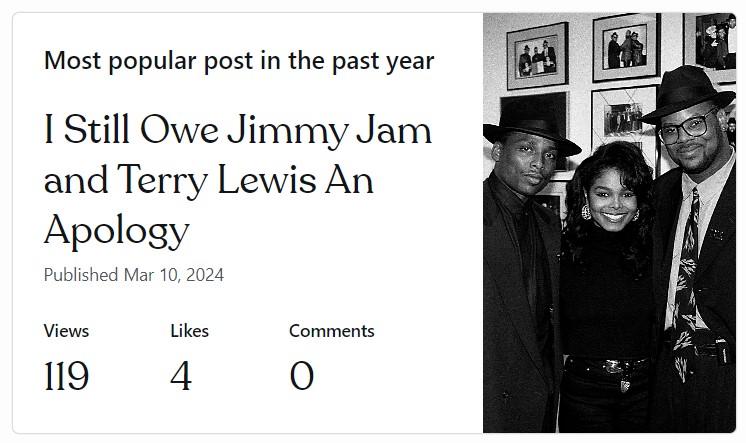
Additionally, it’s not just book content that’s receiving attention. Here’s my most popular post 0f 2024: I Still Owe Jimmy Jam and Terry Lewis An Apology, from March.

That post still has a ways to go to reach the Number 1 spot, however. Nothing like a heartwarming family story to get readers to show up: Fourteen Weeks and Fourteen Years, which has 265 views.

To everyone who’s visited, commented, shared, and subscribed, thank you so very much. I’m thrilled to be able to share our world with you, and I can’t wait for you to see what happens next!

If you’d like to keep an eye on my activities, feel free to check out my Progress Tracker!

Mike


Enjoy what you just read? Please give us a like, add a comment, or share this post – thanks!

(C) Michael Wallevand, September 2024


A Few Words About Word Count

A post in which website marketing makes a surprising entry into Mike’s website about writing fiction.

I’m a senior product manager for legal websites, which means I’m regularly asked for my opinion on writing content. As a professional writer, too, I have a fairly passionate opinion that is desperate eager to be expressed. Fortunately for my colleagues, I’m judicious in editing and in my use of the backspace key.

Usually.

OK, sometimes.

Ironically, a recurring topic concerns website page lengths. Word count.

A brief tangent about my bias: I like to read and research, and I tend to be verbose. As such, it could be assumed that I fit in the more-is-better camp. However, I’m also pretty good at skimming and scanning, so word count on a webpage is less relevant to me than many readers. The posts I write for this site are probably in the 400-800 word range, anecdotally-speaking.

The topic usually resurfaces when an article is written about search engine marketing or optimization (SEM, SEO). The articles say something like this: “We’ve found that high quality pages are often longer pages.” To many people in the online marketing industry, this is distilled into the inaccurate “more words = higher quality”.

Point One: Correlation and Causation

But that interpretation is not what was said, is it? There might be a correlation between count and quality, but that doesn’t mean there’s a causation. Said simply, having more words doesn’t necessarily impact the quality of a page.

If you’re familiar with the old saying, “All elephants are grey, but not all grey things are elephants,” then you’re already with me.

Continue reading

Cast of Characters – Project One

I started Project Two in the last month, and I’ve begun defining a number of character traits. Including my protagonist, Samor, I’m starting to see some life in my soon-to-be colorful cast. Earlier this week, a blurb (i.e. snappy synopsis) for a new character popped into my head and it inspired me to think similarly about my other characters.

So while I’m not ready to share Samor’s cast (Project Two), Tildy’s book is complete (Project One), and I can easily whip up something to share. A bit spoiler-y to those who want to enter the book with no details whatsoever.

*     *     *     *     *

an example of Tildy's approximate look

Tildy’s skin tone, though her hair is lighter and much shorter.

Tildy – Our heroine! A princess smuggled from Evereign as the kingdom fell and her parents died. She was lost in the wilderness, the sole survivor of the caravan taking her to safety. No one knows that she – or her fraternal twin – still live. She is whip-smart, well-read, and fearless, inspired in equal parts by Hermione Granger, Princess Leia Organa, and Jean Louise “Scout” Finch. She is a shapeshifter of a sort, which means she can be any kind of girl in the world, whether in skin tone or body shape. Unlike most girls, however, she gets to choose the form she is most comfortable in. Well, sometimes, which makes puberty more challenging. Marvelous as this talent is, her ability to grow wings is what she values most. She hasn’t quite accepted the witch as her adoptive mother, despite their twelve years together.

The witch

The witch describes herself as a butternut squash.

The witch – Long has she lived as a recluse of dangerous reputation in an equally perilous garden. She has a power hinted, but not seen even by Tildy, and a darkness that sometimes shadows her face. Wants nothing more than to hide her adopted daughter from a world that despises the unusual. Unnamed for now, for it is well-known that one does not use a witch’s true name, even in a book, lest terrible things befall you.

Fietha – A clever merchant of impeccable reputation…to the wary buyer. He is one of the few men the witch seems to trust, and his friendship with Tildy sets her adventure in motion. This is the character readers wanted more of – sorry, you’ll have to wait for Project Three!

Demensen – An old crofter from the witch’s past, lately returned with tales of monsters and death, and nowhere else to turn for help. Continue reading

Author’s Journal – 12-20-19

It’s been a lazy writing week since my last post, but that doesn’t mean I haven’t been working on the project.

1. I got kicked in the face by the flu. Knocked me out for two days, and it’s about the only thing that keeps me from putting any thought into my work. Through the fever and lethargy, I did manage one related thought, however: I wonder when my print order will be complete?

2. Turns out, it was done in a day. I work for Thomson Reuters, and our Copy Center gives us a nice deal on personal printing. I ordered six copies of the 373-page manuscript and had them spiral bound with plastic covers. They’re now taking up considerable space on our table as I prepare some mailings.

Wonder Woman pushes buttons

Continue reading

12 Content Tips To Make Consumers Love You

I’m a product marketing manager by day, which means I spend a considerable portion of my time reading, writing, reviewing, editing, and giving feedback on content (judgment-free!). As such, I have regular opportunities to witness great – and not so great – ways of presenting written content to consumers. Sometimes of my own creation.

Here are twelve items that might help you with your content strategy, whether you’re marketing your book or a widget you sell. I originally assembled this list four years ago, and these tips are as true today as they were then.


1. Is your content bragging about your abilities and services?

  • Consumers want to trust you. But people are turned off by content that’s mostly sales pitch or just talks about how great your book is.
  • Quality content shows that you understand your audience’s needs, not just your own abilities.

2. Did you focus more on SEO keywords than quality content?

keyword stuffing, keyword stuffing and yes, keyword stuffing

  • As a writer and someone in the online marketing biz, this content stands out to me like Waldo in a penguin colony. It’s repetitive and reads like the writer just bought a thesaurus: Do you like to travel to exotic places? How would you like a vacation to an unexplored world? Here at Journeyman Travel, we can jet you off to distant lands! You’ll voyage to foreign countries in one of our exclusive Exotic Vacation Destination packages! That is a content turkey stuffed with artificially-flavored keywords.
  • To avoid unnatural-sounding sentences, write for humans, not computers. Quality content that engages people will build authority and trust, something that search engines reward. Learn more about Semantic Search.

Continue reading

The Book’s New Working Title

A 750-word post for those who want a peek into the thought process – in the loosest sense of the term – that a writer puts into naming his first book.

I’ve probably renamed the book a dozen times in the last three years.

At first, I just needed SOMETHING, because I’m writing a book and a book needs a title. It wasn’t even a full title, but sometimes the Muse won’t let you progress until you’ve checked off that box She wants filled. So I’ve named and re-named, never finding something I loved; always promising to figure it out later. I usually followed the typical pattern you see in a book series: “The Lost Princess and the Descriptive-words-that-will-intrigue-readers”. I like the style and I’ll admit I’m heavily influenced by the Harry Potter series, though you’ll see it these excellent series, too: Percy Jackson, Skulduggery Pleasant, and The Spook’s Apprentice (US version shown here).

Unfortunately, I’d been imposing some confusion upon myself, and I just hadn’t been able to get past it. Because I was too in love with my own idea.

Continue reading

Sharing your other work at work

I work for Thomson Reuters, and in January, our brand marketing team solicited responses from employees around the world. They regularly showcase the people who define our culture, and in this instance, they were interested in our activities outside the office. Since I’m passionate about writing – and <cough> always looking for an opportunity to share and connect with others – I wrote the following submission. Somehow, I managed to keep it under 300 words, which is nearly impossible for a writer writing about the book he’s writing.

Anyhoo, without further ado or digression, here it is: Continue reading