Writing Exercise – The An-Teak Desk

A writer never knows when inspiration will arrive or from where. Because algorithm, I stumbled upon the podcast of a friend’s wife. It was a clip in which she discussed junk drawers with her friend. They laughed in delight at the idea of the drawer opening up like the wardrobe to Narnia.

An hour later, I had 1,700 words.


Jammie, so nicknamed for her love of footie pajamas, followed her brother Matt up the dim creaking stairs, her eyes fixed on the close-cropped black hair that had earned the slender boy a moniker of his own. “Gramma missed a spot, Matchstick,” she teased, pointing at the tuft on his head.

He reached back and felt for the place, his lips hissing a derisive sound when he found it. “That’s my lucky spot. She says if you find one of those, you’ll be lucky ‘til your next haircut.”

“I think that’s one of those things grown-ups say to hide their mistakes,” she retorted.

He looked over his shoulder as they neared the top of the stairs. “With all that reading you do, I can’t believe you’ve never heard of that.”

“You read as much as I do and I bet you’ve never heard of it, either.”

The dark shape of the heavy oak door emerged from the shadows before them, a dull brass doorknob reflecting the oil lamp at the bottom of the stairs. Instead of reaching for the knob, he turned and looked down at her. “You read way more than I do.”

“Yeah, but you read en-cy-clo-pedias,” she replied, drawing out the enunciation as a sign of reverence. She’d always wanted to enjoy them – knowledge was important, her daddy advised – but she just didn’t have the head for it, her grandma said.

“I didn’t have a choice, you know.”

“But you like them now, right?”

He stared at his sister, her face aglow with wonder and curiosity. Her eyes could drink in all the details of the world, and still her inquisitiveness would not be sated. “I guess. They’re now like reading an old story you know by heart.”

“I know all about that. My books never showed me that symbol you found, though. My stories are all made up, and writers are liars.”

“Who do you think they use for encyclopedias? Are they liars, too?”

Jammie was undeterred. “They’re the non-lying kind, I bet. Exception to the rule.”

“Uh huh. Grandma said the story of the desk is made-up, too.”

“Then how’d that symbol get into the Book of T?” Jammie retorted with a self-satisfied smile.

“They don’t call them the ‘book of such-n-such letter’. They’re called ‘volumes’.”

“My name for them is more fun, though.”

Matt couldn’t disagree. He shrugged. “You wanna stand here on the threshold arguing or go take a look?”

She reached past him and twisted the brass knob, which resisted. He put his hand over hers and they turned the knob together. It released with a click.

He pushed the door inwards, the hinges protesting like a ghost fighting its ethereal chains. Darkness poured out at them like ink spilled from a bottle. “You still got dad’s lantern?” The metal cranking sound was the only response she offered. He laughed, “That thing must be a thousand years old.” She stood beside him but still didn’t say anything. “Hey, you OK? You’ve been here before you know.”

“I was five with dad and grandpa and it wasn’t the middle of the night.”

“You’re twice as old now.”

“And I’ve read a hundred times more scary stories.”

“Give me the lantern and I’ll go in. You stay here and slam the door shut if some goobitty-gah eats me and tries to escape.”

“You’re funny,” she said, but he knew his humor had done the trick. They walked together into the room, the old lantern’s light surprisingly strong.

The attic spread out before them, a cacophony of clutter draped with dust and deep shadows. Old suitcases and steamer trunks lined the wall to their right with mixes of cardboard boxes scattered around and on top of them. To their left stood clothing racks under dingy sheets, covered mirrors, hat boxes, and a few bare mannequin toros. An old radio the size of a small refrigerator stood nearby, as did some old speakers nearly as tall. Odds, ends, and sundry haphazardly filled much of the other available floor space, and they passed through like strangers navigating a crowd.

At last, they reached the far end of the attic, where waited an enormous shape covered with floral-patterned sheets.

“So that’s the an-teak desk?” she asked enjoying her play on words.

He groaned. “Your jokes are worse than dad’s. It’s a teak desk from antiquity. That’s older than antique.” He grabbed the sheets. “Close your eyes and hold your breath.” He watched her cheeks puff out then tugged the filthy coverings away. Gentle as he was, the disturbed dust still filled the air like someone had shaken a desiccated snow globe.

They coughed and rubbed their eyes, and when the air had settled, they beheld the magnificent and monstrous desk.

“There’s no way granddad’s granddad stole that thing and carried it across Asia,” Jammie said. She placed the lantern on a nearby crate to illuminate the area. “It must be ten feet across and a thousand pounds! You’d need an elephant to pull it.”

“Maybe he stole that from the raja, too.”

“I thought it was a maharajah,” she said, her eyes tracing the intricate carvings of animals and unfamiliar symbols.

“Close enough,” he replied, himself distracted by the marvel before them. He began to circle away from her to the place on the other side.

“Nuh uh, ‘cy-clo-pedia boy.”

He sighed. “Fine. A raja is a lesser king, whereas—” he cut himself off as he heard his sister snickering.

“Nerd!” she jibed.

He laughed in spite of himself. She loved her little games.

“I can’t believe you still remember that symbol you saw five years ago,” she said as she ran her hand along the desktop’s smooth surface.

“Me either. I don’t think I would have ‘cept granddad slapped my hand away from it as though it was hot. Grab the lantern, it’s here on the front of this drawer.”

She joined him and the lantern’s light revealed a single oversized drawer that occupied the lower two-thirds of the desk’s right side. “I could almost fit in there, I bet,” she said with not a tiny amount of suspicion.

Matt squatted and pointed to a symbol above the dull brass handle, both of which were dwarfed by the massive front of the drawer. “See, this trident-shaped symbol is called a Trishul, though this is much more intricate than what I found—”

“In the Book of T?”

“In the Book of T,” he laughed. “Stand back, I’m going to open it.” Jammie leaned against the wall, lantern held high. He grabbed the handle, but the drawer wouldn’t budge. With both hands, he pulled harder and finally it slid open. The two of them leaned forward as the lantern illuminated the dark depths of the space.

“It’s a junk drawer,” Jammie said flatly.

Indeed, so it appeared to be. In the sharp light of the lantern, they saw a spool of thread, some fishing lures, a scissors, some knives, and a whetstone. There were scraps of paper and quill pens. A dried-up inkpot. A thimble and measuring tape. Some dice and a battered playing card. An inventory of bobs-and-ends that would have filled a page, maybe two, piled upon one another, layer over layer, and waiting for an excavation by an archaeologist with nothing better to do.

There was nothing at all interesting to the two children who’d spent the morning dreaming of the treasures they’d find in the mysterious desk of their granddad’s granddad’s legend. There wasn’t a single coin or pirate map or firecracker anywhere to be seen.

“It’s just junk,” she repeated.

Her brother, who had just enough knowledge to make anything interesting, tried to save their quest from ruin. “Now wait here, young lady!” he said, raising his hand with a flourish before plunging his arm up to his shoulder into the compartment. He rummaged around, ignoring her dubious face. “I present to you, hidden long years beneath the roots of the Yim-Yam tree,” he straightened up and presented the object in his hand, “the cork of the most noble king of the Whippoo tribes.”

Jammie rolled her eyes. “Is the Whippoo even a real people?”

“They could be,” he whispered conspiratorially. “Who knows what lost peoples may have contributed to the contents of the World’s Most Magnificent and Magnanimous Drawer of Oddments!”

“If I wanted to play with junk, I’d dig into my toybox for the broken doll parts that still live at the bottom.”

“Fine, fine. Well, I tried to make an adventure of it for you. I didn’t really know what to expect, other than that symbol might mean more than a decoration.” The memory of his granddad slapping his hand returned.

“Well, you sounded like you’d hoped this old thing would transport us to far-off lands, like a flying carpet.”

“Whatever,” he replied, pushing against the heavy drawer with his hip.

A metallic click stopped him short. It caught Jammie’s attention, too. “What was that?”

Matt stepped away from the desk and knelt in the lantern light, seeing only a Trishul-shaped hole. He probed it with his longest finger but couldn’t locate the button. He peered into the dark drawer again, expecting to see his fingertip. He didn’t: the inside face of the drawer was solid where the other side of the hole should be. “That’s weird.”

And then, from within the depths of the drawer, a gearwork mechanism whirred and clicked. Too eager to remove his finger safely, Matt fell onto his backside as the front of the drawer came apart, unravelling like a bundle of wood when the twine breaks. When the motion stopped, the wood had mysteriously created two steps that led up into the drawer.

Together they peered down into the opening that had been filled with miscellany.

The junk was gone. The bottom of the drawer was gone.

But a path of glowing green stone led away from the steps and down toward some unseen light at the end of a corridor. The space that had been the drawer was now a low archway through which two children could squeeze.

“I told you I could fit in there,” Jammie said, wryly.

With a shared look of excitement, she took the lantern, Matt took her hand, and together they took their first steps down into the hidden world that lay beyond.


I have 2 criticisms, though I’m otherwise happy with how easily this came together.

First, “An-Teak” is a terrible joke and a worse name for a story. I might leave the pun, since Jammie clearly has a “dad joke” sense of humor, but that title will have to change.

Second, I need to do a better job describing the desk drawer (and probably the desk itself to lend to the build-up). I have a vision but don’t think my words capture it.

I had a third criticism, which I changed before sharing the story here. I leaned in too heavily with the nicknames, and felt silly on my first read-through. So, I gave Matchstick the name Matt and stuck to that. I might just remove it all together. It depends on how serious the story is.

Anyway, I share this as an example of how easy it is to start writing sometimes, which is advice I need to take to heart. I’ve been struggling the last 2 years, and it’s nice to see my tools aren’t rusted away to nothing.

Good luck with your own writing!

–Mike


(C) Michael Wallevand, April 2026

What do you enjoy about being an author?

What do you enjoy about being an author?

Well, that’s easy to answer.

Until someone actually asks the question.

For me, and I suspect many writers like me, it’s something we just know. Perhaps it’s similar to loving milk chocolate melted over marshmallows and graham crackers, Irish whisky splashing into an iced glass, or shaggy dogs who cuddle in your lap. You just know.

As writers, one of our primary jobs is to articulate those concepts that are difficult to put into words. To evoke meaning and emotion from words made of letters made of lines and curves that dance across a page. It’s hard, it’s easy, it’s simply impossible at times. Yet we trudge on because that’s the job.

And so, when I was recently given a survey as part of the publishing process, I paused and took some time to think about things that brought me joy and those that drained my energy. I already knew the answers. I just didn’t know which words I needed to express myself.

Mike fancies himself a Drake meme. This is something he doesn't like.

Please list up to 3 things you enjoy the least as an author related to writing, publishing and selling your books.

  • Book formatting. I wish I’d done more research about manuscript formatting. It’s caused a lot of rework.
  • Marketing myself. Ironically, my day job is marketing.
  • I love the learning process for all of this, though I wish it didn’t take so much time. It’s also very easy to distract yourself with rabbit holes when you’re struggling with the creative process.
Mike fancies himself a Drake meme. This is something he likes.

Please list up to 3 things you enjoy the most as an author related to writing, publishing and selling your books.

  • The pure act of creation energizes me like nothing else.
  • I am compelled to find ways to entertain and comfort people in all aspects of my life.
  • I believe my skills should be used to advocate for human beings who are under-represented, under-privileged, or otherwise face prejudices.

Being able to articulate things like this can be a helpful guide in your writing. If you know what will energize you, tap into that as you sit at the keyboard. If you know what drains you, meet that head on and consider ways to change that chore into something you adore.

Focus and time management are critical aspects of writing that I don’t think get enough attention. An exercise like this can help.

Good luck with your writing in 2026!

–Mike


(C) Michael Wallevand, December 2025

twisting vines footer

Writing Exercise: Use Your College Knowledge

This website is dedicated to my novels and the writing process, as well as advocacy for human rights.

A college buddy recently re-entered my life on Facebook, mocking my alarm at the emboldened fascism of the new U.S. administration.

I didn’t know the Jews r worried Elon and Trump are vicious Nazis who will gas chamber them and other inferior minorities? Man will the hispanics and the blacks be pissed because they sure voted a lot for Trump. Wouldn’t that be ironic?

He probably doesn’t know that I studied so much history during our college days, with a focus on the rise of fascism in the 20th Century, that I accidently got a second major for my bachelor’s degree. I’ve walked through concentration camps. I’ve stood in the gas chambers. Something awful still lingers there, as does a tragedy for which Humankind has no words. So instead of responding with equal sarcasm, and ignoring how he unconsciously described minorities as “inferior”, I put my degree to use.


The quarantine yard at Mauthausen, one of the most sickeningly brutal concentration camps.

It doesn’t start with gas chambers. We all know this.

Like all successful bullies, the Authoritarian is more cunning than intelligent, recognizing that threats, bombast, and lies will be more effective than reason. In this way, he camouflages his weakness and impotence as a strength that people truly believe.

And to be perceived as strong, the bully picks on the weak. They are but the backs that must be trodden on the climb to power. The Undesirables must be identified. The Other. They are named Enemies to give the people something to rally around. It is better to be one of Us than one of Them. And the People buy into it because they respect and fear and covet the Power. More often than not, they are the regular people and the downtrodden, not those marching with torches or hanging nooses from trees. Over and again, they have been told they are powerless – these Enemies have taken their power, their jobs, their money, and the lives of their fellow citizens. The People used to be great, but no longer. Convinced, they actually relinquish power and critical thinking for pretty promises that their lives will improve. Promises without a plan, though like all great salespeople, he’s manufactured a need in people for the thing he’s selling.

And lo, their salvation is at hand.

Continue reading
Writing Exercise – Say Meaningful Things

Writing Exercise – Say Meaningful Things

On May 25, 2020, a police officer murdered George Floyd, a suspect in his custody. As a reminder to Americans, we are all innocent until proven guilty in a court of law.

On May 26, peaceful protests began.

On May 27, peaceful protests continued. Eventually, rioters and outside agitators burned a Minneapolis neighborhood.

On May 28, I wrote this piece. Then I put it aside, unwilling to work further on such a heavy topic.

On November 20, 2024, I rediscovered it. I’m now sharing as part of my month of gratitude and my greater commitment to writing meaningful things.

Sometimes, there are no words.

You want there to be, but they fail.

You hope that you can say that genuine thing to alleviate someone’s pain.

Put an end to suffering.

Quell the madness.

Turns minds away from bigotry.

But there are no words

Tonight as Minneapolis burns.

The writer prides himself on turns of phrase

On vocabulary

On finding the perfect way to state a thing

But the practice, the tools, the tricks

They fail because there are no words.

A word typed

A thought, aloud.

These things are too small for a situation too large.

They are noise.

They are nothing.

Worthless thoughts shouted into the face of the heedless storm.

One day again

The words will come. But today, there are no words

Many of us are grateful that events like this are not part of our world, though we are too ashamed to say it aloud. We need to find our voices. The world becomes a better place when the meaningful things drown out the oppressors’ noise. Please take this encouragement to contribute your own meaningful things.

Thank you for reading. Hug your loved ones this holiday weekend.

–Mike


(C) Michael Wallevand, November 2024

How Do You Honor a Life #3 – Ace

How Do You Honor a Life #3 – Ace

A few years ago, I was invited to join a bunch of dice-rolling, whiskey-swilling hooligans at an annual tabletop gaming retreat called Whiskey Weekend.

Bunch of guys around a large table playing games.
Hooligans, amiright?

I was amazed how quickly I fit in and bonded with the group. With my neurodiversity, I don’t make friends easily or often, nor am I comfortable in social situations. One of the people I connected with quickly was Ace. I suspect this was a combination of our similar senses of humor and my willingness to play any game he rolled out. On a future weekend, I gave him some 3D-printed token holders for Everdell, one of his favorite games. His gratitude became delight when I revealed I’d bought my own copy of Everdell because of him.

About two years ago, he shared some rough news with us. Cancer. In the time leading up to our 2024 weekend, he told us he had chemo scheduled the first Saturday of our retreat. He was going to come up briefly and then jump into the treatments. He was in good spirits, and I could tell he enjoyed even that brief time with us. He offered us silicone bracelets as part of his journey – mine disappeared after Benji snagged it for his stuffies to wear – but I believe it conveyed Ace’s philosophy of staying strong and seizing the day.

Knowing how much he loved the event, I wanted to do something special. I wanted to help him feel like he could still experience some of the weekend, even from a distance. So I did two things.

The first was for the group. I 3D printed tabletop minis for everyone to paint and wrote little stories so people could mix and match. More info here. I gave Ace first pick and he was able to make his selection before he had to leave. I later heard he painted it right away and had a fun time. I wish I could have seen the results.

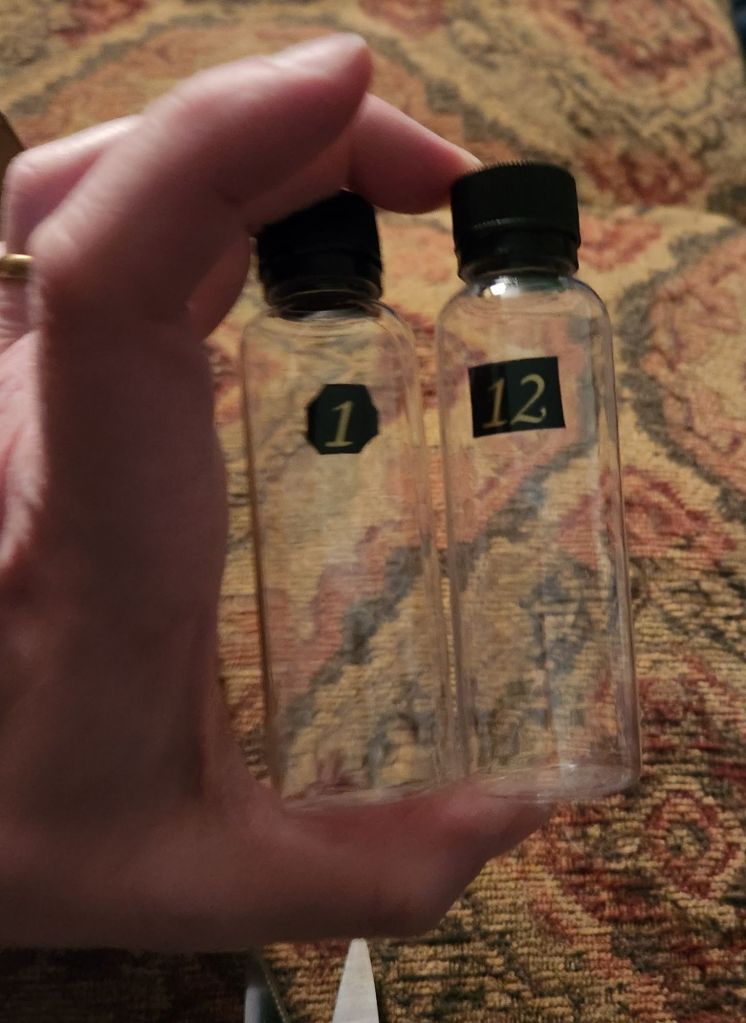
The second was for Ace himself. The whiskey part of Whiskey Weekend involves a double-elimination tournament where we do a blind taste test every hour. I brought little empty bottles for each entry so Ace could sample the same selection he would have gotten with us. It was perhaps a small comfort, considering Ace looked forward to the weekend more than anyone, but he seemed truly touched. I hope he was able to enjoy the drinks and think fondly of Weekends past. I didn’t know that would be the last time I saw him. I never got a chance to ask.

Friendship is wonderful, strange, magical thing. I think I’d been together with Ace less than 10 times, and yet, I quickly, easily considered him a good friend. I don’t think I knew his actual name for two years.

And so, I found myself at my first Jewish funeral today.

Continue reading

Writing Exercise – Don’t Write Yourself Off

Mike Wallevand on high school graduation day at 135 pounds

I hadn’t worked out in 28 years.

I graduated high school a skinny 5’11”, 135-pound basketball player who’d spent his childhood with a ridiculous metabolism. For many of us, things changed in college. Four years later, I’d gained 30 pounds. It wasn’t muscle. Those size 32 pants were a bit snug.

Fast forward nearly twenty years – around 2015 – I stopped checking my weight. A scale displaying 220+ pounds wasn’t something I wanted to see any more. I had more willpower for that than to make any meaningful lifestyle change, and my weight continued to increase.

Collage of Mike at his heaviest

In fact, the only real change I would make was cutting out soda and trying to walk the dogs more. From 2012-2017, I lost maybe 10-15 unremarkable pounds. I certainly didn’t feel any better, physically, mentally, or emotionally.

My wardrobe also remained the same: layers of bulky clothes to hide rolls, folds, and not-quite-manboobs. My shirts were XL and my pants were 38 waist. The collars of dress shirts were hangman’s knots and suitcoats were sausage casings.

Five years ago, in early 2019, I was invited to a class at a local boxing club. Did I mention I hadn’t worked out in 28 years? I found workouts boring. Or intimidating: I didn’t want to be the fat bald guy in a massive fitness center who was wheezing on a treadmill or struggling under weights. And if that were true, punching something for an hour was certainly far outside my interest, not to mention my personality.

Coming into the class, I didn’t expect anything to change, even if a small voice between my ears told me that I really, really needed an exercise routine. But I’d been ignoring that guidance my entire adult life.

In that first 1-hour class, I thought I was going to die.

Continue reading
I Still Owe Jimmy Jam and Terry Lewis An Apology

I Still Owe Jimmy Jam and Terry Lewis An Apology

It was late 1998. I worked for the Suncoast Motion Picture Company, which sold movies and related merchandise. I’d recently transferred from the flagship Mall of America store to the Southdale Mall in Edina. The commute was longer, but I didn’t mind for a couple reasons. The one I’ll articulate here pertains to the clientele.

The Mall of America location was great for people watching. At the time, tourists came from around the world to see the spectacle of the largest mall in the Western Hemisphere. But Southdale, due to the prestige of Edina, attracted a number of celebrities. I was thrilled to learn Janet Jackson (whom I’ll call Ms. Jackson cuz I’m nasty) shopped there when she was in town. And she bought her movies from Suncoast.

The Suncoast where I was now a manager.

In 1998, I was still that small-town kid who’d grown up in a town so tiny it was technically a village. I’d never met a celebrity, and the prospect of meeting Ms. Jackson, someone whose music I absolutely loved, hyped me to a ridiculous degree. I’m embarrassed to admit that I was on the lookout on many shifts.

I grew up loving her albums Control and Rhythm Nation 1814, the latter of which I owned. Back in 1990, I knew everything about that album. You see, I didn’t have many albums as a kid, so when I got a new one, I poured through the liner notes, sitting cross-legged on my bedroom floor beside my cassette deck. I memorized the lyrics, tracked the music labels, and learned about every musician or other person connected with the production of the album.

If you’re familiar with Janet’s music, the headline of this post is beginning to make sense.

Back to 1998. I’m working the checkout in our third-floor location, when two well-dressed men came in. I offered the usual greetings, made small talk, and helped them as best I could.

These two gentlemen were Jimmy Jam and Terry Lewis. And they were aware that I didn’t recognize them.

It must have been an unusual experience, especially in the Minneapolis area. Here’s why.

When it comes to the Minneapolis music scene, it didn’t get much bigger than this duo. They formed the band Flyte Tyme, which became The Time under the influence of Prince, and the group would go on to help define the Minneapolis sound in the early 1980s.

After being fired from the band, they started Flyte Tyme Studios, and their partnership went on to earn more than 100 gold, platinum, multi-platinum, and diamond albums. Over their storied career, they’ve worked with some of the biggest names in the biz, including Lionel Richie, Herb Alpert, TLC, Michael Jackson, Aretha Franklin, Boyz II Men, Usher, Patti LaBelle, Mary J. Blige, Chaka Khan, Mariah Carey, Bryan Adams, Spice Girls, Vanessa Williams, Rod Stewart, Gwen Stefani, and New Edition. I particularly loved George Michael’s “Monkey” and The Human League’s “Human” songs. But those weren’t the only memorable tracks.

Forty-one of their songs reached the Top 10 of the Billboard Hot 100. They won five Grammys and got an Oscar nom for their work with Janet Jackson on the song “Again” for the movie Poetic Justice.

EDINA, MN – SEPTEMBER 1989: Singer Janet Jackson poses for photos with music producers Terry Lewis and Jimmy Jam during the opening of Flyte Tyme Studios in Edina, Minnesota in September 1989. (Photo By Raymond Boyd/Getty Images)

And speaking of Ms. Jackson, they won a Grammy for producing her album Control. Their follow-up collaboration, Rhythm Nation 1814, dominated the charts with seven hit singles and became one of the biggest albums in the world from 1989-91.

Most of that album work had been done at Flyte Tyme Studios, a convenient 5-minute drive from Southdale.

As I look back upon their visit to my store, I like to imagine these world-renown producers were taking a shopping break from their busy studio schedule. Perhaps, the perfect movie would be a nice diversion, or provide some inspiration for the their next movie project. Little did they know they were talking to a guy who knew every beat and could sing every lyric from Rhythm Nation 1814, many of which they’d written.

A guy’s whose memory was about to betray him, despite his brain containing most of the information I just shared.

Continue reading

Prologue: Stories for Whiskey Weekend

Every year for the last four, I’ve attended a tabletop gaming and whiskey retreat that we call Whiskey Weekend. I wouldn’t be exaggerating much if I said we played games from sunrise to midnight. The titular game of the weekend is a double-blind tourney where we pit our whiskeys against each other.

A row of whiskey bottles, placed from 12-1.
Entries in the blind whiskey tournament, placed from 12-1.

It’s an unbelievably fun time filled with camaraderie, laughter, self-deprecation, and good conversations about gaming of all forms. The event is in its 16th year, having started as a Dungeons & Dragons getaway for a few friends. Over time, the event has morphed into the amazing experience it is today. We have a social media following and even have swag sometimes.

This year, I was no longer the rookie, as we were adding two people to the invitation. I figured it was my turn to bring the swag. So, when the event organizer suggested we take some time to paint tabletop minis, my partially formed idea sprung to full life.

My idea was to not only 3D print some minis in resin, I would also give people the option to choose a custom base and a backstory. The writer should use his skills, right?

3D Models source: Adaevy Creations (except the tall Viking, which was created via Hero Forge)

Within a few hours, I’d whipped up sixteen 200-word stories. I’m never sure whether I should tell people just how quickly I created each one: I worry that their response will be disbelief or a derisive “well, obviously“. Each one sprung to life relatively easily, which is partially due to their nature. They’re not intended to tell a complete story, but to inspire my friends into considering what comes next. Each one centered around a simple concept, like these:

  1. A curse is causing a village to forget their entire spoken language. The town chronicler is trying to choose the last word he’ll think about before it’s also forgotten.
  2. When he sees his doppelganger, a man with a strong regenerative power wonders, “If I can regrow a part, can a part regrow a body?”
  3. She slipped into a time paradox which causes her to see stages of a tragedy in reverse.
  4. He thinks he randomly turns invisible. Often he’s right, but that also means, sometimes he’s not. He can’t tell the difference.

It was a ridiculously fun writing experience, and not just because the stories came effortlessly. No, it was also freeing, a way to re-engage my creativity, which has been dormant a few months. And, it was a gift to friends that I hoped would make their weekend experience better. It worked.

Over the next week or so, I’ll be sharing these stories in a series of posts. It’s partially a way to showcase a project I’m proud of, but also, like the stories themselves, I’m hoping to inspire you to consider how else you might use your writing skills. So, tell us….what comes next?

Mike

Related posts:


Enjoy what you just read? Leave a comment or like the post, and we’ll ensure that you see more like this!

© Michael Wallevand, February 2024

Driven to write by a word

Schmutz.

It’s a word of Yiddish and German origins, and for some reason, it popped into my head this morning.

If it’s a word unfamiliar, it’s often used to describe a bit of unidentified something on a person. Usually their face. For many of us, that’s followed by your mother wetting her thumb with saliva to wipe it away.

Ah, mothers. So loving. So sanitary.

In my part of the world, it’s an uncommon word, which usually means I’m going to work it into my book (and apparently, a blog post).

And then my writer’s brain was off to the races.

In 45 minutes, I whipped up about 550 words, or a page and a half, inspired by the idea that Tildy has schmutz on her face, but due to her ability to unconsciously shapeshift, the schmutz avoids her mother’s efforts to clean it away. It’s actually a pimple, and it disappears and reappears across Tildy’s face.

I immediately fell in the love with the scene, and not just because writers often fall in love with their writing (a PAINFUL truth, except when they hate it). No, it’s because it accomplishes many things in service to the story.

It fits into the first chapter of Tildy’s second book, helping reintroduce our characters to the Reader with things like Tildy’s abilities, her relationship with the witch (her adoptive mother), and a little bit about their personalities. Additionally, we get the melodramatic woes and annoyances of a teenager.

But to me, the best part is the humor. You see, it’s actually an outbreak of acne, but Tildy’s skin is trying to prevent the pimples from surfacing.

“I no longer think it is a simple pimple moving around your face. I believe there are many, but your skin is resisting the outbreak. I wonder what would happen if you stopped doing whatever you are doing?” the witch mused, as she turned Tildy’s face, that way and this, as she looked for the next pimple’s appearance.

Tildy didn’t particularly care, but as the thought entered her mind, her face grew red and itchy.

“Oh ho!” the witch laughed, her face delighted. “Now they are everywhere! You really are a sight.”

I think it also creates some tension for Tildy. She has the ability to fight acne, something that many teens would be jealous of, but she can’t control it. Quite the opposite. Ironically, her efforts only seem to make it worse. Her struggles, however, eventually result in new mastery of her abilities, which is a recurring theme throughout the series. It helps us see Tildy growing up.

Sometimes, inspiration comes as simply as that. A single word demands several hundred in response. If only it was always as easy as that.

It’s a good start to a day, and as I write this, it’s now time to get to my office job. Good luck with your own writing (and that other work that pays the bills).

Mike


Enjoy what you just read? Leave a comment or like the post, and we’ll ensure that you see more like this!

© Michael Wallevand, October 2023

Lost Horror Story: Witch Hunt

While working on the new story “Chew”, I found a lost folder of horror stories I’d started more than 10 years ago. Intrigued by tales I’d forgotten, I started opening files. This one is dated February 8, 2007.

NOTE: this is a classic writer procrastination trap.

I read it quickly at a coffee shop and was pleasantly surprised. There are some quaint things, such as references to VCRs and a payphone, but I’m also referring to my writing style. The double space after a period and using space bar to indent are notable examples. But otherwise, I think it holds up and I could see myself returning to it.

In the spirit of the Halloween season, I present the opening of “Witch Hunt” unedited. I hope it puts you in the mood to write your own thrilling tale, or to sit down in a cozy place with a favorite scary book, movie, music, or video game.


A man in his early sixties sits at his kitchen table, surrounded by the typical breakfast accoutrements: a plated of eggs, bacon, and toast, a cup of coffee, a pitcher of orange juice and a newspaper, which is folded upon its spine to hold open an interior page.  Dressed for the pending workday, the man ate casually, reading the paper while keeping an eye on the small white television on the counter.  His wife, in a white terrycloth robe, busied herself with the clean-up, while keeping an eye of her own on her husband.

“Looks like we’ve got a nice weekend coming up,” he said.  “Be perfect for taking the kids and grandkids out to the lake for a picnic.”

 “Yes,” she agreed with a smile.  “I saw the same thing on the internet this morning.”  She never missed an opportunity to remind him that she was more computer savvy than he.

“How you learned how to work that thing, I’ll never know,” he said, referring to the computer she had insisted they purchase.

“Oh, you know how I like to fiddle,” she said, still keeping her night classes a secret.  He has his secrets, she had hers.

A loud beeping from the TV drew their attention.  “Ladies and gentlemen, good morning,” interrupted a tan news anchor.  “We have late-breaking news and exclusive footage from a breakout in Split Rock prison in upstate Vermont.”

“Split Rock?” she asked, “I’ve never heard of it.  Have you, Hank?”

Hank O’Leary didn’t respond.  He stared intently at the television, his fork hanging loosely in a hand raised partway to his mouth.

Continue reading