My First Epigraph

My First Epigraph

This post is about a 5-minute read.

What’s an epigraph? If you’re a regular reader, you’ve seen a page that quotes a poem, song lyrics, or other meaningful sentiments. The author chose it to set the mood, foreshadow, or elicit a reaction from readers. The epigraph page lives in the front matter of novels. Oh. Front matter is all the pages at the front of a book that you skip over. Y’know, the copyright page, dedications, foreword, etc. However, if you enjoy that stuff, this post is for you.

As a supporting task to my writing, I’ve been collecting song lyrics and other quotes that evoke the same feelings I’m expressing in TILDY SILVERLEAF and the STARFALL OMEN and future books. As I mentioned above, I had specific reasons for choosing each of these:
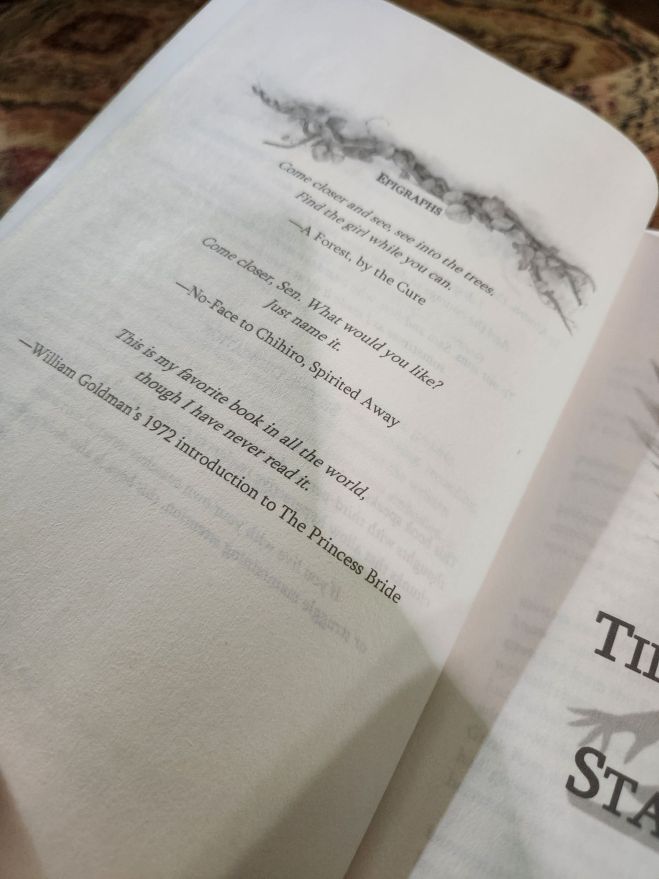
Photo of the Epigraph page from Tildy Silverleaf and the Starfall Omen. Text starts in the 3rd paragraph of the post.

Come closer and see, see into the trees.
Find the girl while you can.
—A Forest, by the Cure

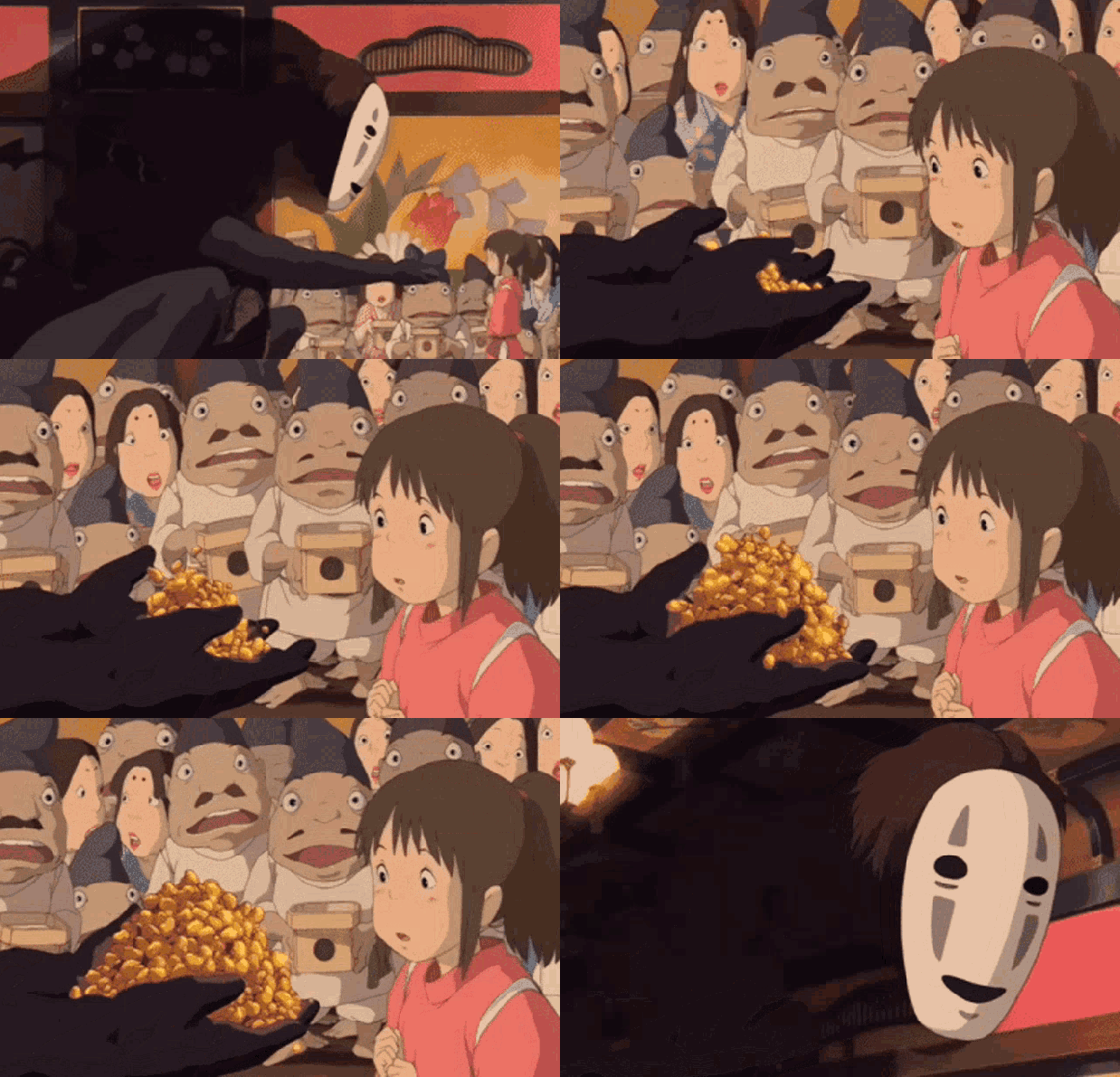
Come closer, Sen. What would you like?
Just name it.
—No-Face to Chihiro, Spirited Away

This is my favorite book in all the world,
though I have never read it.
—William Goldman’s 1972 introduction to The Princess Bride

A Forest echoes a feeling that other characters have when they see Tildy in the trees. Spirited Away is foreshadowing. The Goldman quote represents my homage to that wonderful book. If you’re a curious bird who wants to learn more, read on!

Psst…as long as you’re here: Tildy Silverleaf and the Starfall Omen is available October 1, 2026! If you’re looking to support independent bookstores, check out Bookshop.org, who’s currently offering 10% off preorders. It’s also listed in the usual online retailers (B&N, Amazon, Kindle, Smashwords, Apple). Thanks in advance for your support!


A Forest was an obvious choice. One day, I was paying particular attention to all the lyrics on my playlist, as writers do, and when this came on, I sat upright. It was like they were singing the thoughts of the people who caught a glimpse of Tildy within her haunted forest home. I wasn’t considering the epigraphs at the time, but I immediately made a note to add this one.
Black and white photo for The Cure's "A Forest".
Come closer and see
See into the trees
Find the girl
While you can
Come closer and see
See into the dark
Just follow your eyes
I hear her voice
Calling my name
The sound is deep
In the dark
I hear her voice
And start to run
Into the trees
Into the trees
Into the trees
Suddenly I stop
But I know it's too late
I'm lost in a forest
All alone
The girl was never there
It's always the same
I'm running towards nothing
Again and again and again and again...

Songwriters: Laurence Andrew Tolhurst / Robert James Smith / Simon Gallup / Matthieu A. Hartley
© Fiction Songs Ltd.

I’ve loved Studio Ghibli movies for thirty years, and Spirited Away has always been my favorite. The setting and accompanying mythology was different from anything I’d seen or read. I still believe it, and I often write with that in mind. Another consideration is this: Studio Ghibli stories don’t end with the killing of the antagonist. Compassion often saves the day. I really like that idea…

Ahem. Segueing from one bit of foreshadowing to another, I chose this quote to foreshadow the temptation heroes often face. I also liked using a movie quote because it reflects my diverse interests in storytelling.

No-Face: [offering a bowl of food] “Try this. It’s delicious. Want some gold? I’m not giving it to anybody else! Come closer, Sen. What would you like? Just name it.”
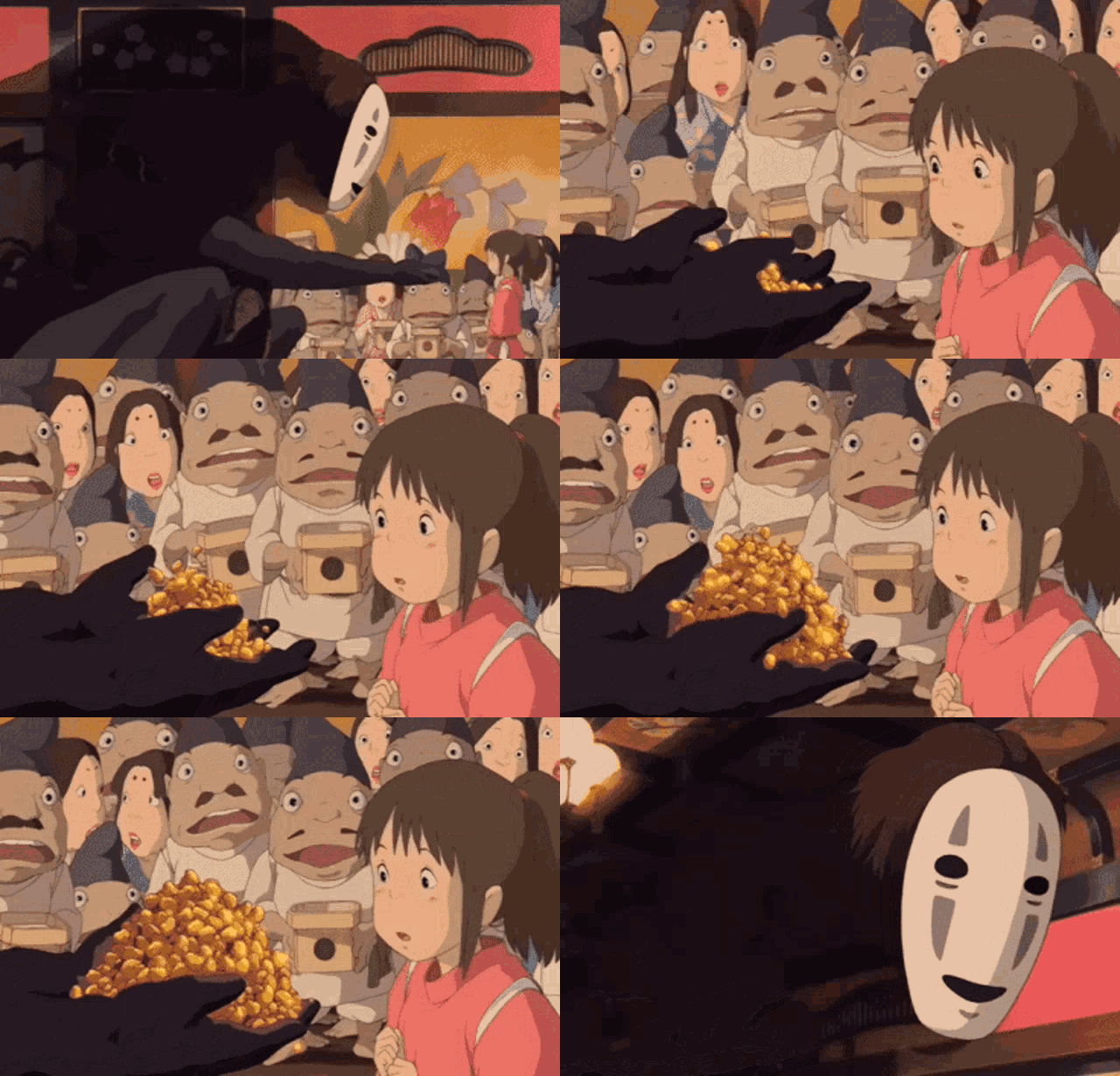
Image of a book page that reads, "This is my favorite book in all the world, though I have never read it."
—William Goldman’s 1972 introduction to The Princess Bride.

Late in the writing process, I still had a Prologue no one liked. Trusted Readers told me the heavy, formal tone wasn’t working, even if it achieved my goal of contrasting the lighter style of the rest of the novel. And if that wasn’t enough feedback, a professional reviewer had this advice:

The author of TILDY SILVERLEAF AND THE STARFALL OMEN might consider shortening the prologue in order to get to the main plot more quickly. The prologue is interesting, and has vital information, but could be trimmed significantly for the sake of allowing readers to access the most integral parts of the book more easily.
–The Blacklist

Message received: “Murder your darlings.” So I axed 90% of one of the first chapters I wrote and created a new problem. How do I quickly engage Readers and convey critical info with just a fraction of that original Prologue? I found inspiration in Peter Falk’s wonderful grandfather portrayal in the movie version of The Princess Bride. Not wanting to appear to be ripping off Goldman, I riffed instead, changing the nature of the relationship between the Golden Narrator and the Child, as well as the tone of their interactions. They also serve as a stand-in for the Readers, perhaps echoing some criticisms they had. And so, this quote provides the bridge between that work and my homage.

If you read this far, thank you! I hope you found this behind-the-scenes look interesting. A writer has so many considerations when writing a story, the logistics are often staggering. And so, putting this much thought into a few quotes might not appear to be the best use of time. However, the Reader experience is important to me, so I consider as many things as I can to deliver a enjoyable activity.

Mike


Enjoy this post? Please give us a like or leave a comment, and we’ll share more like this!

(C) Michael Wallevand, September 2026
decorative image of twisting ivy vines and leaves

Considering Reader Needs

This post is about a 6-minute read.

I’d started a different post to talk about my book launch – OCTOBER 1! – and got sidetracked by a worthwhile question. So instead, I decided to write about helping other humans. This post will give you some starting information about digital accessibility.

Accessibility means designing products, places, services, and digital tools so that everyone can use them, regardless of their physical or cognitive abilities.

“What’s good for a few can be good for all.”

– the witch, in Tildy Silverleaf and the Dungeon of the Dreadwyrm

Am I using a good color for people with eyesight issues?

I’ve had a basic style guide for my website pretty much since the beginning. I’ve made updates here and there, and I’ve recently been wondering if the text color for links popped enough. I’ve been using a deep green, wanting to reflect the forest setting of Tildy Silverleaf and the Starfall Omen.

OK. Hypothesis; time to test.

I started experimenting with lighter greens, and for the most part, they seemed like an improvement. Before I changed my style guide, however, I wanted to check the accessibility score of the color.

  • This random text helps illustrate how a color might pop or blend into a white background. It’s important to consider color blindness or other eye conditions that might make the font difficult to read.
  • This random text helps illustrate how a color might pop or blend into a white background. It’s important to consider color blindness or other eye conditions that might make the font difficult to read.
  • This random text helps illustrate how a color might pop or blend into a white background. It’s important to consider color blindness or other eye conditions that might make the font difficult to read.

I used Gemini just the way I’d use Google Search, and here’s how it advised me to improve my website experience for other humans:

Gemini: Yes, the bright green #37B904 presents significant accessibility concerns across contrast ratios and color vision deficiency (color blindness). 1. Color Contrast Failures (WCAG 2.1): The relative luminance of #37B904 sits in a mid-tone “dead zone” where it fails accessibility standards against both light and dark backgrounds. 2. Red-Green Color Blindness (Deuteranopia & Protanopia). Recommended Alternatives: Use a darker green to hit the 4.5:1 ratio minimum (e.g., #247B02 or #1E6B02).

Let me translate. The #37B904 is the digital code for this particular color green. WCAG is a set of standards to ensure online content can be viewed by humans with a variety of conditions. If you want a little more info, read the entire post.

So, I tried Gemini’s suggestions and a few other colors. Then I measured my original green, which met or exceeded a number of guidelines and scored better than any other test. So for now, I think I’ll keep my choice, but also continue to underline all links (in my lifetime I’ve seen the invention of hyperlinks, which used an underlined light blue font, and I’ve seen modern sites that use no unique styling to indicate a clickable link, which feels like a miss, even if it makes the overall page a little cleaner-looking). Between my color and underlining, I’ve got 2 different ways to help users interact with my site. It feels meaningful, but it’s also a reminder that there are probably other things I can do to improve.

I hope this helps! If you want to learn a little more about accessibility, hex codes, and why an author should care, read on!

–Mike


What is WCAG?

The Web Content Accessibility Guidelines are the international rules for making digital content usable for people with all kinds of abilities. The guidelines are broad, many, and updated regularly, which can make following every single one a very challenging task. Understanding even a little bit of this, however, will also ensure you’re not doing funky things that impact every reader. Such as putting grey text on a mint background, which would look like this (it says, “which would look like this.”).

What are Hex colors?

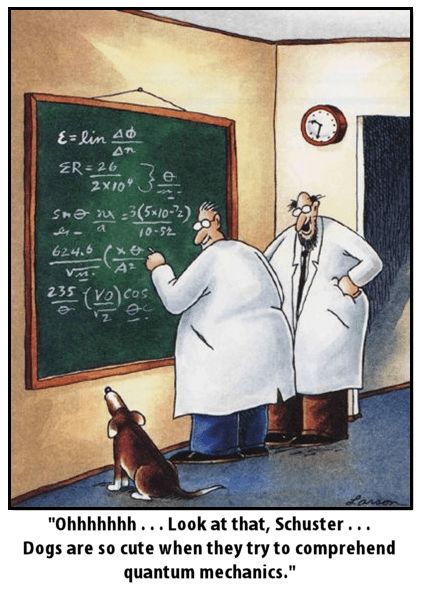
A classic Far Side cartoon in which a dog considers the chalk board that two scientists are using. One says, "Ooooooh....Look at that Schuster....Dogs are so cute when they try to comprehend quantum mechanics."

In school, many of us learned the colors of the rainbow thanks to Mr. ROY G BIV (red, orange, yellow, green, blue, indigo, violet). So, I’m going to level up your knowledge just a smidge.

A hex color is a six-digit code used in digital design and coding to represent a specific color, starting with the basic red, blue, green (RGB) palette. Hex is short for hexadecimal, which is a 16-digit numbering system (0123456789ABCDEF), unlike our standard decimal system (1-10); it’s how we tell our masters the machines which very specific color we want.

  • Format = #RRGGBB
  • Lowest intensity = 00
  • Highest intensity = FF
  • #000000 is white
  • #FFFFFF is black

I originally went to college for computing programming, and hexadecimal still gives me a headache.

Dammit, Jim, I’m a writer not a software developer! Why, oh why would an author care about this stuff?

It would be very easy to say, “I just wanna write” or “this is too complicated”. My response would be, as an author I have a responsibility to connect with as many humans as possible, and since we live in an age where answers can be delivered instantaneously, a little AI Q&A can go a long way to informing us. I’m sharing this info to give others a starting point from which they can make their own decisions about learning and changing. Do some research; do some good!

And when it comes to publishing, the more production aspects you’re doing yourself, the more you’ll need to understand. I do everything on the website and I self-publish. RGB and Hex are for digital (WordPress uses Hex; MS Word uses both). Actual print, y’know, on paper, has different color standards: CYMK (cyan, yellow, magenta, black). When I was exporting my cover from Canva, this was an important to select.

Do you or I need to be an expert on any of this? No, but new knowledge is a good thing in my opinion. Helping others is even better. It could also save you some missteps on your writing journey, and gods know there are a heckuva lot of steps.


(C) Michael Wallevand, September 2026
decorative image of twisting ivy vines and leaves

So Mike, How Many Books Ya Working On?

Oh, Ok! That’s a good question.

Over the years, I’ve spoken about starting Project Two and Project Three, and sometimes it’s hard to keep track. What are the chances my answer is “more than one”?

A physical proof copy of TILDY SILVERLEAF AND THE STARFALL OMEN just shipped and it’s scheduled to arrive Monday! I can hardly begin to imagine what it will feel like to open that box and hold my book for the first time. This journey started more than ten years ago, and many times I thought the day would never come. To be honest, many other times I considered giving up and destroying the book due to soul-crushing self-doubt. I imagine it will take a few days to fine-tooth-comb the print to verify it’s ready for sale.

I honestly can’t believe I’m finally at this point.

So that’s technically one book. Number two is the ebook version of that. You might think that would be an easy task, considering I already have a finished manuscript, but they require different formatting. Some of that is a real pain in the rear because of the effort I put into the interior design. I also lose control of the font because readers can choose their own. That’s, sigh, not the end of the world, but I used different fonts a few times to create an experience for readers. Fortunately, my favorite example of this, “Thems Trolls” survived due to some creative thinking I’d done when I wrote that verse a few years ago. Once I wrangle the formatting, we’re ready to publish. So, that’s two books I’m working on.

Of course, I’m not stopping there. Oh no. This is a millennia-spanning epic fantasy tale with many stories to tell.

Last week, I started a novella that spawned from some tough choices in Starfall Omen. My original storytelling strategy had a prologue and epilogue for each book that told the tale of a third character: the Mellifluent, the indentured servant of the Dark God, who had its own schemes involving the royal children, who are now known as Tildy and Samor. But, “murder your darlings” they say, and the prologue was a regular source of criticism by Trusted Readers. So it had to go. It was slowing down the opening of the book significantly. As they say in Monty Python:

GIF from Monty Python and the Holy Grail, which shows an impatient army shouting "Get on with it!"
Continue reading

Writing Exercise – An unexpected prompt

“Mike, try to think of one of the most insane things that could happen…” the text conversation began.

Turns out, that’s EXACTLY the kind of writing prompt I LOVE. And even better, he didn’t want to share the experience until our next call.

“You should write a three paragraph story of what you think happened.”

It’s like someone gave him a manual for hacking my writer’s brain.

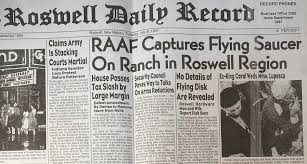
Front page of the Roswell Daily Record, reporting a UFO crash in 1947.

I replied that writing was the easy part, but expected I wouldn’t be anywhere near the mark for what actually happened. In much of my writing, I tend to drift into fantastical situations or absurdity, and I’m usually not interested in reining myself in.

I was waiting for the school bus, so I started telling myself a story similar to the 1947 Roswell UFO crash, but in his neighboring state instead of New Mexico. However, it immediately became clear that he was bursting to share, even if he was keeping the full story secret until we could talk.

“It involves death, prison, and six hours at the animal care center.”

WOW. OK, no aliens. For now.

I’ve had conversations like this before, if not with details as intriguing as this, and I’ve found that including some personal info is a great way to draw the person into the brief story I’m crafting for them. It’s same reason I first considered a regional event like Roswell. I set the aliens idea aside and let those three details form a kind of movie for my mind’s eye.

Fifteen minutes later, I had this.


A Day of Troubles

Saturday. Bright. Warm but not too hot. One of the best kinds of days to say goodbye. Little did we know, God had more than one kind of farewell on the agenda.

Scratch that. There’s no way we could have had even the smallest inkling, but I get ahead of myself.

The day of my mother-in-law’s funeral had finally arrived. I say ‘finally’ because the disease had taken a long, tortuous route toward the final conclusion. But as I stated above, it was a good day – the kind she would have liked. One where we might have had lunch as a family in the park, or perhaps spent some time hiking in the desert foothills.

We were both drained and energized in a way that only funerals make a person feel. You reconnect with so many people and share so many wonderful stories. You also laugh more than you anticipate. And yet, you have to be on the whole day. It’s like you’ve adopted a persona that people expect to see: someone strong and well-adjusted. They don’t want to see behind the mask you wear, even though they wouldn’t be surprised because they’ve worn that mask, too.

Afterwards, we enjoyed the weather like she would have wanted us to: my wife, myself, and our dog, Trouble. He’s quite empathetic for a dog, and he seemed to be behaving out of respect for us. Until he wasn’t.

On our way home from the park, he caught me off-guard as he chased a rodent or something under a car. Before I could blink, I lost the leash, he scurried under the car, and disappeared on the other side.

We searched for hours, considering ourselves fortunate that we could follow the occasional bark or curse words that chased him as he scampered through people’s yards.

Dusk approached, heralding more than the night. Ahead lay the state prison, and it was lit up like a city under siege. We’d later learn that Trouble had discovered a hidden tunnel under the fences, and that three inmates had discovered Trouble.


What happens next? I have no idea. It’s an unedited draft of an idea that simply flowed from brain to page. It might never be fleshed out. Despite that, conscious writing decisions were made.

The story begins with a mix of emotions and proceeds at a slow pace, which was deliberate so I could ramp up the action or whatever absurdity my writer brain could conjure. I’m building toward something, even if I don’t know that is.

This brings me to another decision: while there’s nothing particularly profound about these 350 words, I’ve left myself an intriguing mystery to help spark inspiration, should I ever go back to it. It’s a writing technique I developed to help me on those days when my creative tank is running low. To learn more, check out Set Yourself Mysteries.

Cover of a Mad Libs book

It reminds me of another creative exercise I did in college after I changed my major from computer programming to writing. I’d tell someone to give me three details, usually something like a name, a place, and an event, and then I’d spend ten or fifteen minutes telling a story I was making up on the spot. Call it “reverse Mad Libs”. In hindsight, I was teaching myself a way to organize my thoughts around a few key details.

I share these techniques as examples of the tools in my writer’s toolbox. Even when I’m enjoying a simple writing exercise, I’m using these tools without having to think about them. It means the creativity flows better and the effort of writing is more joy than work.

Good luck with your writing!

–Mike


(C) Michael Wallevand, June 2026

Collaboration like peanut butter and chocolate

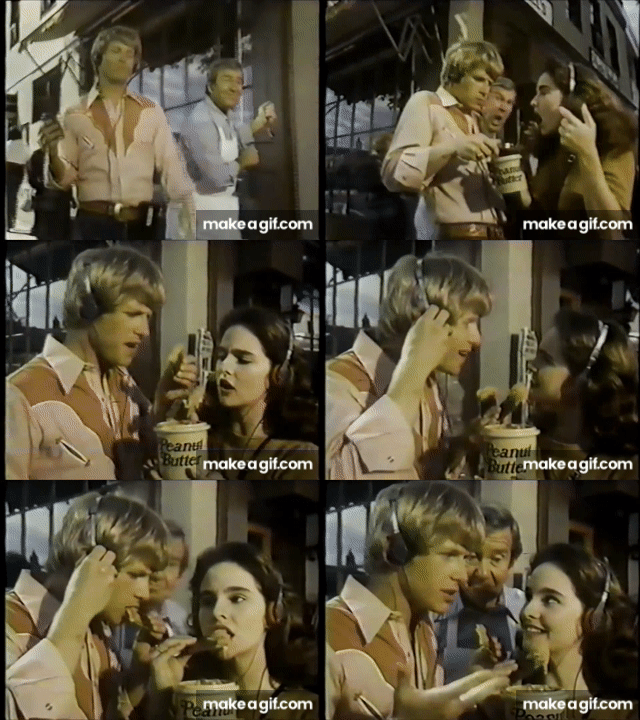
gif of a famous 1970s-1980s era Reese's commercial in which a young man accidentally dunks his chocolate bar into a woman's peanut butter. And the rest was advertising history.

Recently a colleague and I connected over lunch about our creative passions. To my surprise, his are music composition and arrangement. To his delight, writing is mine.

It wasn’t quite as legendary as this seminal Gen-X moment in advertising, but maybe it’s close.

There’s something freeing about sharing your creative passions with others, especially those who have their own. The conversation evolves and builds momentum in a way that doesn’t happen when only one person is sharing.

And let’s be honest: most people enjoy the back-and-forth dialogue. They don’t want to feel like a talk show host who’s there to keep a guest talking. Or worse still, simply be an audience for someone who loves to hear themselves talk.

We shared our projects and the things that fired our creativity. We delighted in finding someone who was mutually respectful, energized by the creative process, and with whom the conversation was never forced. We discussed the craft, each from our own experience and through the language of our chosen medium.

We had two creative passions moving in parallel directions, and while we didn’t know where we headed, we knew there would be an intersection. Personally, I love this approach because it prevents us from putting up artificial guardrails that stifle creativity. We were just talking about the ways words and music could come together.

It was simple, casual, spontaneous.

Freeing.

Continue reading

Writing Exercise – The An-Teak Desk

A writer never knows when inspiration will arrive or from where. Because algorithm, I stumbled upon the podcast of a friend’s wife. It was a clip in which she discussed junk drawers with her friend. They laughed in delight at the idea of the drawer opening up like the wardrobe to Narnia.

An hour later, I had 1,700 words.


Jammie, so nicknamed for her love of footie pajamas, followed her brother Matt up the dim creaking stairs, her eyes fixed on the close-cropped black hair that had earned the slender boy a moniker of his own. “Gramma missed a spot, Matchstick,” she teased, pointing at the tuft on his head.

He reached back and felt for the place, his lips hissing a derisive sound when he found it. “That’s my lucky spot. She says if you find one of those, you’ll be lucky ‘til your next haircut.”

“I think that’s one of those things grown-ups say to hide their mistakes,” she retorted.

He looked over his shoulder as they neared the top of the stairs. “With all that reading you do, I can’t believe you’ve never heard of that.”

“You read as much as I do and I bet you’ve never heard of it, either.”

The dark shape of the heavy oak door emerged from the shadows before them, a dull brass doorknob reflecting the oil lamp at the bottom of the stairs. Instead of reaching for the knob, he turned and looked down at her. “You read way more than I do.”

“Yeah, but you read en-cy-clo-pedias,” she replied, drawing out the enunciation as a sign of reverence. She’d always wanted to enjoy them – knowledge was important, her daddy advised – but she just didn’t have the head for it, her grandma said.

“I didn’t have a choice, you know.”

“But you like them now, right?”

He stared at his sister, her face aglow with wonder and curiosity. Her eyes could drink in all the details of the world, and still her inquisitiveness would not be sated. “I guess. They’re now like reading an old story you know by heart.”

“I know all about that. My books never showed me that symbol you found, though. My stories are all made up, and writers are liars.”

Continue reading
What do you enjoy about being an author?

What do you enjoy about being an author?

Well, that’s easy to answer.

Until someone actually asks the question.

For me, and I suspect many writers like me, it’s something we just know. Perhaps it’s similar to loving milk chocolate melted over marshmallows and graham crackers, Irish whisky splashing into an iced glass, or shaggy dogs who cuddle in your lap. You just know.

As writers, one of our primary jobs is to articulate those concepts that are difficult to put into words. To evoke meaning and emotion from words made of letters made of lines and curves that dance across a page. It’s hard, it’s easy, it’s simply impossible at times. Yet we trudge on because that’s the job.

And so, when I was recently given a survey as part of the publishing process, I paused and took some time to think about things that brought me joy and those that drained my energy. I already knew the answers. I just didn’t know which words I needed to express myself.

Mike fancies himself a Drake meme. This is something he doesn't like.

Please list up to 3 things you enjoy the least as an author related to writing, publishing and selling your books.

  • Book formatting. I wish I’d done more research about manuscript formatting. It’s caused a lot of rework.
  • Marketing myself. Ironically, my day job is marketing.
  • I love the learning process for all of this, though I wish it didn’t take so much time. It’s also very easy to distract yourself with rabbit holes when you’re struggling with the creative process.
Mike fancies himself a Drake meme. This is something he likes.

Please list up to 3 things you enjoy the most as an author related to writing, publishing and selling your books.

  • The pure act of creation energizes me like nothing else.
  • I am compelled to find ways to entertain and comfort people in all aspects of my life.
  • I believe my skills should be used to advocate for human beings who are under-represented, under-privileged, or otherwise face prejudices.

Being able to articulate things like this can be a helpful guide in your writing. If you know what will energize you, tap into that as you sit at the keyboard. If you know what drains you, meet that head on and consider ways to change that chore into something you adore.

Focus and time management are critical aspects of writing that I don’t think get enough attention. An exercise like this can help.

Good luck with your writing in 2026!

–Mike


(C) Michael Wallevand, December 2025

twisting vines footer

Writing Exercise: Use Your College Knowledge

This website is dedicated to my novels and the writing process, as well as advocacy for human rights.

A college buddy recently re-entered my life on Facebook, mocking my alarm at the emboldened fascism of the new U.S. administration.

I didn’t know the Jews r worried Elon and Trump are vicious Nazis who will gas chamber them and other inferior minorities? Man will the hispanics and the blacks be pissed because they sure voted a lot for Trump. Wouldn’t that be ironic?

He probably doesn’t know that I studied so much history during our college days, with a focus on the rise of fascism in the 20th Century, that I accidently got a second major for my bachelor’s degree. I’ve walked through concentration camps. I’ve stood in the gas chambers. Something awful still lingers there, as does a tragedy for which Humankind has no words. So instead of responding with equal sarcasm, and ignoring how he unconsciously described minorities as “inferior”, I put my degree to use.


The quarantine yard at Mauthausen, one of the most sickeningly brutal concentration camps.

It doesn’t start with gas chambers. We all know this.

Like all successful bullies, the Authoritarian is more cunning than intelligent, recognizing that threats, bombast, and lies will be more effective than reason. In this way, he camouflages his weakness and impotence as a strength that people truly believe.

And to be perceived as strong, the bully picks on the weak. They are but the backs that must be trodden on the climb to power. The Undesirables must be identified. The Other. They are named Enemies to give the people something to rally around. It is better to be one of Us than one of Them. And the People buy into it because they respect and fear and covet the Power. More often than not, they are the regular people and the downtrodden, not those marching with torches or hanging nooses from trees. Over and again, they have been told they are powerless – these Enemies have taken their power, their jobs, their money, and the lives of their fellow citizens. The People used to be great, but no longer. Convinced, they actually relinquish power and critical thinking for pretty promises that their lives will improve. Promises without a plan, though like all great salespeople, he’s manufactured a need in people for the thing he’s selling.

And lo, their salvation is at hand.

Continue reading
How Do You Honor a Life #3 – Ace

How Do You Honor a Life #3 – Ace

A few years ago, I was invited to join a bunch of dice-rolling, whiskey-swilling hooligans at an annual tabletop gaming retreat called Whiskey Weekend.

Bunch of guys around a large table playing games.
Hooligans, amiright?

I was amazed how quickly I fit in and bonded with the group. With my neurodiversity, I don’t make friends easily or often, nor am I comfortable in social situations. One of the people I connected with quickly was Ace. I suspect this was a combination of our similar senses of humor and my willingness to play any game he rolled out. On a future weekend, I gave him some 3D-printed token holders for Everdell, one of his favorite games. His gratitude became delight when I revealed I’d bought my own copy of Everdell because of him.

About two years ago, he shared some rough news with us. Cancer. In the time leading up to our 2024 weekend, he told us he had chemo scheduled the first Saturday of our retreat. He was going to come up briefly and then jump into the treatments. He was in good spirits, and I could tell he enjoyed even that brief time with us. He offered us silicone bracelets as part of his journey – mine disappeared after Benji snagged it for his stuffies to wear – but I believe it conveyed Ace’s philosophy of staying strong and seizing the day.

Knowing how much he loved the event, I wanted to do something special. I wanted to help him feel like he could still experience some of the weekend, even from a distance. So I did two things.

The first was for the group. I 3D printed tabletop minis for everyone to paint and wrote little stories so people could mix and match. More info here. I gave Ace first pick and he was able to make his selection before he had to leave. I later heard he painted it right away and had a fun time. I wish I could have seen the results.

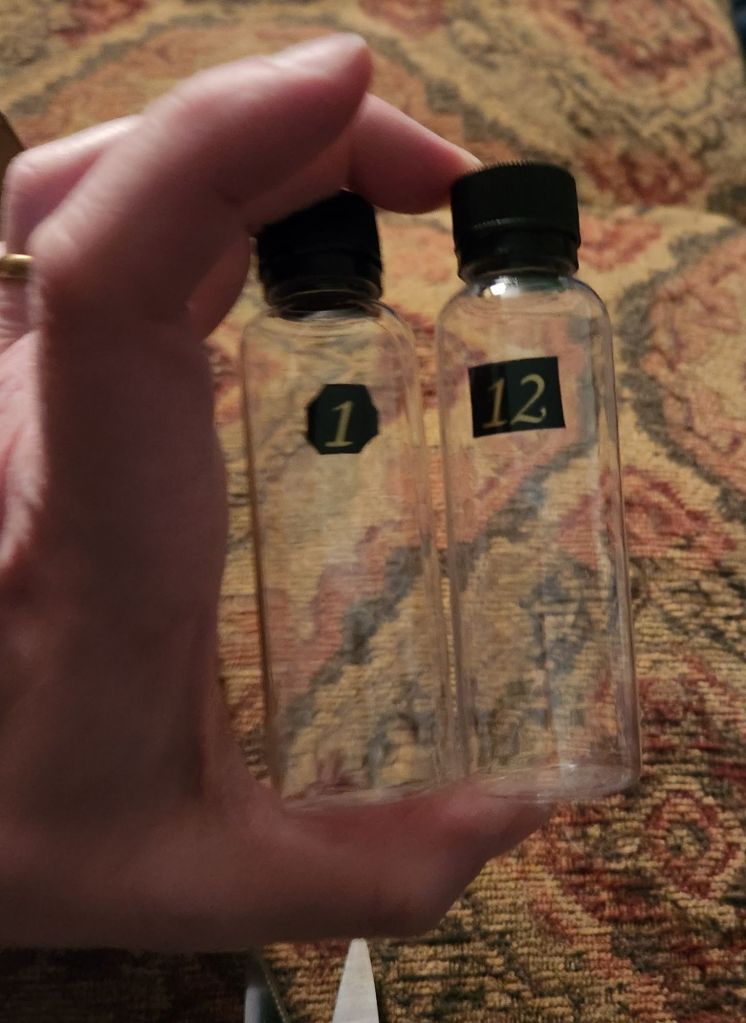
The second was for Ace himself. The whiskey part of Whiskey Weekend involves a double-elimination tournament where we do a blind taste test every hour. I brought little empty bottles for each entry so Ace could sample the same selection he would have gotten with us. It was perhaps a small comfort, considering Ace looked forward to the weekend more than anyone, but he seemed truly touched. I hope he was able to enjoy the drinks and think fondly of Weekends past. I didn’t know that would be the last time I saw him. I never got a chance to ask.

Friendship is wonderful, strange, magical thing. I think I’d been together with Ace less than 10 times, and yet, I quickly, easily considered him a good friend. I don’t think I knew his actual name for two years.

And so, I found myself at my first Jewish funeral today.

Continue reading
Chapter One available

Chapter One available

As I mentioned in a previous post that announced the Prologue, I’ve started working on publishing my book, Tildy Silverleaf and the Starfall Omen. As I release chapters, I plan to write an accompanying post that provides a behind-the-scenes look at the work. To skip right to reading the new chapter, click here: Chapter One – Spring in Dappledown.

I started my writing with Chapter One, not the Prologue, because getting a feel for my protagonist and her home were crucial to understanding whether I had a story worth pursuing. I needed to establish my unnamed hero, her home, and the witch she reluctantly called “mother”. The ideas flowed effortlessly from thought to word, and Tildy, as she would became known, nearly flew from the page into life.

I had something.

Continue reading