Power of Words: Also

Words have power. It’s a simple enough concept, though perhaps underappreciated or downplayed when compared to fists or guns. That said, each of us has emotional reactions to words, whether a Shakespearean play, a political speech, or the handwritten note in a birthday card. And therein lies the control they have over us.

Many of us have heard as children, or said as adults, “Sticks and stones may break my bones, but words will never hurt me.” It’s a comforting lie that both parties believe because it makes the problem go away. At least for a little while.

If you’ve ever been the victim of slurs, whether racial, sexual, or gender-based, you already know the power of a single word. For those of us who haven’t, we can appreciate the impact of a good F-bomb, though that doesn’t tend have the same power as the examples of above.

Additionally, as I recall important events of my lifetime, there is considerable power in certain words, such as “marriage”, “Black”, “abortion”, “conservative”, and “liberal”. Just post a social media update that includes one of these to remind yourself of that.

I’m of the belief, however, that there is power in any single word – important or not – depending on the context. Which is why I’ve chosen “also” as my topic for today.

The aforementioned subjects are of great consequence to our world, and I am not suggesting that a linguistic discussion about a common adverb is of equal concern. Rather, I hope to demonstrate how something insignificant can change the tone and intent of any conversation.

I mean, come on, we probably give it no extra thought in writing, reading, or speech. In many cases, we could rewrite it out of a sentence and the reader wouldn’t know the difference.

  • We should get groceries and also pick up vacuum bags.
  • We should buy groceries and vacuum bags.

But that’s a minor application compared to its role in the following examples.

I would also like the right to vote.

I am his parent, so I also need custody of my child.

I would like my culture’s history also studied

I would like my child’s gender identity to also be respected

I would also like to practice my religion

In those examples, “also” plays a more powerful part. It leaves no doubt that a person is requesting an addition to an established practice or point of view. It speaks to inclusion and acceptance. Said another way, it suggests that we have room to grow: Here is where we are today, and this is where I’d like to go so we can be equal or have a mutual understanding.

And it has power not just for the person saying those things. When it comes to arguments against these concepts, “also” seems to have been mistaken as an outrageous synonym for “instead of”.

Continue reading
Hey writer: What’s more important?

I wrote this just over a year ago, when many of us were still underestimating the impact of the pandemic upon our worlds. “Oh, my sweet summer child,” to borrow George R. R. Martin’s commentary on naiveite. I found the post waiting in my drafts folder, one of a number of writing projects that got shelved due to other priorities. I share it now because it touches on an important matter for writers. Please don’t mind the dust.

A friend (Trusted Reader #12), sent me this message:

So, I have a “what’s important about writing question” for you when you have a moment.

YES! There are two surefire ways to get my attention: 1) talk about Star Wars (my wife does this) and 2) ask a question about writing.

As you can imagine, I dropped what I was doing and emphatically replied. My brain raced. Was this philosophical? Perhaps this was related to me having a writing degree in the business world. Oooh, could it pertain to the importance of reading?

What’s more important, story or character?

Uh oh.

It’s a great question, and I’m glad he asked. I had an answer, of course, but part of me wondered if I was walking into something.

Continue reading

Write that down now!

This post is approximately 400 words.

Lonely stop sign

Writers: A quick plea to capture those amazing ideas immediately as they come to you lest they disappear with nary a trace. Often this has happened to me, and I have worn my soles thin from kicking myself.

I often like to let an idea run around in my head for a bit as I try to form it into something more tangible. If I can keep thinking about it as the day goes on – maybe water it, fertilize it – it starts to develop and grow. Suddenly, a day or a week later, I find myself typing away, turning thought into word and idea into story.

But that idea is very much like a cloud riding the head of a storm, and if I turn my focus away, sometimes for even a moment, those skyborne wisps will be something else by the time I look back, leaving nothing but gray thunderheads in their wake. The storm itself arrives days later when my mind gives a little poke and says, “Hey, you had a great idea last Wednesday, but it’s soooo gone now. Just thought you’d like to know.”

So, stop whatever you are doing because that interesting idea…

The creature kept coming, inexorably, despite its ruined leg. It dragged the damaged limb along, giving no heed to the pain inflicted by my axe. Vengeance burned from its eyes, striking me like a physical blow yet holding me fast. The look I read on the pages of its face told me the creature meant to take more than my leg as recompense. And it needed no axe to collect.

…will be reduced to…

The angry creature stomped vengefully toward me.

….when you try to write it down later. That is, if you’re able to write down anything at all.

And this is why, having just written this article, I am now, at four in the morning, starting a second one. Good luck wrestling your own inspiration!

–Mike

PS: I hope you abandoned this post before getting this far, because that means you went to write something amazing of your own. If not, well, say hello to your brain next week when it reminds you that you lost a brilliant idea today.


Enjoy what you just read? Leave a comment or like the post and we’ll ensure that you see more like this from Michael!

© Michael Wallevand, June 2021

Editing Exercise – Help that stumbling sentence

My various lives (personal, work, writing) have been busy for the last couple months, so blogging took a back seat for a bit. However, while doing some writing over lunch, I was struck by an idea that led to this post.

Many writers will tell you not to stop for proofreading or editing while you’re writing. I generally agree. It interrupts the momentum, and in many cases, drives that wonderful idea right out of your head. Anyways, a little separation from the act of writing and the act of editing is a good thing, especially when you’re looking to be more objective.

But sometimes, a clumsy sentence keeps stumbling through your brain until you put it out of its misery fix it. Today, I wrote such an example.

Samor smirked, but he was unable to extricate himself as the jostling of people propelled them forward at greater speed to the dining hall.

If that sentence were a person, it would be trying to keep its balance while blundering down a hill. Let’s take a closer look. “Forward” is redundant since in the greater context of the passage it’s clear they were going to the dining hall.

Samor smirked, but he was unable to extricate himself as the jostling of people propelled them at greater speed to the dining hall.

“Propel” indicates a force to the motion, so “at greater speed” is unnecessary.

Samor smirked, but he was unable to extricate himself as the jostling of people propelled them to the dining hall.

“Of” is unnecessary in this context. It reads the same without it, though changing “people” to “crowd” is more evocative.

Samor smirked, but he was unable to extricate himself as the jostling crowd propelled them to the dining hall.

Much smoother. I only eliminated 5 words, but I believe my sentence-person is now surefooted in their descent of the hill. Are there other ways to tighten up that sentence? Of course! Spending a few more minutes, I could probably rework it completely. There’s also a case to be made for the addition of words to add flourish or pizzazz! Either way, that’s what the editing process is for: get the idea out now; refine it later.

For now, I’m happy with the change and I’ll let it simmer. You can do the same. With a few simple cuts, a tortured sentence is no longer a tongue-tangled torment for your Readers. Good luck with your writing!

Mike


Enjoy what you just read? Leave a comment or like the post and we’ll ensure that you see more like this!

© Michael Wallevand, June 2021

Project Three Begins

Waitaminute, buster. Didn’t you just tell us you were starting Project Two a year ago? Didn’t your first book take four years to write?! Is this one of those flighty writer things, where you get distracted by a new project?

There’s more to it than that, which I’ll get to in a moment. Project Two has continued to move over the course of the last year, though 2020 was rather disruptive to my writing schedule and I haven’t made the progress I wanted. I’m still discovering the characters and I’m not as invested in them as I need to be, especially when compared to Tildy and co., with whom I spent four years. Admittedly, we’re still in early draft territory and there’s lots to uncover.

Here’s why I’m not worried that this will become an abandoned project that I’ll find in a dusty hard drive ten years from now. The Lost Royals series is a tale of two siblings. Project One is the completed Tildy Silverleaf and the Starfall Omen. Project Two follows her brother Samor on a similar but separate path a continent away. Project Three returns to Tildy.

That’s a lot of words to say, “Mike is writing two separate books series concurrently with a conjoined ending. It’s probably a stupidly ambitious endeavor fraught with complexity and peril.” Way to sell it, buddy!

Anyway….the intent is to allow Readers to choose how they want to experience the series. They could only read Tildy’s storyline, read Samor’s, or to go back and forth between them. As such, I don’t need to know everything that happens in Project Two before beginning number Three.

Back to the original question about this shift in focus being a ‘flighty writer thing’, yeah, there’s a bit of that. A lot of us are distracted by shiny new projects, which results in piles of unfinished manuscripts. I have a few of those myself.

It means I’m hedging my bets a little. You see, despite being a fledgling author, I do understand that stupidly ambitious endeavors projects that break norms, such as alternating books from character to character, are rare and harder to sell to agents, publishers, and readers (e.g. if JK Rowling had decided to write a book about Harry, then Hermione, and back to Harry). Novelty in a novel can be good…to a point. It’s quite possible my series won’t find life in the order I’ve envisioned. So three years ago, I started the outline for Tildy’s second book, and I’ve been adding bits as I worked on the other projects.

Yes, there are two paths you can go by, but in the long run
There’s still time to change the road you’re on.

STAIRWAY TO HEAVEN – LED ZEPPELIN

Today, rather than struggling through my few precious writing hours, I decided to tap into Tildy’s energy to see where it might take me. I’m pleased to share the first-draft opening to Tildy Silverleaf and the Dungeon of the Dreadwyrm.

Continue reading

Writing Is Weird

It’s a Friday afternoon, and I’ve had the day off from work. Ahem, a day off from the office job. It’s allowed me to put in some writing work. I knocked out just over 2,000 words today, interspersed with some family responsibilities. As satisfying as the day has been, that’s not my purpose for this post.

I’ll just say it aloud: Writing is weird. It really is. You sit, you think, you write out thoughts. Some day, not today, they make sense. Hopefully, to others besides yourself.

I planned to write something of a scene today, and as I consider the labyrinthine journey I took as I worked, I’m surprised – and pleased – with the results. For those of you interested in the writing process, I whipped up a quick post to shed some light on my own methods and madness. Be advised, Dear Reader, this will be a strange walk through one writer’s mind and his storytelling process. Consider yourself well-warned.

* * * * *

In my second novel, my protagonist has been raised without any knowledge of his past life. Like his sister Tildy in the first book, the world thinks Samor dead. But as the children of a Queen and King, their worlds are filled with paintings, books, people, and other references that provide insight into their family and their early lives. The children do not realize this, but assuming I do a proper job, the Reader will.

As I was getting ready for the day, I started debating what I might write about. My mind followed Samor’s book journey and decided I would have him discover the painting of his parents. Tildy does a similar thing in her book, and neither of them recognize the experience for what it is: the first time either of them have beheld their parents – or the infant images of themselves.

Parallel scenes like this are one of the reasons I wanted to tell their stories in separate books. It also allows a fair amount of compare and contrast, which is a handy way to derive inspiration: Oh, Tildy handled the experience this way? How would her brother handle it differently? And what are their shared reactions?

OK, so I’ve set a goal, a destination, for my scene. How do I get there? (For spoiler-y reasons that I won’t explain here, the portraits have been hidden. The why isn’t important to the scene.) I now needed a beginning and a middle.

Continue reading

Oh, You Just Sat Down and Wrote?

It’s 7:30 on a Sunday night. Beside me sits a glass of whiskey and ice. I’ve poisoned it, some might say, with Coca-Cola. And that’s fine for this ending to a long day because I’m desirous of the effects, if not so much the taste.

Much of these first three paragraphs was written, and re-written in the car this evening, while listening to Neil Gaiman’s The View From The Cheap Seats (It’s one of three books I’m currently enjoying. The softcover Brimstone by Preston & Child sits beside the whiskey glass and Harry Potter and the Sorcerer’s Stone awaits my ears when I get to bed, whenever that might be.).

The Gaiman writing is good, as he usually is, but I think there’s more than that pleasure contained in this particular work. It also contains some unspoken encouragement for writers, and I wonder if other people realize that when they read it.

I’ve hardly been writing since the pandemic was declared in March. The Gaiman book, and another huge relief that occurred this week, have served to remove some of the weight that’s been crushing me. Today, some pent up energy was released.

I’ve already mentioned that I began writing this post ahead of time, and that’s much like the new story I sat down to type this morning. Similarly, it formed in my head before I knew I was going to do any writing. As I showered today, two distinct lines popped into my head, as though I had discovered a thing that existed or was remembering something whispered to me in my sleep.

The first was a title: The Time Travel Tinkerer.

The second was the opening: Putter was a tinkerer, a time traveler, and a bastard. At least, that’s how people would have viewed him, if they’d known what he’d done. Or would do, depending on their places in time.

Continue reading

Squeezing in writing time

As I mentioned in Whatcha writing during isolation?, I hadn’t been doing much writing. Thinking, yes; time at the keyboard, no. I also stated that I was taking a break.

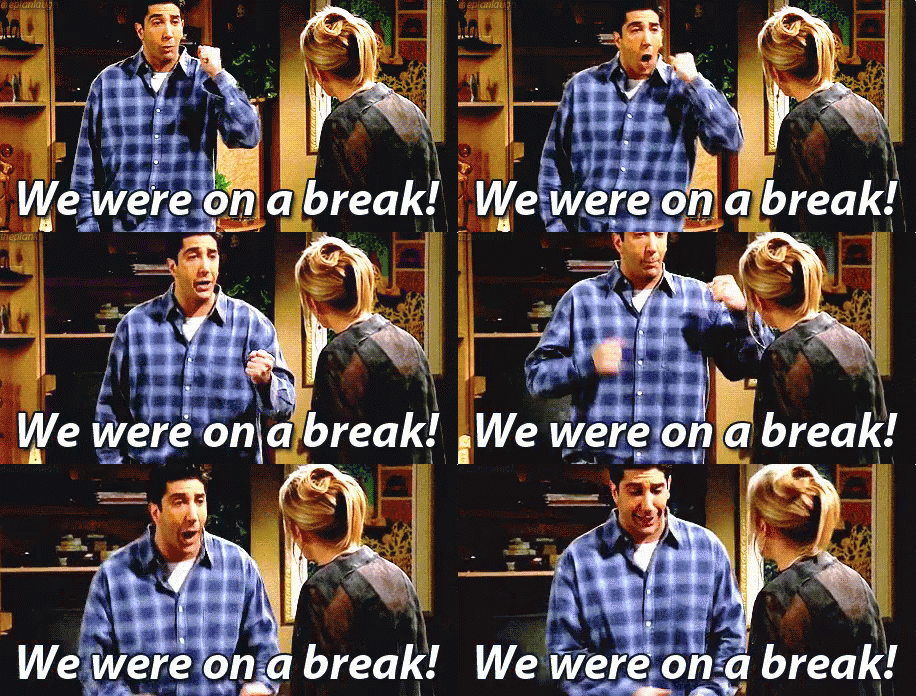
I think that means different things to writers than many other people. You see, much like the famous Ross and Rachel argument on Friends, whether I was on a break could be debated.

We. Were. On. A. Break!

Since it’s Fathers’ Day, and I’m writing, I think you know the winner in my particular debate.

I was putting a lot of thought into the future of the series, and I don’t mean whether I’d get published or whether I should shelve the project. I was contemplating the ongoing storyline and the eventual intersection of Tildy and her lost brother, Samor (for a little preliminary info on him, go here: the Prince).

Much needs to happen to create the dynamic between them when they meet. Without being too spoiler-y, they are both heirs to the throne. Due to the patriarchy of their society, many will favor him; however, as the first-born, Tildy will also have a legitimate claim, as far a many are concerned.

Before I digress too far, there are beats in the story that must be hit and I need to determine the best books for them to occur. When does Tildy realize this? Book 2. When does Samor achieve that? Book 3. And so on.

So, I’ve been taking notes. Lots of ’em.

Yesterday, I found myself with a little free time. I pulled up Evernote and started popping notes into the appropriate manuscripts. After an hour or two, I’d added maybe 30 total notes into nine manuscripts. You can verify that here: Progress Tracker.

That’s….an ambitious project.

Yeah, which is why I need to understand where the overall story is headed. Otherwise, the – let’s call it writing math – isn’t going to add up at the end.

Equally important, it was a telling thing because I wasn’t “in the writing mood” and the house was hardly free of distractions. The perfect writing environment isn’t sustainable for a married guy working through a pandemic as Summer arrives with two dogs and two kids. I’ve changed my approach to ensure I’m spending my time working, not waiting. Fortunately, I started that transformation years ago.

For me, writing has never been limited to words appearing on a page. Having a similar philosophy will help you spend more time working and less time waiting. Good luck!

–Mike


Enjoy what you just read? Leave a comment or like the post and we’ll ensure that you see more like this!

© Michael Wallevand, June 2020

Whatcha writing during isolation?

Nothing.

I should be writing something. I always should be. But I’m not.

At least, I hadn’t been.

When Covid-19 started to get serious back in March, but before a pandemic was declared, I’d been working on agent submissions. That carried me into early April.

I don’t know whether this is the worst time or the best to query. I guess we’ll see. At the very least, maybe it will provide some interesting insight into the industry. If you’re wondering, I’m 0-2-1 right now. When the agent just stopped repping my genre, I’m counting that as a tie. Glass half-full, people!

But the stresses of two parents working from home with a special needs child began to mount. Additionally, I no longer had those simple moments where I just worked on the story in my head: the daily commute, waiting in line for lunch, boxing class, pumping gas, and so on.

I tend to be a creature of habit. I’ve created a number of different ways to get my brain ready for writing. I’ve described them here:

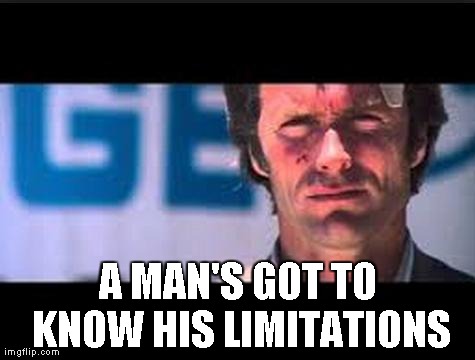
Unfortunately, stress, frustration, and exhaustion have been deadly foes these last eight weeks. Something had to give – or break – and it certainly wasn’t going to be me. As Clint Eastwood said in Magnum Force:

“A man’s got to know his limitations.”

So, I created a new tip. I took a break. In hindsight, it was 50% conscious and 50% deliberate in the way that a person stumbles down the stairs but stays on their feet.

Physically and mentally, some pressure was relieved. I didn’t attempt to write. I didn’t blog. I even paused my agent submissions. I’ve written through some tough situations – insomnia, unemployment, hangovers, work stress, death – but I knew this situation was different.

However, that small voice between my ears kept reminding me that something was missing. I listened, but knew I’d get back to it once we’d sorted out life in isolation.

And so, here and there, I’ve started working in my head again. Rolling over in bed, half asleep, to jot something down (note: that’s how the reptilian slither-withers came to life). Giving myself permission to chase a character down an unfamiliar path. Write this post. It feels good – natural. I’m not surprised, but the reassurance that your skills haven’t dulled, well, that’s a nice feeling.

A loss of momentum for writers is inevitable. Some call it writer’s block. Others, the vengeance of an angry muse. Regaining your momentum is no guarantee of success; however, giving up is certainly a guarantee of failure.

Don’t give up on your writing!

–Mike


Enjoy what you just read? Leave a comment or like the post and we’ll ensure that you see more like this!

© Michael Wallevand, May 2020

Enticed by Pepper – Writing Exercise

I was going to shut myself away in a quiet room, but my wife’s making homemade chicken noodle soup and the enticing smell is irresistible. It’s the smell of home, but a nostalgic kind. A place where hungry people come in from a wintry outdoors and suddenly find themselves ravenous in a warm, aromatic kitchen.

And so, with no preparation, I sat down and wrote a little about it. I don’t know what this is. Just stream-of-consciousness stuff. I provide it as an unedited example of how easy it is to get writing momentum some days, especially when you’re not overly concerned with structure or other grammatical rules.

I’m writing at the kitchen table

with headphones in.

It keeps out the distractions of home life

Yet allows me to stay within my family’s presence.

I sit here so I can smell my wife’s homemade chicken noodle soup.

As it bubbles on the stove

Its pepper enticing, the rich broth,

the concoction of ingredients that dance merrily in a savory swirl

“Pepper makes me sneeze,” I said as a kid.

It no longer has the effect I pretended it had back then.

Now, it’s an enticement, I want to bask in its aroma

and be inspired by cauldron thoughts

and salivating mouths,

of cooking herbs found near the camp

fresh-picked and green,

their earth nourished by a nearby brook that delights in its passage.

I cannot hear the roiling water as it swirls upon the stove.

It waits for noodles, thick and grand, pleasures each to taste.

And so I type, I write.

I take white pages and darken them with hope.

With no planning save that which can be done in preparation to sit

and bask within a kitchen breeze

its peppered breath a kiss,

A promise,

An inspiration.

Perhaps it will be worth editing later, or pieces will be borrowed for something else. At the very least, it got my mind ready for the other writing I intended to complete. And it got me hungrier.

It’s time for a luncheon interruption.

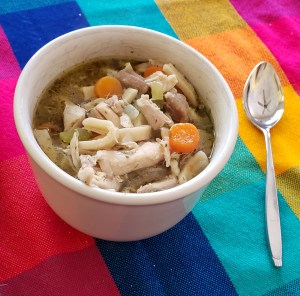
Homemade chicken noodle soup with carrots, onions, celery, and big thick noodles.

Enjoy what you just read? Leave a comment or like the post and we’ll ensure that you see more like this!

© Michael Wallevand, March 2020