Writing Update: Oct 15, 2017

This post is approximately 450 words, and I originally just wanted to share the clever t-shirt I’m wearing.

Choosing a t-shirt to wear is a bit of a ritual for me, and while that might sound like hyperbole, I do put a ridiculous amount of thought into it (‘ridiculous’ being a relative term, used to compare myself to regular people, who might be making sartorial decisions, whereas societal fashion plays almost no role for me).

Today’s selection is Call of Snoophulhu, a mash-up of two writers: H. P. Lovecraft (The Call of Cthulhu) and Charles M. Schulz (Peanuts). It tickles me, although most people don’t get it.
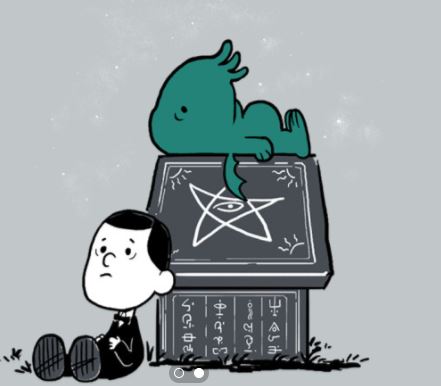
Call of Snoophulhu

This morning I realized I have a number of literary-themed t-shirts and it surprised me. It shouldn’t have, considering that friends and family enjoy buying things like that for the writer in their lives. Additionally, I like to organize things and should have made the connection. But I’d missed the fact that I have at least five shirts in this category.

In that vein (did you see this segue coming?), I realized I have two connected scenes in my story, but I’d forgotten to help the reader see how they’re related. When it comes to writing, I’m sometimes inconsistent with that. On one day, I can’t see anything but the interconnectedness of things, some of which span chapters or books. Other days, I’m so close to the writing that I can’t see the forest for the trees. That idiom is particularly appropriate today as I realized I missed a key opportunity to connect one scene to the climax of my book.

An important person in Tildy’s life comes to help her, seemingly out of nowhere. It felt a bit deus ex machina, and that annoyed me (ever since I’d learned about that theatrical device in a Greek history class, I’ve been hyper-aware to its use in any story, mine or someone else’s). I’d already established that the character was hiding in a tree near her, waiting for an opportunity to help. Tildy even passed by the place, but I never actually wrote any indication of this or gave any clue to the reader. Alas, for the brain of a writer. This morning’s task is rectifying that oversight (i.e. connecting one scene to another for the reader).

Sometimes, connections like this are part of the writing plan in your head (architect); you’ve grouped things together and you’re presenting them in a logical fashion. Other times, they come naturally (gardener). Editing and re-writing is a great way to find those opportunities you’ve missed.

Good luck with your writing!

–Mike


Enjoy what you just read? Leave a comment or like the post and we’ll ensure that you see more like it!

© Michael Wallevand, October 2017

Get back to writing, you!

This post is approximately 550 words. Most of them from more than a year ago.

Not a week passes where I don’t see a meme or social post chastising writers who aren’t writing. Sometimes I think, “Yes, thanks!” and others, “I can’t look at that damned manuscript for more minute.”

Misery writing

I found this unfinished post and thought I’d share. It captures my thoughts from a time when I’d been struggling with the work of writing, yet I felt like I was climbing out of the rut. Since those times are safely in the rear-view, I thought this post would be a nice reassurance for writers in ruts of their own.


I’ve discovered that longer and longer breaks are occurring between writing attempts. The fear is that eventually, there will be no more attempts. For someone who enjoys writing as much as I do, this is, of course, unacceptable.

We all have personal responsibilities or weights that drag us down or roadblocks in our way. I started identifying a few of mine. I’ve had a diminishing community of writing people around me. My friend and one-time collaborator has given up writing to focus on a different enterprise. I’m no longer engaging with writers on Twitter. My blog has remained dormant. I seem to know fewer people making serious attempts to write on a regular basis. When weighty things force your head toward the ground, it’s difficult to see the sunrise ahead.

But things are changing. Finally. Though I say this feeling surprised at the amount of time that’s passed since I was serious about writing. I’m discovering the hidden talents of coworkers. My wife and son have written intriguing stories this last year. I’m doing more writing at work, allowing me to flex the important parts of my brain whilst shaking off the rust that’s collected on my fingers.

Certainly, you need to write to write. It’s a stupidly obvious statement. But it is true. The more you write, the more you can write (he says, making another stupidly obvious and trite statement). And to accompany that, you need to surround yourself with discussions about writing, about creation, about art. You need read and read and read. And read some more. You need to create an environment for yourself where, even when you’re not writing, you’re writing. When done correctly, I’ve found the ideas flowed like exhaled breath to the page, effortless and natural.

So, all of that said (he says, using a terrible segue and allowing for another parenthetical aside), I come to the inspiration of this post. I love to hear writers talking about writing. I consume every word as a morsel of inspiration. Last summer, I read a blog post by one of the writers of Community, in which he tells an expletive-laced story about going to write for the show. I can boil it down to “writing is re-writing”, but that’s not as much fun to read, if you like vulgarity.


It usually gets better. It sometimes gets worse. But you guarantee the latter when you’re not sitting down to write. Which result do you prefer?

Apologies for the distraction. Get back to writing, you!

Doctor Who writing


–Mike


Enjoy what you just read? Leave a comment or like the post and we’ll ensure that you see more like this from Michael!

© Michael Wallevand, September 2017

Sanding down the rough spots

This post is approximately 500 words.

I speak regularly with others about writing, many of whom love the idea, but don’t have the desire. As such, it can be challenging to find common ground – common understanding, I should say – when we talk.

I’ve found that analogies are helpful and I’m always looking for a good one. Today, as I wrote and re-wrote a chapter-end that I lamented about nearly a month ago, it occurred to me that sanding wood might be a strong analogy.

If you had woodshop in school or you’ve done a home improvement project, you’ve likely done a bit of sanding. I’m not much of a craftsman, and I always have rough spots on cut wood. So I’d sand-sand-sand-sand-sand, and then feel the spot. Sand-sand-sand-sand-sand, feel the spot.

sanding

I learned early that focusing only on the one spot Continue reading

Writing Is Pre-writing

This post is approximately 400 words.

Even if you don’t consider yourself a writer, you’ve probably heard the phrase “writing is rewriting”. This is absolutely accurate. I’ll probably write a future post on this, but for now, I wanted to establish that I am talking about something different here.

writing thinking2.jpg

When the hours of the day are comprised of varying combinations of family, friends, work, and other activities, writing time can be limited. Precious, really. The last thing you want to do is take that jewel and toss it down the drain.

Many writing efforts are like that. If you’re a writer like me, you’ve logged hundreds of hours staring a blank screen, jaw and fingers slack. It’s frustrating to think you’re squandering that rare opportunity to conjure some magic from a keyboard.

But what if you could take that wasted time and expend it elsewhere? Continue reading

Writing Update: March 12, 2017

This post is approximately 600 words.

Last night, the clock on my computer screen read 11:48 pm. Including the last two hours, I’d spent six or seven hours yesterday working on Chapter 14, a 4000-word section which in hindsight, should have had a working title of “The Long Walking Chapter Full Of Exposition”.

I required this chapter to do a lot of heavy lifting for the story: the one being told in the current book, but also in the greater overall tale I wanted to tell throughout the series.

My characters began to understand that there was more going on than a simple adventure story filled with monsters. Additionally, readers needed to know that our heroes had just one choice for sanctuary, but the destination might be only slightly less perilous than the wilderness. I had backstory about the place and needed a thorough-enough depiction so I wouldn’t have to keep describing it (I’d rather establish a scene early and as we go on, allow readers to recall as little or as much detail as they wanted to enjoy the story). We also meet two secondary characters and a few tertiary ones.

Oh yeah, and I needed to continue the character development of my three heroes. Whew.

wp-1489337156611.jpg

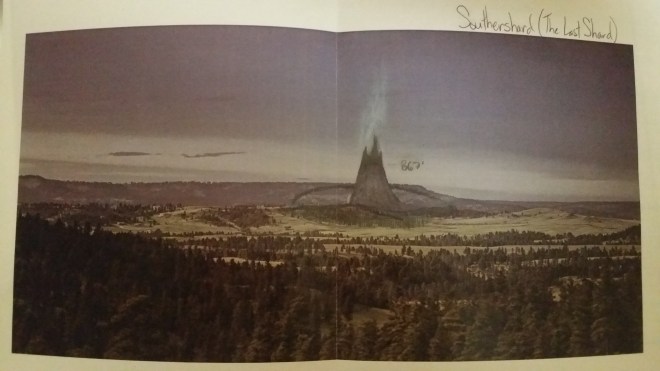
The Last Shard (modified image of Devils Tower)

Continue reading

Tighten Up Your Writing (or not?) #4

This post is approximately 400 words.

calvin-resolutionsIt’s the first day of a new year, which generally means resolutions and other pledges of life changes, blabbity-blah. I usually don’t hold to such traditions, uh, mostly because I forget my New Year’s promises before January ends. But as an idea formed in my head this morning, it occurred to me I might be writing such a post.

Yes and no. This post does contradict other guidance I’ve given about reducing words during a rewrite. But as with most other advice in life, just because you CAN do something, it doesn’t mean you SHOULD. Forsaking context or intent for the sake of brevity is an excellent way to deliver a quick read that readers misunderstand. That’s why I’m going to show the other side of word reduction. Continue reading

Tighten Up Your Writing #3

This post is approximately 400 words. There’d be 25% more, if I hadn’t…tightened up my writing. Yeah, that’s right: bad jokes and math on this writing blog.

Many of the writing questions I’m asked are in the category of “Where do ideas come from?” which usually elicits a response about “mommy and daddy ideas that love each other very much.”

But I also get quite a few inquiries about mechanics, which to this grammar nerd, is pretty cool. We can all put words on paper in a coherent order, but it’s challenging to do it crisply and succinctly. Especially the first time.  I rarely deliver a sentence that completely satisfies me after the first writing.

kneading

It’s like making dough: you can put the ingredients together, but if you don’t massage that lump, it’s not going to taste right. As someone who’s reviewed thousands of pages, I know that many people are satisfied with the lumpy dough of first drafts. I get it. There’s that impatience factor. But just as people are discriminating about pizza joints, so they are about books. They’ll stop coming for sub-par sustenance.

Not stopping at one draft is the key. The following examples demonstrate various ways to change up your thinking as you work through the editing process. Compare my lumpy messes to the dough I’m putting in the oven (he said, reconsidering his analogy). Continue reading

Writing Update: December 4, 2016

This post is about 350 words. 

kermit writing.gif

It’s been about three weeks since my last writing update, where I mentioned that I’d uploaded the first two chapters to this website. Since then, I’ve finished up* the next three, though I’m not sharing them yet.

*As always, when I say, “finished up”, there’s a big disclaimer about reserving the right to go back and tweak them as needed. Or to change things based on revisions to later chapters. Or to fix things that have woken me in the middle of the night. Or when I realize I’m having the same delusion as Ralphie in A Christmas Story.

OK, so rambling aside, I’m satisfied that FIVE chapters are ready for reading. They have cohesion and flow, and each considers the length of the ones before (i.e. I don’t have a 3,000-word chapter followed by one that’s 10,000 words). They have transition and connection to each other, so they are no longer five separate pieces. They feel like the first act of a three-act story. And that’s about 20% of the book completed, which feels pretty good. But….

Continue reading

Building Blocks of Imagination

This post is about 400 words. 

I’m at my parents’ house for Thanksgiving, sneaking in whatever writing time I can in a house with eleven people, two dogs, and more leftovers than any one fridge could contain. Despite these distractions, I’ve spent enough years writing that I have some tricks for keeping the creative fires warm. Right now, I’m sparing some time for a post that serves as writing analogy and inspiration for building creativity in your children.

Last night, our youngest son Ben brought out the blocks I played with as a child, and suddenly I was writing this post in my head as I built with him.

20161126_115336.jpg

My maternal grandfather made these blocks for me using 2x4s and some leftover paint. The basic blocks looked like this, though there were other lengths, too. With these, I could construct walls and forts and many other things as I played with my Star Wars figures.

But it was the oddballs that truly fueled my imagination. Call them scraps or discards, many would consider these pieces worthless. Clearly, my grandfather did not agree. Nor do I.

20161125_201638.jpg

Continue reading

Writing Update: November 13, 2016

This post is about 250 words. 

It’s been a few months since I published an update like this, but with back-to-school, Boy Scouts, the election, and the release of Gears of War 4, it’s been a busy Autumn.

Oh yeah, and I’ve been doing  massive amounts of editing.

typing 5.gif

I haven’t been idle, even if this blog has been a bit quiet. To remedy that, I’ve uploaded excerpts to the site.

Continue reading