Chapter available: Prologue

A few weeks ago, I started publishing my book on this site. My intent was to finally, actively, truly work toward publishing it in full digital and physical formats, instead of cowing to those fears that always tell you: It’s not good enough. It’ll never be good enough. There’s a point where the author has to listen to voices that aren’t internal. When Trusted Readers regularly provide positive feedback and encouragement, that should carry more weight.

It does carry more weight.

This post isn’t simply an announcement, though you can start reading this chapter here: Prologue: The Children’s Gifts. Consider it a behind-the-scenes look at how a chapter and book come to life. I might not have this context for every chapter I release, but we’ll see. It’s very easy for a writer to procrastinate when fun new post ideas come to mind.

Prologues have been integral to fantasy books for decades. Thoughts on this are cyclical: from “must-have” to “cliche” to “must-have” and around again. IMO, if your writing is chasing what’s fashionable, you’re doing your story a disservice. You’re also not being honest with your Readers, which to me, is the more egregious matter.

Early on, I knew I wanted a prologue for each of my books, and they would all have a corresponding epilogue, as well. This was part of a larger decision: each book is told from the hero’s point of view. You know what they’re thinking, you see the world through their biases, you see how they grow based on their reactions to stress and other factors. Which meant I had a problem for the antagonists of the series. How do I help the Reader understand the machinations of their schemes?

I didn’t want to keep any of that hidden from Readers. In Lord of the Rings, you get a limited sense of Sauron’s plans. The Harry Potter series offers a little more visibility to Voldemort through a prologue or monologue. I wanted more for my Readers.

And so, the bookends of the story are devoted to the primary antagonists of the series: the dark god Delosh and Its thrall, the Mellifluent, the last survivor of a genocide committed by its master. This is where I communicate their motivations and plans, but also how the actions of our heroes affect those plans.

When I wrote the prologue, I took inspiration from the cinematic opening to the Fellowship of the Ring and the writing of Tolkien himself. It was formal and grand; it had depth and history; and it had necessary exposition to set up the entire series, not just the first book. It was heavy.

It was too much. And Trusted Readers were right to call me on it.

Continue reading

Writing Exercise: A Day Bright and Full of Promise

It was time for the school bus. Following Benji, I stepped into a beautiful Autumn morning. As though someone spoke to me, this line popped into my head.

A day bright, and full of promise

I stopped in my tracks, my brain beginning to answer the question I no longer had to consciously put into words: “What happens next?” Even after so many years of writing, I continue to be surprised by the amount of creativity sparked by that simple question. Most notably, What if I paused my writing about the lost prince and started a female-centric story about his sister?

It’s a tip I use not only for writing, but in my office job, as well. “OK, we have an issue. What happens next? And then what?” And so on.

The following is about 2 minutes’ work. It’s a minor piece of writing, but I wanted to capture it because it helped inspire me. It’s about having days ahead of you that you want to spend writing. It’s the promise that you’ll create something worthwhile. It’s the power of positive thinking, if you will.

It’s Hope.

Continue reading

Waiting is the hardest part

We’re sitting in Children’s Hospital this morning while our son Benji has a heart procedure. As medical procedures go, especially ones concerning your child, an invasive cardiac electrophysiology and ablation is relatively straightforward and routine.

And yet, it’s a medical procedure involving the heart. Of your child.

It’s a hard thing to watch him wheeled away, even when you have absolute faith in the medical staff. It feels impossible to let him go. And yet, you do.

Then you sit. Then you wait.

And wait and wait.

I thought I might play games on my Steam Deck to pass the time, either some brainless distraction or immersive experience, but my wife wisely suggested I try writing instead. So, I brought the laptop and left the Deck behind. An easy decision, I had hesitation, nonetheless. You see, writing has been hard for the last, hmmm, 18 months or so as stresses piled upon each other. I was out of practice and easily distracted.

As we sat in the waiting area, I set my phone aside and opened the laptop. I’d recently started an alternate prologue for Tildy Silverleaf and the Starfall Omen that brought the reader into the action sooner. The approach was more Show and less Tell, and based on feedback Trusted Readers had provided, I thought it would be better received. As I read through rough paragraphs, the visuals resurfaced in my mind. Perhaps it is more accurate to say that I submerged into the world I’d created.

And I wrote.

Continue reading

Author’s Journal – I Put Myself In Editing Purgatory

Altar from Franciscan Monastery of the Holy Land in America, Washington, D.C.

In December 2019, I finished the final draft of Tildy Silverleaf and the Starfall Omen. I exhaled, wrote a post, and put the book aside for the holiday season, intent on querying in 2020. I started researching agents over the winter and began querying in earnest in early spring.

Around that time, rumors had begun, followed by vague news reports, about a new disease that would eventually be known as Covid-19. In March 2020, I said goodbye to my office desk and began working remotely for nearly 3 years. In May, riots erupted in Minneapolis and elsewhere over the murder of George Floyd. As the year progressed, the political landscape in America became fraught, then angry, then vicious, and civil discourse became less common.

The world seemed to stop.

And so did I.

I tried to write, and in two years, I had about 100,000 words of my next book, which featured Samor, Tildy’s brother. There was some joy, but the weight of things beyond my control pressed upon me, and the work became more grind than pleasure. I struggled to recapture the magic.

I decreased my blogging output in that time, too. After all, what did I have to write about my process? I wanted to share positive things and my passion for writing, but they were hard to think of, much less give enough attention to bring to life. There seemed to be more important things in the world.

I started Project 3 in that time, hoping a return to Tildy’s familiar story would help me push through. For a time, it did.

It wasn’t enough.

Continue reading

Difficult Story Choices #2

I knew it was coming.

I didn’t want to admit it. I figured if I kept these parts in the book, eventually I’d find a way to make the passages work.

But the writer knows. You know when it’s not going to work long before you concede the reality.

And then about a week ago, I wrote this note which sealed their fate: “Repurposing these words to the Elf would move the Dragon to Samor Book 2; at which point all the other Dragon stuff could be moved out. I’ve been struggling with their purpose for a while.”

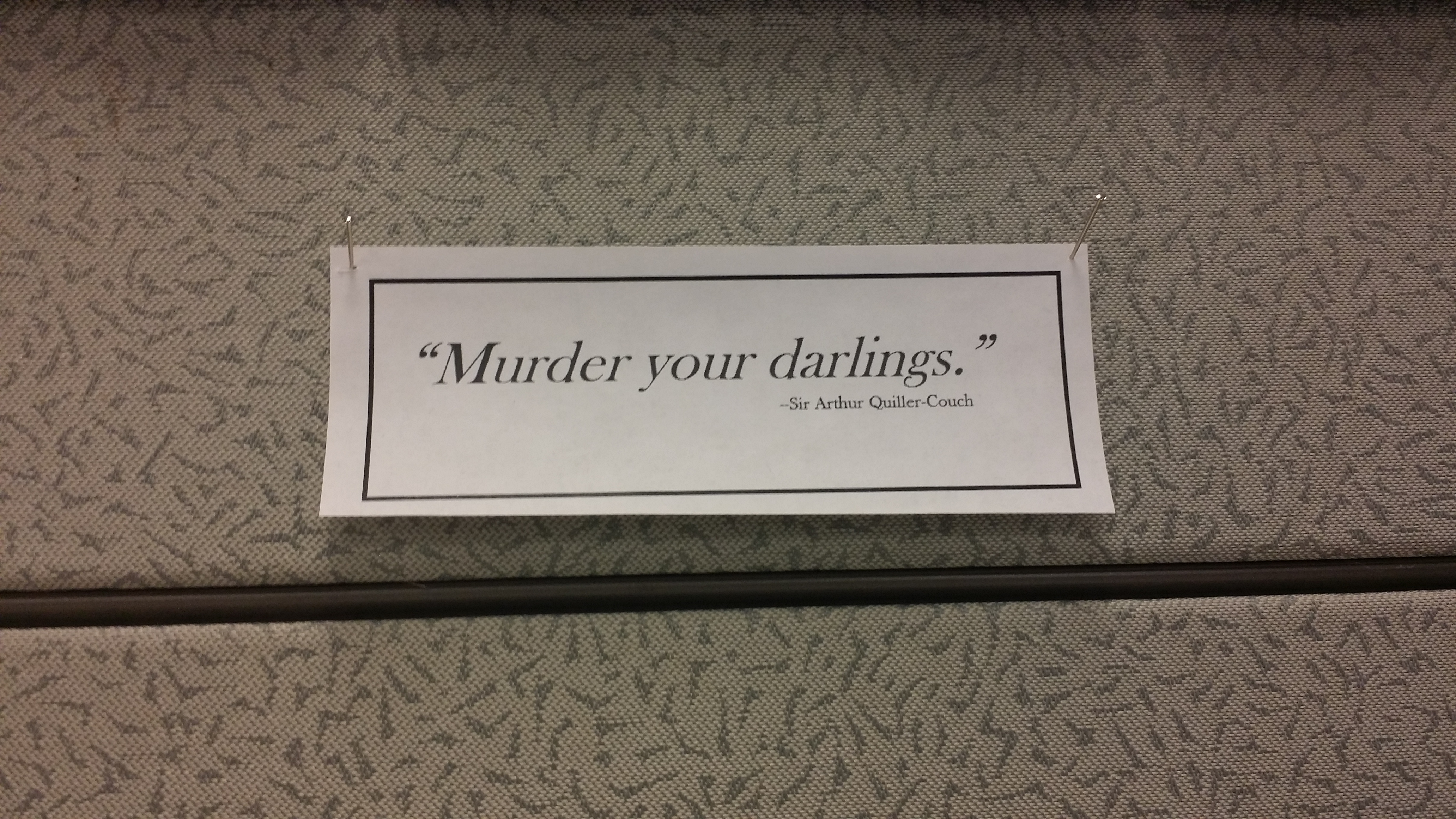
Even then, it took a few more days before I started yanking stuff from the manuscript. I once again followed the advice of Stephen King, who was borrowing from Sir Arthur Quiller-Couch:

Murder your darlings
Continue reading

My Writing Freaked Out a Rock Star

Writing inspiration comes from everywhere. Looking out a window or considering how a person might react to a situation or watching your kids play. In this example, it came from the song “Iris” by Goo Goo Dolls.

“You bleed just to know you’re alive.”

When I wondered what might cause a man to literally, not metaphorically, do such a thing, the story erupted from me. It was the writing experience I’d always imagined, though rarely had. And it came from questions that followed one after the other, piling up until I couldn’t type quickly enough.

More than fifteen years later, I still recall the first scene. A man in a cheap apartment staring at himself in a grimy mirror and hating what he saw. He picked up the razor blade, as he had many times before, and cut his wrist. A single droplet of blood fell into a claw-footed bathtub. As he watched, his cut healed and he screamed in helpless rage. He slashed again and again, healing again and again…until he didn’t. He breathed a sigh of relief. Soon, it would finally be over.

While there’s a violence and hopelessness to the scene, I believed the book would be a beautiful take on the unrequited love story: A man who heals others and himself, and the nurse searching for the person performing miracles in the streets. He falls in love, but will never tell her, never end his self-imposed exile, because his body is too scarred, his psyche too damaged. He’s unworthy of redemption. To further quote the song, “I don’t want the world to see me ’cause I don’t think that they’d understand.”

A few months later, I had the draft of a 30,000-word novella.

Fast-forward to sometime in 2006. Goo Goo Dolls were promoting their latest album, Let Love In. I worked in the Best Buy Music department, and we were often a stop for such junkets. Artists would talk about the album, maybe spin some tracks or perform, and then we’d often get a chance for handshakes and pix. It was the coolest job perk I ever had.

It’s key to understand that “meet and greet” is a brief encounter. Obviously, no one’s making friends, but it is a chance to say a few kinds words or ask a question before quickly moving on. Sometimes, it’s idle chitchat; other times, you get to thank someone for a meaningful impact they had on your life.

Continue reading

Oh, You Just Sat Down and Wrote?

It’s 7:30 on a Sunday night. Beside me sits a glass of whiskey and ice. I’ve poisoned it, some might say, with Coca-Cola. And that’s fine for this ending to a long day because I’m desirous of the effects, if not so much the taste.

Much of these first three paragraphs was written, and re-written in the car this evening, while listening to Neil Gaiman’s The View From The Cheap Seats (It’s one of three books I’m currently enjoying. The softcover Brimstone by Preston & Child sits beside the whiskey glass and Harry Potter and the Sorcerer’s Stone awaits my ears when I get to bed, whenever that might be.).

The Gaiman writing is good, as he usually is, but I think there’s more than that pleasure contained in this particular work. It also contains some unspoken encouragement for writers, and I wonder if other people realize that when they read it.

I’ve hardly been writing since the pandemic was declared in March. The Gaiman book, and another huge relief that occurred this week, have served to remove some of the weight that’s been crushing me. Today, some pent up energy was released.

I’ve already mentioned that I began writing this post ahead of time, and that’s much like the new story I sat down to type this morning. Similarly, it formed in my head before I knew I was going to do any writing. As I showered today, two distinct lines popped into my head, as though I had discovered a thing that existed or was remembering something whispered to me in my sleep.

The first was a title: The Time Travel Tinkerer.

The second was the opening: Putter was a tinkerer, a time traveler, and a bastard. At least, that’s how people would have viewed him, if they’d known what he’d done. Or would do, depending on their places in time.

Continue reading

Squeezing in writing time

As I mentioned in Whatcha writing during isolation?, I hadn’t been doing much writing. Thinking, yes; time at the keyboard, no. I also stated that I was taking a break.

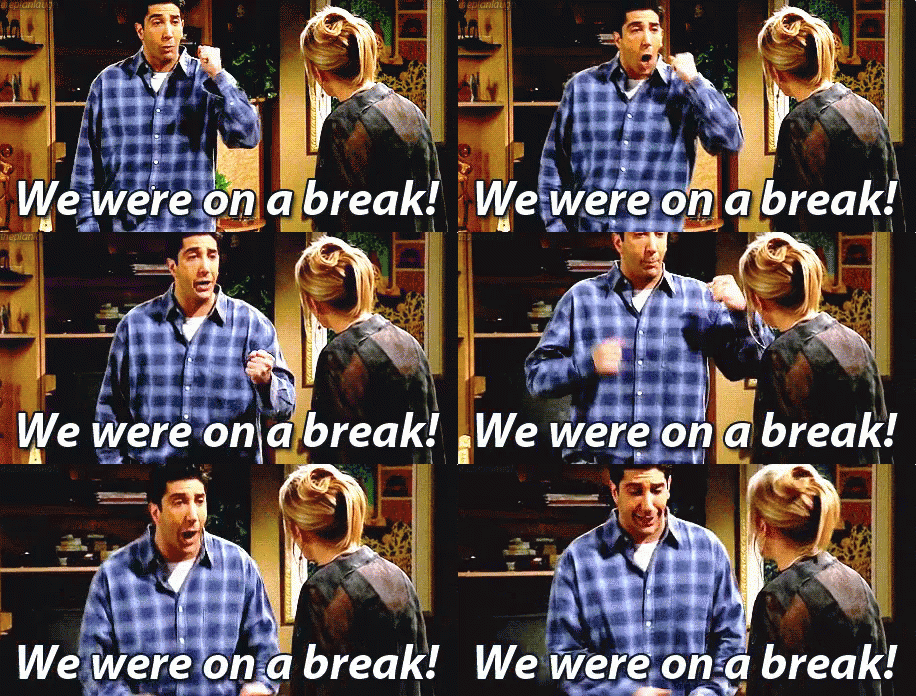
I think that means different things to writers than many other people. You see, much like the famous Ross and Rachel argument on Friends, whether I was on a break could be debated.

We. Were. On. A. Break!

Since it’s Fathers’ Day, and I’m writing, I think you know the winner in my particular debate.

I was putting a lot of thought into the future of the series, and I don’t mean whether I’d get published or whether I should shelve the project. I was contemplating the ongoing storyline and the eventual intersection of Tildy and her lost brother, Samor (for a little preliminary info on him, go here: the Prince).

Much needs to happen to create the dynamic between them when they meet. Without being too spoiler-y, they are both heirs to the throne. Due to the patriarchy of their society, many will favor him; however, as the first-born, Tildy will also have a legitimate claim, as far a many are concerned.

Before I digress too far, there are beats in the story that must be hit and I need to determine the best books for them to occur. When does Tildy realize this? Book 2. When does Samor achieve that? Book 3. And so on.

So, I’ve been taking notes. Lots of ’em.

Yesterday, I found myself with a little free time. I pulled up Evernote and started popping notes into the appropriate manuscripts. After an hour or two, I’d added maybe 30 total notes into nine manuscripts. You can verify that here: Progress Tracker.

That’s….an ambitious project.

Yeah, which is why I need to understand where the overall story is headed. Otherwise, the – let’s call it writing math – isn’t going to add up at the end.

Equally important, it was a telling thing because I wasn’t “in the writing mood” and the house was hardly free of distractions. The perfect writing environment isn’t sustainable for a married guy working through a pandemic as Summer arrives with two dogs and two kids. I’ve changed my approach to ensure I’m spending my time working, not waiting. Fortunately, I started that transformation years ago.

For me, writing has never been limited to words appearing on a page. Having a similar philosophy will help you spend more time working and less time waiting. Good luck!

–Mike


Enjoy what you just read? Leave a comment or like the post and we’ll ensure that you see more like this!

© Michael Wallevand, June 2020

Whatcha writing during isolation?

Nothing.

I should be writing something. I always should be. But I’m not.

At least, I hadn’t been.

When Covid-19 started to get serious back in March, but before a pandemic was declared, I’d been working on agent submissions. That carried me into early April.

I don’t know whether this is the worst time or the best to query. I guess we’ll see. At the very least, maybe it will provide some interesting insight into the industry. If you’re wondering, I’m 0-2-1 right now. When the agent just stopped repping my genre, I’m counting that as a tie. Glass half-full, people!

But the stresses of two parents working from home with a special needs child began to mount. Additionally, I no longer had those simple moments where I just worked on the story in my head: the daily commute, waiting in line for lunch, boxing class, pumping gas, and so on.

I tend to be a creature of habit. I’ve created a number of different ways to get my brain ready for writing. I’ve described them here:

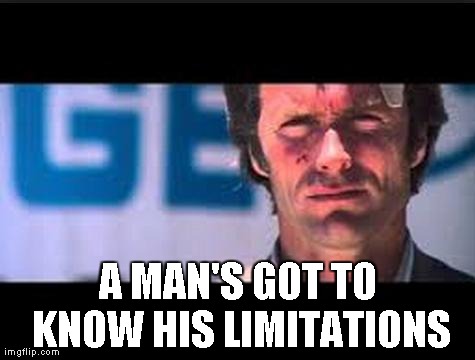
Unfortunately, stress, frustration, and exhaustion have been deadly foes these last eight weeks. Something had to give – or break – and it certainly wasn’t going to be me. As Clint Eastwood said in Magnum Force:

“A man’s got to know his limitations.”

So, I created a new tip. I took a break. In hindsight, it was 50% conscious and 50% deliberate in the way that a person stumbles down the stairs but stays on their feet.

Physically and mentally, some pressure was relieved. I didn’t attempt to write. I didn’t blog. I even paused my agent submissions. I’ve written through some tough situations – insomnia, unemployment, hangovers, work stress, death – but I knew this situation was different.

However, that small voice between my ears kept reminding me that something was missing. I listened, but knew I’d get back to it once we’d sorted out life in isolation.

And so, here and there, I’ve started working in my head again. Rolling over in bed, half asleep, to jot something down (note: that’s how the reptilian slither-withers came to life). Giving myself permission to chase a character down an unfamiliar path. Write this post. It feels good – natural. I’m not surprised, but the reassurance that your skills haven’t dulled, well, that’s a nice feeling.

A loss of momentum for writers is inevitable. Some call it writer’s block. Others, the vengeance of an angry muse. Regaining your momentum is no guarantee of success; however, giving up is certainly a guarantee of failure.

Don’t give up on your writing!

–Mike


Enjoy what you just read? Leave a comment or like the post and we’ll ensure that you see more like this!

© Michael Wallevand, May 2020

Author’s Journal – 12-20-19

It’s been a lazy writing week since my last post, but that doesn’t mean I haven’t been working on the project.

1. I got kicked in the face by the flu. Knocked me out for two days, and it’s about the only thing that keeps me from putting any thought into my work. Through the fever and lethargy, I did manage one related thought, however: I wonder when my print order will be complete?

2. Turns out, it was done in a day. I work for Thomson Reuters, and our Copy Center gives us a nice deal on personal printing. I ordered six copies of the 373-page manuscript and had them spiral bound with plastic covers. They’re now taking up considerable space on our table as I prepare some mailings.

Wonder Woman pushes buttons

Continue reading