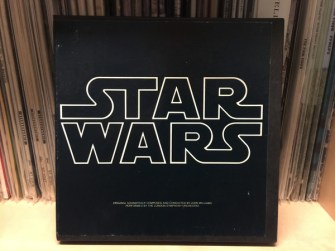
Inspiration: the Star Wars soundtrack

This post is approximately 900 words and focuses on one of my favorite topics: Music. Ooh, and Star Wars.

Star Wars reel-to-reel 1You won’t be surprised that Star Wars has been hugely influential to this 40-something writer. It’s second only to family in that regard. I’ll probably write about that on some future date. A large part of my adoration/zeal/mania is the soundtrack. I’ll get to this in a moment, so please bear with me while I set the stage, sounding like an old man as I do so.

When I was a kid, we didn’t have streaming services that allowed us to watch any movie when we wanted. We didn’t have cable. VCRs were around $1,000 and video tapes were $100.

I grew up twenty miles from the nearest movie theater, which doesn’t sound like much these days, but when you’re on the edge of the North Dakota prairie, you don’t make a lot of trips “to town”. Back then, you saw a movie once, and you might never see it again. If you were lucky, one of your three TV channels might air it, though your rooftop antenna was at the mercy of the elements. Yes, yes, first-world problems.

Continue reading

Wonder – Discovery – Adventure

I started this post in June, but set it aside as part of the writing break I described in my last post. The title comes from three words I wrote as they came to me. Behind my office desk, I might refer to them as ‘guiding principles’ or ‘fundamental values’. But we’re talking about writing today, so no stuffy corporate phrases allowed!

macbook pro beside white cup and saucer on table

Here’s what they really are. They are the heart of Tildy’s character, and therefore, the heart of her story. Of all the words in the English language that I could use to describe her, these three are all I need. Everything I have written so far – and everything I will write – needs to convey this or I haven’t adequately transported the reader.

The amount of thought writers put into their works might surprise people. Using a scientific measuring tool known as ‘my gut’, I’d estimate nearly half of my time is spent thinking about the story. Yeah, it’s not all butt-in-chair, typing away like a half-crazed hermit. Whether I’m walking in to work, driving, or waiting in line for coffee, I’m thinking about where the story is going. What happens beyond the first book? Am I doing my female protagonist justice? Is it marketable? There are myriad questions, and if a writer isn’t focused, it’s easy to deviate the story too far from your original intent.

Continue reading

Writing Update: Oct 1, 2018

This post is approximately 400 words, which is about 4 words for every day since I last posted here.

This probably isn’t the first time I’ve said this: it’s hard to keep a blog going (especially for me, a person who likes unfocused research and differing outlets for creativity). Given the choice – as many writers are – I’d rather spend the time on the manuscript than the blog. Honestly, I didn’t do much of either kind of writing over the summer.

From a high school graduation and sending a kid to college, to lazy weekends at the lake, to re-discovering Warhammer modelling, to getting a wife and second son off to school, well, there have been a distractions a’plenty.

Work’s been crazy, too. Some of it good, some of it (checks Corporatespeak Thesaurus) sub-optimal. More on that for some future date. Beyond that, current politics in America are distracting as hell, but I’m certainly not touching that tonight.

That’s a long list of factors, and some would rightly name them excuses. But c’est la vie.

Continue reading

Helping Define Your Company’s Culture

This post is a quick ‘un.

A few weeks ago, I wrote a post entitled Sharing your other work at work in which I described my submission to the Thomson Reuters brand marketing team, who was looking for employees to help showcase and define our culture. It’s part of a greater recruiting effort to bring in top talent from around the globe.

Sharing your writing can be nerve-wracking at the best of times, but there’s a certain other level of anxiety that comes with standing up and saying, “Hey coworkers, I think what I’m doing is important enough to help define our brand to the world.”

Continue reading

Sharing your other work at work

I work for Thomson Reuters, and in January, our brand marketing team solicited responses from employees around the world. They regularly showcase the people who define our culture, and in this instance, they were interested in our activities outside the office. Since I’m passionate about writing – and <cough> always looking for an opportunity to share and connect with others – I wrote the following submission. Somehow, I managed to keep it under 300 words, which is nearly impossible for a writer writing about the book he’s writing.

Anyhoo, without further ado or digression, here it is: Continue reading

An illustratration [sic] for the importance of proofing

This post is approximately 600 words, some of which are likely misspelled because that’s what happens when writers talk about typos.

Holy lexicon, do I hate misspellings. When it comes to my own writing, I’m a firm believer in self-flagellation. And I know there’s a special place in dictionary purgatory for self-proclaimed grammar perfectionists and those people who allow typos into published books.

Regardless of how much you’ve typed, or how fast you do it, typos are a way of life. When it comes to typing, I’m a cheetah with 30 years’ experience: bursts of speed followed by periods of rest and reflection. If I’m particularly inspired, I probably reach 120 wpm.

kermit-writing

Continue reading

Celtic Christmas Poem

When I read ancient tales like Beowulf or the Odyssey, I like to consider the challenges faced by translators. It’s not simply replacing one word for another; in some cases, it’s also preserving the rhythm, often at the expense of what we’d consider ‘standard grammar’. Rhythm is a critical component of memorization, which was essential for stories that passed from mouth to ear, rather than by written page.

I kept that in mind when I wrote this poem in 2005. I put myself in the mindset of a translator struggling to capture the flow of some ancient chant. To me, it’s a combination of science and art, with the latter given preference. You’ll hear similar things in modern music, when the lyricist chooses rhythm over the rules taught in high school English.

Without further preface, my Celtic Christmas poem:


Come, my dear friends and do hearken
And sit by my fire for awhile.
For I am about to regale you
Of the Scourge of the Emerald Isle. Continue reading

Reveal Just Enough Detail

This post is approximately 600 words. And if you’re not familiar with these sculptures, there is artistic nudity when you follow the links. 
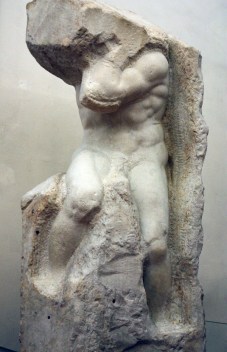
prisoner-atlasTwenty years ago – almost to the day – I was at the Galleria dell’Accademia in Florence, Italy, the museum that famously displays Michelangelo’s “David“. And while I was in awe of this 17-foot masterpiece, it was not his familiar form that stayed with me after I left.

It was this piece, known as “The Atlas”, one of Michelangelo’s four Prisoners done in the non-finito, or unfinished, style. To me, these seemed most representative of his philosophy about sculpture: that every block already contained the figure, he just had to chisel away the unnecessary marble. Some claim these works are the best representation of Michelangelo’s sculpting prowess, though this might not be immediately evident compared to the seeming perfection of David.

But you’re not here for an art history lesson, so let’s segue into the point for this post.

I left the museum with an understanding that Michelangelo revealed only enough of the figure for it to come to life (though whether a tour guide said it or whether I was brilliantly struck with inspiration, I’ll never know. Feel free to guess.). That thought has stayed with me for twenty years and it’s a philosophy that I’ve applied to my writing.

I love to write. I’m often verbose (this is one of the reasons I start each post with a message about word count – it keeps me in check!). If I could indulgently describe a scene or a character in a thousand lush words, I would. But I think that does the reader a disservice. I want to provide just enough detail to bring the story to life in your mind. If I write too much, well, I feel like I’m taking away too much of your imagination, which I think reduces a reader’s enjoyment of a book.

I’m not alone. In his book “On Writing“, Stephen King says something similar about his characters:

…if I describe [my complete mental picture], it freezes out yours, and I lose a little bit of the bond of understanding I want to forge between us. Description begins in the writer’s imagination, but should finish in the reader’s.

As an example, let me describe a mountain range at the edge of sight: its jagged outline and snowy peaks; the evergreen treeline that marks the highest point at which foliage can grow; or the treacherous recesses that are but dark wrinkles upon an ancient gray face. I could go on and on, depicting the clouds that obscured the tallest peaks or the shadows they cast upon the insignificant hills below, but there comes a point where your interest fades. You get it. There are mountains in the background. They are imposing and old and magnificent. You don’t need me to zoom in until we’re so close we can see the shiny flecks of mica in the granite.

Rockies 1

So here’s the deal: you bring your imagination and I’ll bring the right number of words, and we’ll meet in the lands of Empyrelia, each of us with our own vision of the world around us. Work for you?

A picture might be a thousand words, but you don’t need a thousand words to form a picture in the reader’s mind. Sometimes less is more. The successful writer finds the balance.

–Michael

Enjoy what you read? Leave a comment or like the post and we’ll ensure that you see more like this from Michael!

© Michael Wallevand, May 2016