12 Content Tips To Make Consumers Love You

I’m a product marketing manager by day, which means I spend a considerable portion of my time reading, writing, reviewing, editing, and giving feedback on content (judgment-free!). As such, I have regular opportunities to witness great – and not so great – ways of presenting written content to consumers. Sometimes of my own creation.

Here are twelve items that might help you with your content strategy, whether you’re marketing your book or a widget you sell. I originally assembled this list four years ago, and these tips are as true today as they were then.


1. Is your content bragging about your abilities and services?

  • Consumers want to trust you. But people are turned off by content that’s mostly sales pitch or just talks about how great your book is.
  • Quality content shows that you understand your audience’s needs, not just your own abilities.

2. Did you focus more on SEO keywords than quality content?

keyword stuffing, keyword stuffing and yes, keyword stuffing

  • As a writer and someone in the online marketing biz, this content stands out to me like Waldo in a penguin colony. It’s repetitive and reads like the writer just bought a thesaurus: Do you like to travel to exotic places? How would you like a vacation to an unexplored world? Here at Journeyman Travel, we can jet you off to distant lands! You’ll voyage to foreign countries in one of our exclusive Exotic Vacation Destination packages! That is a content turkey stuffed with artificially-flavored keywords.
  • To avoid unnatural-sounding sentences, write for humans, not computers. Quality content that engages people will build authority and trust, something that search engines reward. Learn more about Semantic Search.

Continue reading

Set Yourself Mysteries

epiphany

Epiphany

from Merriam-Webster

As happens to most of us, something profound occurred to me in the shower this morning. For me, I was thinking about my story. Not the first book I am writing, but the entire story. It was the kind of thought that made me end my shower, towel off quickly, and open my computer to write it down.

Here’s some context first, though I’ll be generic to prevent spoilers: I have a scene between two characters that is the genesis of their friendship. I like the scene because it imparts important information to both the reader and my protagonist, Tildy.

But there’s something else in the scene, a catalyst. It’s the thing that brings these two together, yet it also returns later with significant results. One of the characters even warns against it. Three books later, it fulfills this apparent destiny, devastating both Empyrelia and Tildy in the process.

How did I get there? Am I more architect than gardener, a writer who has a perfect plan in which all things are connected? No.

I set myself a mystery.

It wasn’t something I did consciously, yet I’m aware that I do it all the time. That was my epiphany: I had identified one key element of my writing style. I throw out interesting details, predictions, or other tidbits, which forces me to find a creative solution to explain why these things are important to the story. It also makes writing more fun because I love a good mystery.

I’m not talking about the main plot, however. This isn’t, Tildy needs to journey into the world, fight a heroic battle, and return triumphant – what does she fight? No, this is about smaller details, such as the witch wearing a pearl in her flyaway hair or Tildy not getting along with the birds in Dappledown (the first, I’ve solved, but not the second).

I’m certain this isn’t unique to me, though I can’t recall reading about other writers that do this. If this is new to you – cool! If you’ve read something similar elsewhere, I’d love to get a link to the story.

We can’t wait for inspiration, but if we put in enough time at the keyboard, I think we can find ways to summon it. If I can have fun doing it, too, then that’s a process that works for me. Hopefully, you can find those things that work for you.

Good luck with your writing!

–Mike

Postscript: What I also like about this epiphany is that it prepares me to give more satisfactory answers when people ask about my writing process. In my experience, “I just, uh, write?” is usually met with confusion or disappointment because people think I’ve discovered an ancient secret or something. I’ve just found some tools that work for me, and this is one of the better ones.


Enjoy what you just read? Leave a comment or like the post and we’ll ensure that you see more like this!

© Michael Wallevand, August 2019


Tighten Up Your Writing #7

I recently wrote about removing the word “now” from my manuscript. It wasn’t the first such word I’d targeted, but since it proved to be a popular post, I decided to dedicate another to the subject.

Removing unnecessary words

In my final edit, I’ve targeted about a dozen common words and phrases for elimination or replacement. While it can feel like extra work, it improves the manuscript and sets me up for less work in the next. Here are two of the more fruitful tasks I took on.

Then

  • Unlike “now”, which is a strange choice for past-tense sentences, “then” is usually implied or simply unnecessary.
  • It’s a word that often feels critical (Tildy ran up the stairs and then slammed her bedroom door), but it’s not (Tildy ran up the stairs and slammed her door).
  • While reviewing 277 instances, I cut about 200 unnecessary words and was rewarded with tighter descriptions.

do or do not

Try to

  • Just gross and passive and weak. Again, it often feels necessary (Tildy stood on her toes and tried to see).
  • Channel your inner Yoda here: Your characters do or they do not. There is no try (Tildy stood on her toes to see). If she can’t see, well, describe that!
  • I cut the instances by half. However, the quantity is less relevant: I have 60+ stronger sentences. This is why you do the work.

I also targeted “passed”, “past”, and “know”, which fit into the category of word variety. I was a bit embarrassed to discover their overuse. Fortunately, replacing them wasn’t much work once I put a little extra thought into it.

C’mon, you’ve got a vocabulary – use it!

I’ve been a writer for 20 years and it’s always been an iterative process for me: Write the thoughts quickly, organize the story, and improve my word selection. Over time, my usage of some of these words has declined, which means less rework. When it comes to editing, I’d rather spend more time on shaping the story and less on swapping words.

We’re here to tell tales, after all. Good luck with your writing!

–Mike

Click for more posts: Tighten Up Your Writing


Enjoy what you just read? Leave a comment or like the post and we’ll ensure that you see more like this!

© Michael Wallevand, August 2019

Difficult Choices #1

This post is approximately 550 words. It had been longer, but…difficult choices were made.

Phew. It’s been more than four months since I posted Tighten Up Your Writing #6. The final draft editing continues apace, which is the primary reason I haven’t been blogging.

Well, that and the Gears 5 Tech Test over two weekends in July.

Anyway, today’s update is about a choice I’d been debating a few months. Jack, aka Trusted Reader 16 and one of my most enthusiastic contributors, had given me the same feedback each time I provided new chapters: Some were too long.

He was right every time and I followed his suggestions.

After his latest round of feedback, I literally tallied up the word counts of every chapter and put them in a spreadsheet (hey, I’m a data guy).  A few hit 6,000 and two were on their way to 8,000. In most cases, every scene within a chapter was connected and followed a theme. I did my job well enough that the chapter titles fit all the pieces within.

And yet, those were some long chapters. I’d recently set a target of 3,000 to 4,000 words to keep the reading effort light, while also making it feel like the story kept moving. I was missing the mark. It reminded me of reading when I just want to get to the end of a chapter so I can take a break. Fortunately, I’ve yet to receive that criticism from my Trusted Readers.

I had a difficult choice to make. Do I break up the big chapters?

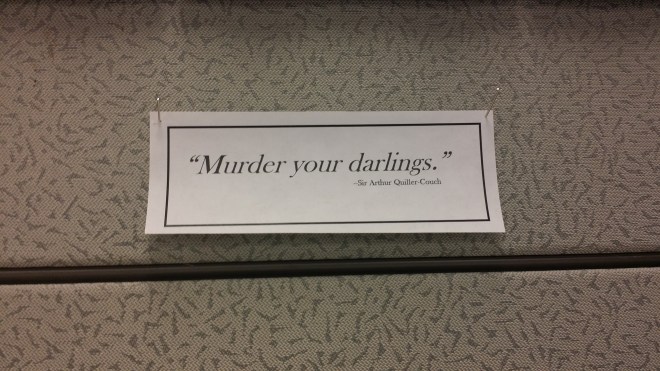
Murder your darlings

Continue reading

Tighten Up Your Writing #6

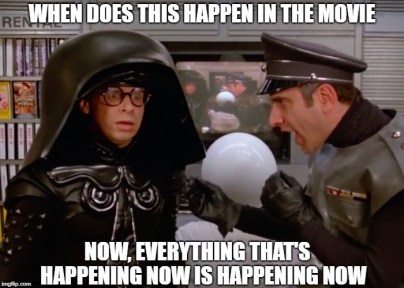
A 370-word post in which we realize that things in the past are not happening “now”.

Spaceballs now

Right after Christmas, I finished my mid-draft, which represents the complete book before I check for plot holes, inconsistencies, and other mechanical issues. It’s the first time I read the story straight through and it’s the first time I print out the manuscript to give it a thorough redlining.

I also use blue and green lines, and a yellow highlighter, so perhaps I need a new term.

It’s a time when you sit back and try to enjoy the story (I did!). This additional distance means you’re seeing things you couldn’t when you were nose deep in the writing (oh boy, did I!). I discovered my overuse of the word “now”, which is an odd writing choice when the verbs of the book are all past tense. If you’re not a grammar nerd, it’s the difference between “We walked now” and “We are walking now”.

After Control-F’ing the word (trying saying that in mixed company), I found far too many instances. I was using it as an unnecessary adverb, a way to transition into a new sentence, or as an awkward conjunction. Here’s a list of all the ways I used it. Continue reading

Asking Your Customers Questions

This quick post is approximately 350 words, and I typed it with one hand whilst eating a tasty quesadilla.

Fridays are quesadilla days at the Eagan Thomson Reuters office. I dig ‘em. On Friday, the chef was out of green onions, which was fine. As he was serving up my food a few minutes later, he asked me a question. Would I be interested in sautéed onions or mixed peppers as an alternative ingredient? Some days when he’s out of onions, he’s thinking about other ways to serve his customers. I believe my response was a dignified, “Oooh! Onions!”

20181221_123957.jpg

These two crumbs are all that remain. I even ate the to-go box.

He graciously thanked me for my feedback and we both went about our workdays. With that simple question, he found a way to solve a problem, while also improving the service he could provide to customers. For me, I like that he cared enough to ask my opinion, but I also get the satisfaction of influencing the deliciousness of a future meal.

Writers should have a similar mindset. True, much of what we do is for ourselves, and we have the right to be as selfish as we want in our stories. However, we also need to keep a portion of our brains on our readers. Our customers. That is, unless you don’t intend to have anyone read your story, which sounds like zero funs.

Readers have myriad desires when it comes to reading a book. They want to enjoy it. They want new experiences. They want to be surprised, but they also like to figure things out before your protagonist. Perhaps they want their spirits lifted after a long day or feel the melancholy tugs of nostalgia.

You don’t need a person to read an entire chapter or even a passage. It’s terrifying: I know (here and here). But it’s not very scary to ask a friend or family member, “Hey, what do you think if I did ____________ in my story?”

I believe you’ll find yourself pleasantly surprised by the experience. So will your trusted person.

–Mike


Enjoy what you just read? Leave a comment or like the post and we’ll ensure that you see more like this!

© Michael Wallevand, December 2018

Music and the Muse

This post is approximately 900 words, most of them song titles and artists.

Writers want to evoke specific emotions within the reader, which sometimes means you have to feel them yourself as you write. On those days when the Muse is with you, and She’s of generous mood, it’s easy. You’re typing as fast as thought, and you laugh or you cry as you experience those terrible, wonderful, breathtaking moments with your characters.

It can be draining. There’s an emotional, and often physical toll. It might even make you reconsider your next venture to the keyboard because you just don’t have the strength.

Sometimes, you need a little help. Or, Muse forgive me, other inspiration. For me, it’s music, although it can also be art, books, or even a stick. Heck, I write about it all the time – click for more posts that discuss inspiration.

But I digress. I often listen to music as I write, generally preferring songs without lyrics (i.e. movie soundtracks). However, when I need a stronger emotional inspiration, I put on some of these songs. I might even listen to one track on repeat, letting my mind drift into the story. Maybe I’m in the car; maybe I’m taking a walk. When I’m finally in the right frame of mind, I start writing. When it works, oh man, it works. When it doesn’t, well, it’s gotten me to the keyboard, and even a bad day of writing is better than one without any writing at all!

Without further preface, here’s a partial list. You’ll find love and loss, sadness and melancholy, anger, hope, and heroism. Maybe you’ll discover some new tunes, too!

Continue reading

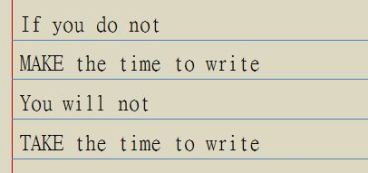
If You Do Not Make The Time To Write

This post is approximately 500 words, and it has something for writers and data geeks!

Make the time to write.JPG

The Summer of 2018, I started to get worried. I was 2 1/2 years and 170,000 words into the book. Writing wasn’t starting to feel like the all-consuming (in a good way!) thing it had been. I talked about this back in my October 1 Writing Update, and how I felt I was getting back into the rhythm. I had decided to make the time to write because I was suddenly aware that I hadn’t been. As you’ll see below, it still took some work.

This is going to sound weird, but sometimes I had to remind myself that I was writing a book. How does a person forget about 170,000 words? Sigh.

20181214_124744.jpg

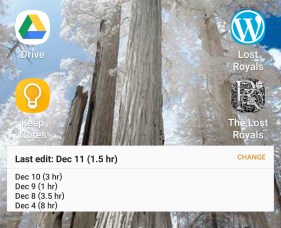
To fix this, I needed to 1) have a reminder and 2) shame myself a bit. A daily alarm or BUJO had had limited success: I’d just snooze away the reminder or turn the journal page. I’m a visual guy, and my memory is heavily dependent on reminders right in front of my face. In late June, I started tracking my daily writing in a notes widget on my phone’s home screen.  Now, several times a day, I could see how much I was writing. Or as was the case for a long time, how much I WASN’T writing.

Because I’m data guy, I turned my tracking sheet into a chart (but just for this post). Correction, an embarrassing chart. These are all the days my fingers were typing away. Continue reading

Writing Update – 3 Years In

Three years.

December 11, 2015 is more of a ceremonial date because I’m not sure how much writing I did at the start. Did I sit down and type, “Tildy sat up so quickly her head swam” – the first sentence of the first chapter – that first day? I don’t think so. I’m pretty certain I didn’t have her name yet. If memory serves, I started with the prologue, which has a boatload of too much historical context in it.

I recall thinking about a new direction for my story over the Summer of 2015. I started parts of it twenty-five years ago and I still liked much of the world I’d created. However, I needed to inject something into it: something to make it appeal to a broader audience and something to reinvigorate myself as a writer.

I wondered what kind of books the real world needed. It occurred to me that we could use more stories with empowered female characters, and they had to appeal to girls and boys. As simply as that, I was running, sprinting, in a new direction.

The writing came suddenly. One day I wasn’t writing; the next day I was.

superman_typing

Three years later, and more than a thousand hours of effort, I’m coming up on 190,000 words, which is about 100,000 more than I intended. I’ve also removed characters, places, and scenes to cut another 30,000 words. And I’m pretty sure I’ll have a bit more culling to do. Continue reading

Writing Exercise #8 – Whimsical Horror

This is post is approximately 650 words, many of them silly nonsense, but limned with a sinister tone, I hope.

I like fun and I like whimsy, and I like them mixed with horror. In the appropriate proportions, of course. Without the proper balance, a story is either too dark or too goofy. It’s something I’m managing in certain parts of my current manuscript.

I think this penchant comes from fairy tales I read in childhood. They’re cautionary stories, of course: stay in bed, eat your peas, don’t lie! They all promise horrible fates to children who fail in some regard. Take Little Red Riding Hood, who was devoured by a slavering wolf before a woodcutter sliced open the beast’s belly to free her.

In deliberate contrast to the horrors of the story, the pages often featured colorful illustrations of cherubic tots venturing obliviously into danger. After a few similar stories, we all knew something bad was coming, despite the innocence of the art. And we loved it. As kids, we were practically watching them through half-covered eyes, gleefully anticipating their demise as we imagined their chubby little legs carrying them toward certain doom.  Continue reading