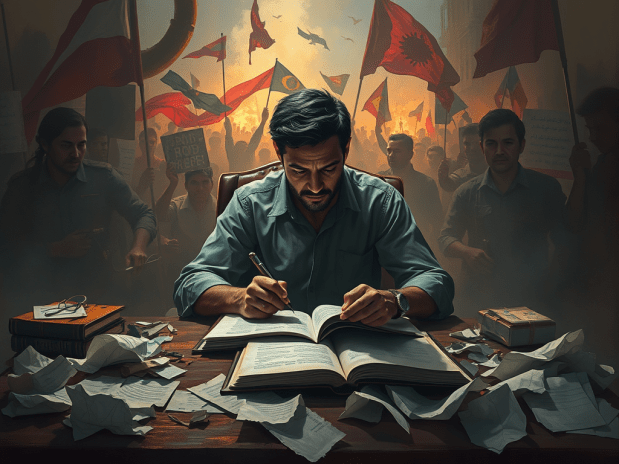
Writing Exercise – Say Meaningful Things

Writing Exercise – Say Meaningful Things

On May 25, 2020, a police officer murdered George Floyd, a suspect in his custody. As a reminder to Americans, we are all innocent until proven guilty in a court of law.

On May 26, peaceful protests began.

On May 27, peaceful protests continued. Eventually, rioters and outside agitators burned a Minneapolis neighborhood.

On May 28, I wrote this piece. Then I put it aside, unwilling to work further on such a heavy topic.

On November 20, 2024, I rediscovered it. I’m now sharing as part of my month of gratitude and my greater commitment to writing meaningful things.

Sometimes, there are no words.

You want there to be, but they fail.

You hope that you can say that genuine thing to alleviate someone’s pain.

Put an end to suffering.

Quell the madness.

Turns minds away from bigotry.

But there are no words

Tonight as Minneapolis burns.

The writer prides himself on turns of phrase

On vocabulary

On finding the perfect way to state a thing

But the practice, the tools, the tricks

They fail because there are no words.

A word typed

A thought, aloud.

These things are too small for a situation too large.

They are noise.

They are nothing.

Worthless thoughts shouted into the face of the heedless storm.

One day again

The words will come. But today, there are no words

Many of us are grateful that events like this are not part of our world, though we are too ashamed to say it aloud. We need to find our voices. The world becomes a better place when the meaningful things drown out the oppressors’ noise. Please take this encouragement to contribute your own meaningful things.

Thank you for reading. Hug your loved ones this holiday weekend.

–Mike


(C) Michael Wallevand, November 2024

Writing Exercise: A Day Bright and Full of Promise

It was time for the school bus. Following Benji, I stepped into a beautiful Autumn morning. As though someone spoke to me, this line popped into my head.

A day bright, and full of promise

I stopped in my tracks, my brain beginning to answer the question I no longer had to consciously put into words: “What happens next?” Even after so many years of writing, I continue to be surprised by the amount of creativity sparked by that simple question. Most notably, What if I paused my writing about the lost prince and started a female-centric story about his sister?

It’s a tip I use not only for writing, but in my office job, as well. “OK, we have an issue. What happens next? And then what?” And so on.

The following is about 2 minutes’ work. It’s a minor piece of writing, but I wanted to capture it because it helped inspire me. It’s about having days ahead of you that you want to spend writing. It’s the promise that you’ll create something worthwhile. It’s the power of positive thinking, if you will.

It’s Hope.

Continue reading

Sometimes you write a poem

I’ve always loved the idea of writing poetry, but I viewed my attempts as the equivalent of chopping at rocks with a chisel. I suppose this comes from reading so many things of beauty as a literate person who went on to study all kinds of literature in college. You feel a fool for even making an attempt.

However, a person walking through a museum never sees the thousand scrapped canvases that preceded the masterpiece.

I do not profess any particular skill in this medium, though like many writers, perhaps I make up with passion what I lack in other areas. Regardless, a man celebrating his wife on their 25th anniversary should be given a little grace, in my opinion. And so, here we are.

A breath, taken away

Not for a day

But forevermore

As I remain

Entranced

Within a love

I dared not dream

The years pass

Still, I am enamored

Both lost within a love

And found

A man, content

Never searching

Filled with incandescent joy.

Sometimes, you write a poem, and it flows effortlessly from the wellspring of inspiration and love. And usually, that’s more than enough. Happy 25th Anniversary, my love.

Mike


Enjoy what you just read? Leave a comment or like the post, and we’ll ensure that you see more like this!

© Michael Wallevand, October 2023

Only Some Came Back – Writing Exercise

I find it easier to write when I’m speaking from the heart. As the son of a Vietnam veteran, I believe it’s important to acknowledge Veterans’ Day, so I always feel an obligation to say something meaningful.

This year, it started with a simple thought: “some came back”. It came to me while contemplating the difference between today and Memorial Day, but was also inspired by sentiments my father has shared.

As often happens, a simple idea blossomed into something greater, a working piece entitled, “Only Some Came Back”.


Some came back, wondering why they returned so all alone.
Some came back, their bodies hardly whole.
Some came back, prisoners lately freed.
Some came back, with so many healing needs.

Heroes all, whether wounded, captured, tortured, or flesh unscathed.
Heroes all, though they would never, ever think themselves as brave
Or worthy to have lived when so many others fell in foreign lands.
Or worthy to continue in a world that cannot understand.

Backs bent, carrying the weight of comrades lost, of life post-war.
Hearts pierced by steel, by loss, by unfathomable gore.
Minds burdened by nightmares, grief, and shattered innocence.
Souls broken upon the fields of demarked happenstance.

It’s not a day for politics
Or the whims of money’s end.
It’s a day for remembering veterans,
The women and the men.


This piece took about 30 minutes to write. While it’s a work-in-progress, I’ll let this one sit for a time. It’s more personal than it might seem, and there are current political things that cut deeper than I care to discuss.

I share it as an example of writing outside my manuscript. Sometimes the work can be a drag, and creating things that bring you joy can help you get past them. And sometimes, it’s cathartic, too.

Mike


Appreciate what you just read? Leave a comment or like the post and we’ll ensure that you see more like this!

© Michael Wallevand, November 2019

Human Illumination – Writing Exercise

This post is approximately 450 words. Just a little something I wrote to see if I could capture my ideas.

In the city, there are lights to illuminate you

A thousand, a million

They cast you in their glows.

Others see you; you see yourself:

A combination of flaws and perfection,

Truths, and the lies that we tell ourselves,

That others interpret.

And while some lights go out, they are but few.

There are always more.

The darkness that falls upon you is scant,

If you are ever shadowed at all.

People never see themselves by the light of a single source.

And they never truly disappear;

Though perhaps they are never truly seen.

In the country, where there are fewer lights

A handful, a dozen,

Few and far between.

Defined as much by the darkness between them,

As by their shine.

Each precious in its illumination,

Though less stark in contrast,

And we all are deemed the same

In the same light

A single one extinguished has a meaningful impact

In what people see; how people see you.

You might lose yourself in the night,

Or reveal only those parts of yourself you wish didn’t exist.

And yet, when there is naught but darkness around you

You can see the brighter universe.

Take comfort knowing that light can never be extinguished,

And you will never truly disappear into the black,

Though it remains a reminder

That there are never enough stars to conquer the night.


Closer still, the horizon glow:

A welcome promise of light still existing.

Few or many, free to embrace.

They will shine upon us,

And we will be grateful to be seen,

Even if we do not always accept what we show.

This sprang up from the simple idea of using lights as a metaphor for people. We often see ourselves differently because of others. We might be surrounded by people, yet alone. The loss of people in your life could be more impactful, depending on where you live.

As a person who’s lived in rural America and her suburbs, I’ve experienced many of the things described above. If I may be so bold, read the text again and see if you recognize similar events in your own life.

The purpose of this post is not about wowing you with artistic imagery or showing off my poetry skills, diminutive as they are. I’m sure similar things have been created before. It’s an example of what can be done in about thirty minutes (including some minor editing and re-organization). Thirty minutes to exercise your writing brain. We all have time for that.

–Mike

PS: Click for more examples of writing exercises


Enjoy what you just read? Leave a comment or like the post and we’ll ensure that you see more like this!

© Michael Wallevand, August 2019

Writing Exercise #8 – Whimsical Horror

This is post is approximately 650 words, many of them silly nonsense, but limned with a sinister tone, I hope.

I like fun and I like whimsy, and I like them mixed with horror. In the appropriate proportions, of course. Without the proper balance, a story is either too dark or too goofy. It’s something I’m managing in certain parts of my current manuscript.

I think this penchant comes from fairy tales I read in childhood. They’re cautionary stories, of course: stay in bed, eat your peas, don’t lie! They all promise horrible fates to children who fail in some regard. Take Little Red Riding Hood, who was devoured by a slavering wolf before a woodcutter sliced open the beast’s belly to free her.

In deliberate contrast to the horrors of the story, the pages often featured colorful illustrations of cherubic tots venturing obliviously into danger. After a few similar stories, we all knew something bad was coming, despite the innocence of the art. And we loved it. As kids, we were practically watching them through half-covered eyes, gleefully anticipating their demise as we imagined their chubby little legs carrying them toward certain doom.  Continue reading

Celtic Christmas Poem

When I read ancient tales like Beowulf or the Odyssey, I like to consider the challenges faced by translators. It’s not simply replacing one word for another; in some cases, it’s also preserving the rhythm, often at the expense of what we’d consider ‘standard grammar’. Rhythm is a critical component of memorization, which was essential for stories that passed from mouth to ear, rather than by written page.

I kept that in mind when I wrote this poem in 2005. I put myself in the mindset of a translator struggling to capture the flow of some ancient chant. To me, it’s a combination of science and art, with the latter given preference. You’ll hear similar things in modern music, when the lyricist chooses rhythm over the rules taught in high school English.

Without further preface, my Celtic Christmas poem:


Come, my dear friends and do hearken
And sit by my fire for awhile.
For I am about to regale you
Of the Scourge of the Emerald Isle. Continue reading