Writing Exercise – Gratitude

It’s very easy in a job – in any job – to get hung up on all the things you’d love to change. Or to get dragged into negativity when simple commiseration with colleagues descends into toxic complaint sessions. Having worked in a wide variety of roles, including food processing, lab assistant, retail, and several corporate jobs, I can attest that it happens everywhere.

My work division (FindLaw, a part of Thomson Reuters) is being sold to another company, and the watercooler talk runs the gamut of perspectives and opinions, which means if we’re not careful, we could spiral into endless negativity. The stress is high, and many have an irrational fear of the unknown.

What’s helpful for me, and what I’m recommending to all my mentees, is a pros/cons list. It perhaps sounds cliché, but it’s still incredibly effective. While pay, merit increases, and advancement opportunities are important, they’re not the reason I stay with a company. For me, a flexible working schedule is paramount.

My younger son, Benji, has severe autism. Sleep is a recurring issue for him. Some nights, he’s just awake. He’s somehow powered through his nighttime meds and can’t fall asleep again. One night becomes two becomes a week or more. There’s a compounding effect to this, meaning some of his behaviors are worsened, which creates difficulties at school or elsewhere in public. There have been days where I have to drop everything and run to school to bring him home.

At a recent social hour at the office, several colleagues asked how our family was doing.

Continue reading


Writing Exercise: Chew.

Last weekend, we were at a park with Benji, enjoying the trails. He kept pointing and giggling, saying “Chew!”, which is his word for his Chewbacca. We didn’t have the stuffie with us, but this isn’t unusual behavior for him. After a few exclamations, my writer brain switched on.

What if he was actually seeing a figure that he mistook for Chewbacca?

A thrill ran through me, and only a little of that feeling was terror. Then The Idea came.

A heartwarming, family story that lies somewhere between Harry and the Hendersons and Gremlins, with a leaning toward the funny PG horror films of the 80s. Chew, which Benji names the monster after his Chewbacca character, is a tall hairy sasquatch kind of creature with an oversized mouth that makes the name “Chew” very apropos.

I worked out some details in my head as we walked. After my wife explained that they’d hidden Chewbacca at that park before and that Ben was remembering it, I shared my idea.

She told me I had to write it out. That means I’m on to something.

In about 2 hours, I had four and a half pages, or about 2,200 words. The work was divided into three parts. First, the treatment, which helped me set the scene, as well as describe the protagonist, whom I modeled after Benji. Second (and bulk of the writing) was the beginning of the story, and finally, a list of foreshadowing items, which any good horror story needs.

Here’s an excerpt from the treatment. It was important to me to show how Ben’s autism impacts the dynamic of the story. Also, representation matters. As Ben’s father, one my responsibilities is to help the world understand what it’s like to be him.

Benji is a young nonverbal teenager with severe autism. He loves stuffed animals and action figures, but his prized possession is a medium-sized stuffed Chewbacca he calls “Chew”. As this the case for many people like him, Benji repeats the known word over and over and again, occasionally adding a “rowr!” to bring his person to life. “Person” is the term his family uses for any stuffie or other character in Benji’s toybox. You see, for a kiddo with a limited vocabulary, you believe you have to choose your words carefully, often using broad terms to ensure comprehension.

Perhaps his family doesn’t give him enough credit for what he does understand, but they are doing the best they can. As is Benji, who doesn’t seem to mind, except when they are too dim to understand what he is communicating, which is a combination of gestures and repeated words. He might have to repeat “Chew” incessantly and with increasing volume to completely convey his message.

But thirty minutes of the word “Chew”, either resulting from playing with his person or because Benji wants something, can try the patience of even the most easygoing person, and Ben’s parents, while not angry people in their nature, do have their limits.

The treatment describes a bit more about the house, Ben’s brother, and some other details. I remember my typing picking up steam at this point, and the treatment suddenly transitioned into the opening of the story.

…Benji often sits at the window, clutching his Chew. Sometimes the Wookiee dances on the sill; sometimes he leans against the glass, staring into the woods with his person, Benji. “Chew” and “rowr!” are usually repeated frequently. Today, there is a new level of urgency, as Benji sees a tall shaggy figure at the forest edge that he thinks is….

Continue reading

Waiting is the hardest part

We’re sitting in Children’s Hospital this morning while our son Benji has a heart procedure. As medical procedures go, especially ones concerning your child, an invasive cardiac electrophysiology and ablation is relatively straightforward and routine.

And yet, it’s a medical procedure involving the heart. Of your child.

It’s a hard thing to watch him wheeled away, even when you have absolute faith in the medical staff. It feels impossible to let him go. And yet, you do.

Then you sit. Then you wait.

And wait and wait.

I thought I might play games on my Steam Deck to pass the time, either some brainless distraction or immersive experience, but my wife wisely suggested I try writing instead. So, I brought the laptop and left the Deck behind. An easy decision, I had hesitation, nonetheless. You see, writing has been hard for the last, hmmm, 18 months or so as stresses piled upon each other. I was out of practice and easily distracted.

As we sat in the waiting area, I set my phone aside and opened the laptop. I’d recently started an alternate prologue for Tildy Silverleaf and the Starfall Omen that brought the reader into the action sooner. The approach was more Show and less Tell, and based on feedback Trusted Readers had provided, I thought it would be better received. As I read through rough paragraphs, the visuals resurfaced in my mind. Perhaps it is more accurate to say that I submerged into the world I’d created.

And I wrote.

Continue reading

Fourteen weeks and fourteen years

Autobiographical account of our son, Benjamin. Writing can help process things that we struggle to verbalize.

Ben remained in the hospital fourteen weeks after his birth.

To save his life, he was delivered ten weeks early, becoming an April baby instead of the June one we’d anticipated. I’ve never seen so many medical machines in my life, but neither had I fed a newborn with a syringe nor seen a nurse cry for another family. In that time, trauma flourished and threatened to overwhelm a love and joy we thought we’d have.

It seemed like an eternity – no, scratch that. An actual eternity passed as we watched him cling to life in that time, hardly able to hold the baby we were desperate to protect.

10 weeks premature and living in a protective isolette, Benji squeezes Sam’s finger, the 9-year-old big brother who grew up a lot after that.
Continue reading

Writing Exercise: Sometimes You Climb

A note to our son Sam, as he’s training to be a climbing instructor at Scout camp. I share it here because it was too long to text. Pfft, writers.

Sam,

I know you had your eyes set on the aquatics director role and how you were disappointed when circumstances beyond your control prevented it from happening this year. However, when I heard you were moving to the rock wall, I thought, ”Now THERE is a role that perfectly suits Sam.”

And so, if you’ve forgotten how much you loved climbing as a kid, I wanted to share three climbing-related moments from your life.

The first happened when you were three, which would have been the Summer of 2003. You were playing in the backyard, and me, still a relatively new parent, assumed you were safely contained by our six-foot stockade fence.

You weren’t. When I opened the front door in response to a tiny knock, you stood there, smiling and oblivious to any of the thousand perils my worried parent’s mind instantly conjured, not least of which were the dangers of traffic or falling onto the concrete pad. To your mind, an obstacle three times your height was a trifle. And a fun one.

Continue reading

The Nonverbal Kid’s influence on my writing

My younger son, Benji, is nonverbal and autistic. I don’t share it much because one of my primary responsibilities is protecting his dignity and privacy. And it’s usually not relevant to this site. But like any person important to you, his influence is always there in my writing, nevertheless. In this post I’ll share one of the ways my craft has changed because of him.

Ben has a limited vocabulary, though his communication includes expressive gestures and sounds, not just words. In talking to us (people who clearly are too dim to understand), he’s practically speaking three languages, and often, more than one at a time. It’s not his problem when we can’t figure out the translation; it’s ours.

To an outsider, however, it might create an uncomfortable situation. Not because that person is a bigot who despises neurodiversity, but because they are walking in unfamiliar territory. I liken it to me meeting a Black man for the first time (in my memory, he looks like actor Brock Peters in his Star Trek days). I was just a little kid, terribly shy around strangers, and before me stood a person so completely unlike every person I’d known in my secluded little rural town. At least, that’s the lie your brain tells you. In every aspect that I could see except skin color, he was like my neighbors.

I hadn’t been taught to hate or even dislike Black people; I just had some unintended bias to push past because my world was filled with people who looked like me and had basically the same beliefs and ancestry.

It’s one thing to know there are a variety of people in the world. Seeing them is another. Further still, interacting with them changes your perspective in significant ways. Watching Black people on TV wasn’t the same as meeting them. And meeting one certainly wasn’t the same as having people like him in my daily life.

I choose to believe the same lack of experience is true for people who aren’t sure how to react around Ben. It could be uncomfortable at first, but the smallest effort by them can overcome that. I don’t think they can do it alone, however. As Ben’s father, I believe one of my responsibilities is to help people with this, which also helps him.

Now, I grew up as a Boy Scout and I’ve always cheered for the underdog. I’m predisposed to helping others and recognizing those who are disadvantaged. But there’s a distinction between that and being an advocate. Believe it or not (sarcasm), there’s a difference between adding a rainbow frame to my Facebook picture and standing up to LGBTQ bigotry when people post it. Advocacy requires deliberate action, and I can help by leading through example, by sharing posts like this, and by injecting it into my books.

Continue reading

Power of Words: Also

Words have power. It’s a simple enough concept, though perhaps underappreciated or downplayed when compared to fists or guns. That said, each of us has emotional reactions to words, whether a Shakespearean play, a political speech, or the handwritten note in a birthday card. And therein lies the control they have over us.

Many of us have heard as children, or said as adults, “Sticks and stones may break my bones, but words will never hurt me.” It’s a comforting lie that both parties believe because it makes the problem go away. At least for a little while.

If you’ve ever been the victim of slurs, whether racial, sexual, or gender-based, you already know the power of a single word. For those of us who haven’t, we can appreciate the impact of a good F-bomb, though that doesn’t tend have the same power as the examples of above.

Additionally, as I recall important events of my lifetime, there is considerable power in certain words, such as “marriage”, “Black”, “abortion”, “conservative”, and “liberal”. Just post a social media update that includes one of these to remind yourself of that.

I’m of the belief, however, that there is power in any single word – important or not – depending on the context. Which is why I’ve chosen “also” as my topic for today.

The aforementioned subjects are of great consequence to our world, and I am not suggesting that a linguistic discussion about a common adverb is of equal concern. Rather, I hope to demonstrate how something insignificant can change the tone and intent of any conversation.

I mean, come on, we probably give it no extra thought in writing, reading, or speech. In many cases, we could rewrite it out of a sentence and the reader wouldn’t know the difference.

  • We should get groceries and also pick up vacuum bags.
  • We should buy groceries and vacuum bags.

But that’s a minor application compared to its role in the following examples.

I would also like the right to vote.

I am his parent, so I also need custody of my child.

I would like my culture’s history also studied

I would like my child’s gender identity to also be respected

I would also like to practice my religion

In those examples, “also” plays a more powerful part. It leaves no doubt that a person is requesting an addition to an established practice or point of view. It speaks to inclusion and acceptance. Said another way, it suggests that we have room to grow: Here is where we are today, and this is where I’d like to go so we can be equal or have a mutual understanding.

And it has power not just for the person saying those things. When it comes to arguments against these concepts, “also” seems to have been mistaken as an outrageous synonym for “instead of”.

Continue reading

Privilege in a time of chaos and injustice

I live in a Minneapolis suburb, though I am far enough away that I cannot see the smoke. I cannot hear the protests. My sleep is not disturbed by the sounds of gunfire and sirens. While the murder of George Floyd has angered me, I have been separated from the cacophony of a world aflame.

I have felt helpless and rooted in place, and it has forced some introspection. I know I do not truly understand the emotions or thoughts of the communities affected by this murder. So I have been listening. As I hear the anguish, the powerlessness, the frustration, and as I read what it’s like to fear a similar fate as George Floyd, I have been reminded that I have lived a privileged life compared to many people in my country.

A decision lay before me: to live within the comfort and protection of my privilege or to use it for something positive. I chose the latter.

I took what I heard and wrote this.

***********************

I am not black.

I am not of eastern Asian descent, nor Slavic or Middle Eastern, nor a member of most of the other wonderful ancestries that humans are blessed to have.

I am not Muslim, nor a member of any of the non-Christian religions that bring people comfort across the world.

I am not female, nor any of the other genders we are discovering in our DNA.

I am not gay, and I do not fit into any of the sexual orientations that close-minded people refuse to acknowledge.

I am not missing any of my five senses or four limbs. My brain doesn’t process the world in a way that requires additional interpretation.

I’ve never been impoverished or homeless.

I am a straight white male living in America and there are very few words that we use to modify that description. We live in a country that must label people to remind them they are different than a particular type of person – that they are other. That they do not have my privilege.

I recognize that in the United States, I have more privilege than all of these wonderfully different ways to be human.

Continue reading

Let’s get kids to love stuff

man dangling noodles into his mouthWe got a text from our neighbor this morning. His daughter loves to cook (she gets it from him) and was enthused that we were enjoying the things she made. They both like to share, and my wife often makes something in return. Here’s what the text said:
Her response to you using her frosting: “Yay! That makes me happy! Let’s make big fat noodles next, everyone likes noodles.”

As you might expect, my response was encouraging, and not just because I really do like big fat noodles. I saw that she loved cooking and I never want her to lose that passion. Simple as that.

As a parent, it’s not that hard to recognize the importance of helping your child find something they like, and then foster a love of that within them. It’s not just about developing a relationship with them, but it’s about helping them find things that bring them joy and might guide them their entire lives. This morning, I was reminded of the important role that adults – not just parents – play here. Continue reading

A Stick and a Story

This post is approximately 450 words – my interpretation of a child’s imagination.

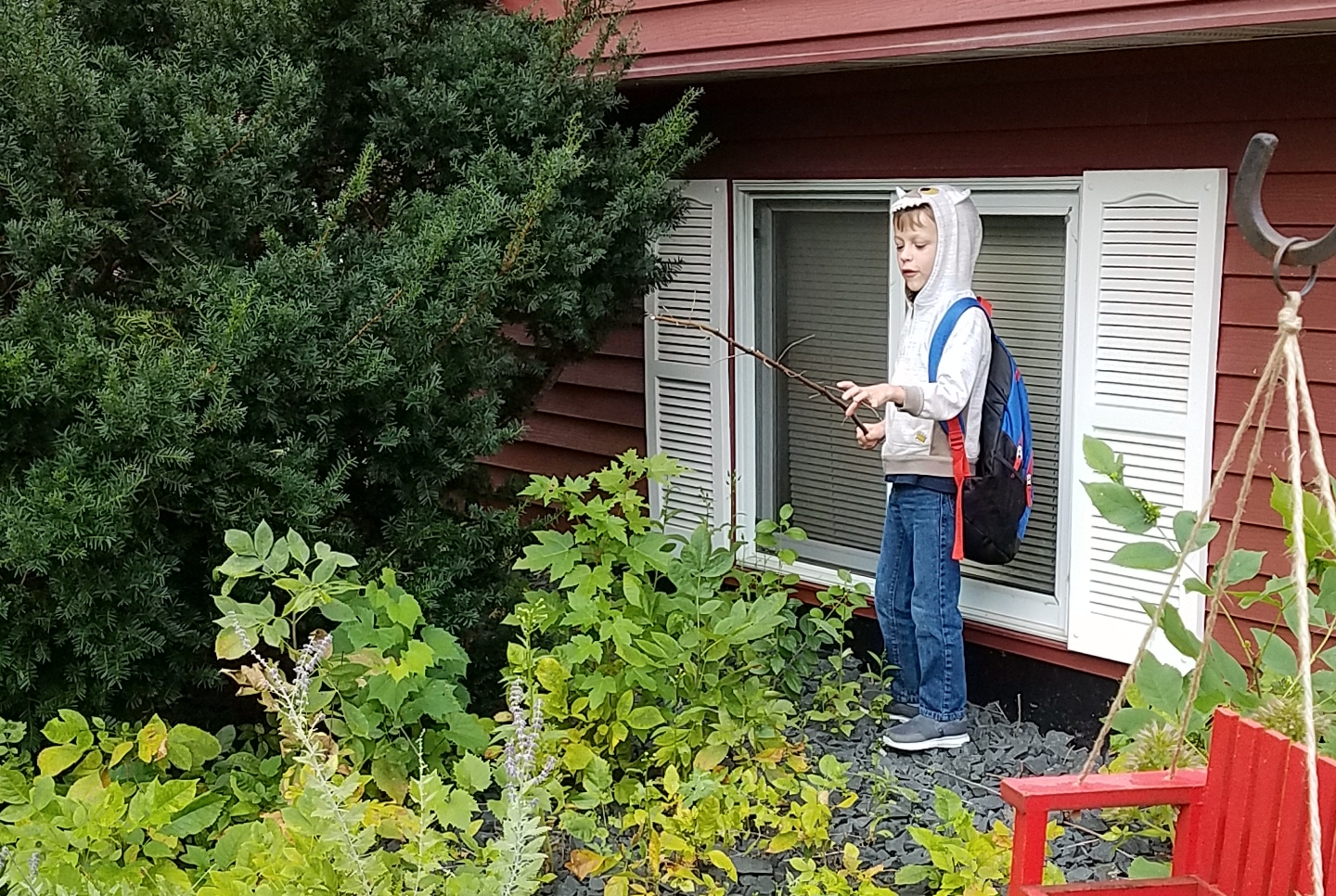
As we waited for the bus the other day, our son Benji picked up a stick and brandished it. He’s non-verbal, but I could tell by the look on his face that he was suddenly going on an adventure. Like millions of kids before him, this simple act transported him from our world to another, turning him into an explorer, a hunter, or a hero.

20170907_191407

Divine providence signified that Ben was to carry Excalibur. That is why he is your king.

The same was certainly true for me. Like many of my generation, I remember playing lightsabers as a kid. As soon as you picked up the perfect stick, you were transported to the hallway outside docking bay 327 on the Death Star: one of you was Obi-Wan; the other, Darth Vader. Good and evil didn’t matter because YOU WERE IN STAR WARS. (Sidebar: Once, I made the mistake of acting out Kenobi’s sacrifice, which resulted in a painful whack across the arm. I still enjoyed my time in a galaxy far, far away, even if I didn’t disappear amongst crumbling robes.)

20170907_080538-1

Like Lucy Pevensie passing through the wardrobe, Benji emerged from the bushes into a strange new world.

It’s times like these when you realize magic is real. Like a portkey, a simple catalyst was all it took to transport you to another place, introducing you to new people and new experiences. It could be wearing a cape like Superman, holding a flashlight like the Hardy Boys, or sliding into the open window of a car like one of the Dukes of Hazzard.

Writing a story is very much the same. You’re looking at the mundane or the unusual in your everyday life, trying to find ways to send readers to places strange and wonderful. Maybe it’s a twisted tree or a distant hill or a scent carried upon the breeze. The point of inspiration doesn’t matter in the end; it’s the resulting idea that counts. If you’ve done your job as a writer, it should be as effortless for the reader as picking up a stick.

20170907_191510

The school bus calls for an end to the adventure.

Being carried away by your imagination is an amazing power, and I think writers need to feel the magic contained within sticks more often. At the very least, we’re transported back to our fondest childhood memories; but at best, we’re inspired to get back to the writing.

Now if you’ll excuse me, I’m going outside to pick up a lightsaber.

–Michael


Enjoy what you just read? Leave a comment or like the post and we’ll ensure that you see more like this from Michael!

© Michael Wallevand, September 2017