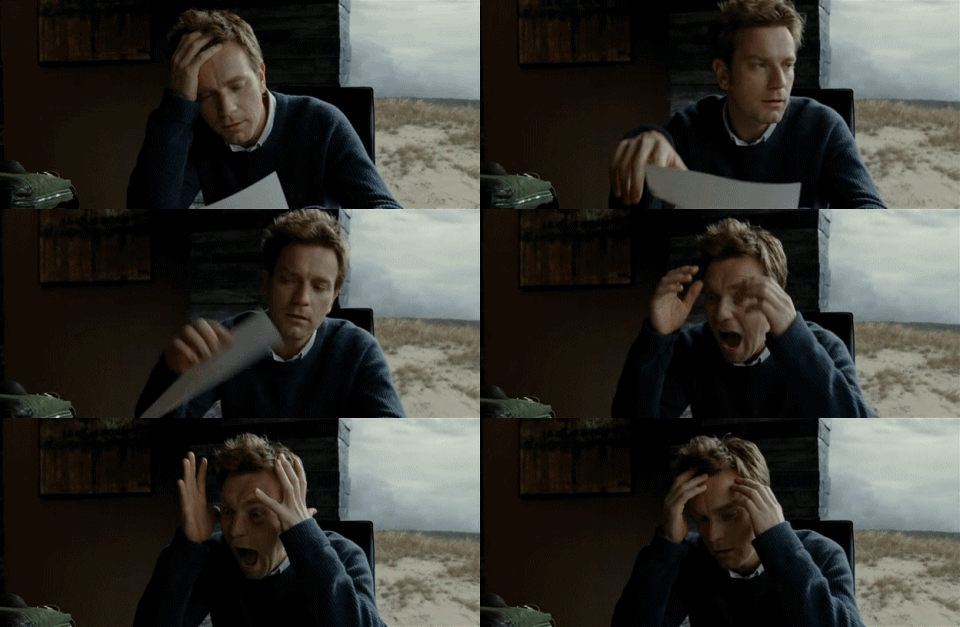
Oh sweet Inspiration, I pledge my eternal lov–hey, where are you going?

This post is approximately 500 words.

Writer's Block 1.gif

I’ve spent enough time staring at blank computer screens and empty notebook pages to know that sometimes Inspiration is nowhere to be found. It also means that I’ve taken the time to develop some tools that help me coax her out of hiding. In this post I write about banking some of that Inspiration you have on Writing Day 1 to ensure you have some left when you return to the story on Writing Day 2, 3, and beyond.

I’d like to think that anyone who has done a little writing has felt the electric spark when the Idea comes Continue reading

Tighten Up Your Writing (or not?) #4

This post is approximately 400 words.

calvin-resolutionsIt’s the first day of a new year, which generally means resolutions and other pledges of life changes, blabbity-blah. I usually don’t hold to such traditions, uh, mostly because I forget my New Year’s promises before January ends. But as an idea formed in my head this morning, it occurred to me I might be writing such a post.
Yes and no. This post does contradict other guidance I’ve given about reducing words during a rewrite. But as with most other advice in life, just because you CAN do something, it doesn’t mean you SHOULD. Forsaking context or intent for the sake of brevity is an excellent way to deliver a quick read that readers misunderstand. That’s why I’m going to show the other side of word reduction. Continue reading

Writing Update: December 21, 2016

This post is about 650 words. 

It’s been a heckuva writing year.

snoopy

As 2016 comes to a close, I realize that another milestone recently passed: one year since I sat down at the keyboard to start writing again. REALLY writing, not just short notes or simple ideas that, if I’m honest, were never going to amount to anything until I took the process seriously.

I really hadn’t been taking the process seriously. Well, not for awhile at least. More than ten years ago, when the dark realities set in, I set aside another novel that I’d been writing tinkering with for years and years, starting back when I was a naïve, fresh-faced college grad with fantasies delusions about the Great American Novel. I had reams of paper manuscripts and files of all the important nouns (people, places, things). But along the way, I lost the spark. Or I became a glass-half-empty guy. Or family and work and life took priority. I stacked up a number of obstacles before myself and simply decided to get off the path: I returned to the road more traveled (apologies to Robert Frost).

That was a damn shame Continue reading

Tighten Up Your Writing #3

This post is approximately 400 words. There’d be 25% more, if I hadn’t…tightened up my writing. Yeah, that’s right: bad jokes and math on this writing blog.

Many of the writing questions I’m asked are in the category of “Where do ideas come from?” which usually elicits a response about “mommy and daddy ideas that love each other very much.”

But I also get quite a few inquiries about mechanics, which to this grammar nerd, is pretty cool. We can all put words on paper in a coherent order, but it’s challenging to do it crisply and succinctly. Especially the first time.  I rarely deliver a sentence that completely satisfies me after the first writing.

kneading

It’s like making dough: you can put the ingredients together, but if you don’t massage that lump, it’s not going to taste right. As someone who’s reviewed thousands of pages, I know that many people are satisfied with the lumpy dough of first drafts. I get it. There’s that impatience factor. But just as people are discriminating about pizza joints, so they are about books. They’ll stop coming for sub-par sustenance.

Not stopping at one draft is the key. The following examples demonstrate various ways to change up your thinking as you work through the editing process. Compare my lumpy messes to the dough I’m putting in the oven (he said, reconsidering his analogy). Continue reading

Writing Update: December 4, 2016

This post is about 350 words. 

kermit writing.gif

It’s been about three weeks since my last writing update, where I mentioned that I’d uploaded the first two chapters to this website. Since then, I’ve finished up* the next three, though I’m not sharing them yet.

*As always, when I say, “finished up”, there’s a big disclaimer about reserving the right to go back and tweak them as needed. Or to change things based on revisions to later chapters. Or to fix things that have woken me in the middle of the night. Or when I realize I’m having the same delusion as Ralphie in A Christmas Story.

OK, so rambling aside, I’m satisfied that FIVE chapters are ready for reading. They have cohesion and flow, and each considers the length of the ones before (i.e. I don’t have a 3,000-word chapter followed by one that’s 10,000 words). They have transition and connection to each other, so they are no longer five separate pieces. They feel like the first act of a three-act story. And that’s about 20% of the book completed, which feels pretty good. But….

Continue reading

Building Blocks of Imagination

This post is about 400 words. 

I’m at my parents’ house for Thanksgiving, sneaking in whatever writing time I can in a house with eleven people, two dogs, and more leftovers than any one fridge could contain. Despite these distractions, I’ve spent enough years writing that I have some tricks for keeping the creative fires warm. Right now, I’m sparing some time for a post that serves as writing analogy and inspiration for building creativity in your children.

Last night, our youngest son Ben brought out the blocks I played with as a child, and suddenly I was writing this post in my head as I built with him.

20161126_115336.jpg

My maternal grandfather made these blocks for me using 2x4s and some leftover paint. The basic blocks looked like this, though there were other lengths, too. With these, I could construct walls and forts and many other things as I played with my Star Wars figures.

But it was the oddballs that truly fueled my imagination. Call them scraps or discards, many would consider these pieces worthless. Clearly, my grandfather did not agree. Nor do I.

20161125_201638.jpg

Continue reading

Writing Exercise #3: Halloween Rhymes

This post is approximately 500 words. 

The following verse represents about an hour’s worth of work, which means it’s not highly polished, yet I still managed to work in rhyme and rhythm with minimal effort.

However, if you’ve ever written a verse in rhyme, you know that sometimes it requires a ridiculous commitment to the style. For me, I usually get about three-fourths done before I start to question my decision. It comes around the time I think, “I need a rhyme for itch: ditch, Fitch, hitch, kitsch, liche, Mitch, niche…” Then comes the expectation that the audience will find the verse absurd because stylistic compromises were made just to get a rhyming word in.

Well yeah….sometimes.

But that’s fine. In a writing exercise, you’re not seeking art or permanence. You’re chasing the muse, curious about where she leads. It’s almost disposable writing, which is not to say it’s worthless. To the contrary, it very well could end up in a finished work. But again, that’s not the point. The goal, the real objective, is to keep your writing tools honed. This makes your daily manuscript work easier because you’ve kept your mind sharp.

In the spirit of the Halloween season, I hope you can enjoy this little cautionary tale, written in the style of old nursery rhymes. Continue reading

Moving Full Speed At The Starting Line

This post is approximately 500 words.

As a writer, I’m continually looking for ways to say things differently: more concisely, more interestingly, and perhaps most importantly, in a way that you haven’t read before.

cartoon-elephant-skating-rollers-25462068.jpgOne of the more enjoyable ways to accomplish this is using analogies, a sometimes challenging exercise because a bad analogy will fall on its face like an elephant on roller skates.
Good, you’re still with me, despite what I just did there.

In the process of writing this book, I’ve found a new method to be more productive when I sit down at the computer. But before this morning, I didn’t have a way to convey it to others, at least not a satisfactory (i.e. interesting) one.

I suspect many writers are like me in this regard: we want our typing fingers moving top speed the moment we sit down to write. But – he said with a smile at this understatement – it’s hard. Ridiculously so on some days. Much time is wasted staring at the screen or typing the literary equivalent of “Me am good writer who tell good story.” As much as I despise the word can’t, sometimes a person can’t just sit down and start writing. Continue reading

Footsteps and raindrops

This post is approximately 350 words, some of them onomatopoetic.

img_20160424_133418.jpg

Life in the asphalt stars

I usually walk the dogs with music playing through headphones. One morning, as mist hung heavy upon the air, I decided to go without.

Diffuse light made determining the direction of the sun impossible, yet every tree, house, and bird enjoyed the kind of perfect illumination that sent photographers running for their cameras.

As I entered the park, and the maudlin noise of suburban life faded away, footsteps and raindrops the only sound to hear.

The split-splash, split-splash of soft dog paws in shallow puddles.

The sploosh-splush of my larger feet, the second step muffled by ripples from the first. Continue reading

Too Many Villains

This post is approximately 600 words.

In this post, you get to travel far down the rabbit hole. But instead of landing in Wonderland, you’ll land in the writer’s brain, a place as equally crazy and confusing.

rabbit hole.gif

As the title implies, I’ve got too many villains in my first book. At least, that’s the perception readers will have. If I’m careful enough – write well enough – I can prevent them from thinking that, but it’s complicated because I don’t want a simple black-and-white story.

In the mix, some win, lose, die, or are redeemed. Some characters might even be more than one of the following:

  • the antagonist of the entire series
  • the lieutenant – the character that does the bidding
  • the manipulator – the deceiver
  • the baron – the non-supernatural foil
  • the monster – in a traditional story, the dragon to be slayed
  • the foot soldiers – cannon fodder

For characters that come and go, interwoven amongst each other’s storylines within a twisty, turny story, it will be easy to lose my readers. In working through the second draft, I find I’m already there. Continue reading