Author’s Journal – 11-25-19

Journal Entry #3. The Muse is withholding all inspiration until I write another update.

It was a tough writing weekend. Not that I didn’t know what to write. I knew what I had to write; I just didn’t know which words to pick.

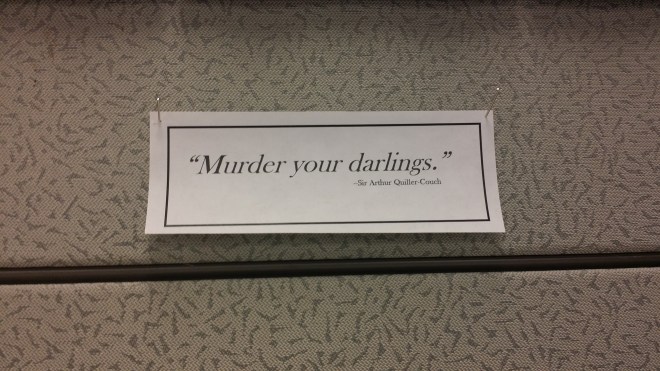
1. I spent time on Saturday and Sunday working on a query submission for a local agent. It requires a pitch, synopsis, and other pertinent info. The challenge is in the distilling of 188,000 words into a couple hundred. It’s a great exercise, tbh. It forces you to hone in on the core idea of your story. But…..it’s damn hard, perfectionist desires aside. I’ve spent my adult life editing, dabbled in the restrictive word count of flash fiction, and write with the “Murder your darlings” philosophy. And still I struggle to rein in the information overload.

It comes down to the old saying, “I didn’t have time to write you a short letter, so I wrote a long one.” Being succinct is tough, and I get why agents push for it.

Prince Super Bowl performance

2. Monday night, I tinkered with the finished manuscript, like a naughty author. Continue reading

Author’s Journal – 11-17-19

Hey, a second entry in a weekend. Doesn’t make it a trend.

Anyway, I worked on three things Sunday.

1. Wrote the first journal post, capturing the work on Nov 15. Happy with it.

2. Started researching literary agents. Since the process will take months, I might as well start while I’m picking at the last nits in the completed manuscript. I found two agents (in researching twenty) that feel like good fits. One isn’t accepting queries; one is.

3. Started writing my query letter. It’s been years since I’ve submitted one. However, since my past inquiries were for children’s picture books, I’m starting from scratch. Not planning to use the old ones for reference. I’m partway through, and taking a break to type up this quick post.

So, it’s 10:30 on a Sunday night as I wrap this up, though I won’t have it post until the morning. I’m not expecting many readers at this point in the evening. Hopefully, this found you during your morning coffee.

Good luck with your writing!

Mike


Enjoy what you just read? Leave a comment or like the post and we’ll ensure that you see more like this!

© Michael Wallevand, November 2019

Author’s Journal – 11-15-19

This will never last.

Because I know myself.

There are people who sing the praises of journaling, but I’ve never been able to maintain a diary or similar collection of thoughts. Oh sure, the desire is strong at first. When it becomes work, however, when I’m trying to make time or backfill missed entries, well, then it’s a hassle.

And free time doesn’t get spent on hassles.

With that encouraging preface, I push onward, nonetheless. At the very least, it will amuse me – and perhaps interest you – while it lasts. It’s my intent to keep these simpler and lighter-weight than other blog posts, in which I try convey some interesting update or learning I have had about writing a book. I generally try to edit them for length, content, and grammar, and while the result is more polished, they take time away from other things in my life. For these, I’m looking to knock out a quick post, straight through, with no rewrites and few edits.

Let’s see how it goes.

Friday, November 15, 2019

1. I’m listening to The Name of the Wind by Patrick Rothfuss on Audible. I’ll use a future post to gush over it, but as often happens while I’m reading, listening, or watching, I got inspired.

The particular scene included the lute of the character’s father. It made me think about a combining of magic and music, and how might a culture use that for things beyond everyday tasks or entertainment. What if the culture developed an interweaving of art into things like defense or warfare? Of the kinds of art in the world – music, sculpture, painting, etc – what if the people maintained their love and awe of these things, yet used them in practical ways? What if they did these things only because they had to or what if these things were incorporated because they were viewed as another skill, like smithing or bricklaying?

I got to work, wrote a few paragraphs about two cultures’ different approaches, and I added the detail into the appropriate books. Book 2 for the Prince and Book 6 for the Princess. Sorry for the tease. Continue reading

A Good Word Is Hard To Find

fun fact - the word setI’m an English major and a writer, which means there’s a notebook on a dusty bookshelf in the attic of my brain that is set aside for fun words. It also means I just wrote a long sentence instead of saying “I collect words.” We’ll delve into that compulsion in a future post.

I was listening to an online session yesterday and one of the presenters used an interesting word I hadn’t heard before. She used it twice, before finally defining it for us with an apology that she had to look it up, too.

What is the word? I couldn’t tell, which meant it was complex, rather difficult to say, esoteric, and oh so tantalizing.

In her context, it meant temporarily joining another team at work to complete a project. She still technically worked for the same manager, but all her duties were tied to this second team.

Since I love words (did I establish that?) and since I couldn’t spell it to write it down, I thought to Google it by the definition this morning.

Easier said than done. Continue reading

12 Content Tips To Make Consumers Love You

I’m a product marketing manager by day, which means I spend a considerable portion of my time reading, writing, reviewing, editing, and giving feedback on content (judgment-free!). As such, I have regular opportunities to witness great – and not so great – ways of presenting written content to consumers. Sometimes of my own creation.

Here are twelve items that might help you with your content strategy, whether you’re marketing your book or a widget you sell. I originally assembled this list four years ago, and these tips are as true today as they were then.


1. Is your content bragging about your abilities and services?

  • Consumers want to trust you. But people are turned off by content that’s mostly sales pitch or just talks about how great your book is.
  • Quality content shows that you understand your audience’s needs, not just your own abilities.

2. Did you focus more on SEO keywords than quality content?

keyword stuffing, keyword stuffing and yes, keyword stuffing

  • As a writer and someone in the online marketing biz, this content stands out to me like Waldo in a penguin colony. It’s repetitive and reads like the writer just bought a thesaurus: Do you like to travel to exotic places? How would you like a vacation to an unexplored world? Here at Journeyman Travel, we can jet you off to distant lands! You’ll voyage to foreign countries in one of our exclusive Exotic Vacation Destination packages! That is a content turkey stuffed with artificially-flavored keywords.
  • To avoid unnatural-sounding sentences, write for humans, not computers. Quality content that engages people will build authority and trust, something that search engines reward. Learn more about Semantic Search.

Continue reading

Set Yourself Mysteries

epiphany

Epiphany

from Merriam-Webster

As happens to most of us, something profound occurred to me in the shower this morning. For me, I was thinking about my story. Not the first book I am writing, but the entire story. It was the kind of thought that made me end my shower, towel off quickly, and open my computer to write it down.

Here’s some context first, though I’ll be generic to prevent spoilers: I have a scene between two characters that is the genesis of their friendship. I like the scene because it imparts important information to both the reader and my protagonist, Tildy.

But there’s something else in the scene, a catalyst. It’s the thing that brings these two together, yet it also returns later with significant results. One of the characters even warns against it. Three books later, it fulfills this apparent destiny, devastating both Empyrelia and Tildy in the process.

How did I get there? Am I more architect than gardener, a writer who has a perfect plan in which all things are connected? No.

I set myself a mystery.

It wasn’t something I did consciously, yet I’m aware that I do it all the time. That was my epiphany: I had identified one key element of my writing style. I throw out interesting details, predictions, or other tidbits, which forces me to find a creative solution to explain why these things are important to the story. It also makes writing more fun because I love a good mystery.

I’m not talking about the main plot, however. This isn’t, Tildy needs to journey into the world, fight a heroic battle, and return triumphant – what does she fight? No, this is about smaller details, such as the witch wearing a pearl in her flyaway hair or Tildy not getting along with the birds in Dappledown (the first, I’ve solved, but not the second).

I’m certain this isn’t unique to me, though I can’t recall reading about other writers that do this. If this is new to you – cool! If you’ve read something similar elsewhere, I’d love to get a link to the story.

We can’t wait for inspiration, but if we put in enough time at the keyboard, I think we can find ways to summon it. If I can have fun doing it, too, then that’s a process that works for me. Hopefully, you can find those things that work for you.

Good luck with your writing!

–Mike

Postscript: What I also like about this epiphany is that it prepares me to give more satisfactory answers when people ask about my writing process. In my experience, “I just, uh, write?” is usually met with confusion or disappointment because people think I’ve discovered an ancient secret or something. I’ve just found some tools that work for me, and this is one of the better ones.


Enjoy what you just read? Leave a comment or like the post and we’ll ensure that you see more like this!

© Michael Wallevand, August 2019


Tighten Up Your Writing #7

I recently wrote about removing the word “now” from my manuscript. It wasn’t the first such word I’d targeted, but since it proved to be a popular post, I decided to dedicate another to the subject.

Removing unnecessary words

In my final edit, I’ve targeted about a dozen common words and phrases for elimination or replacement. While it can feel like extra work, it improves the manuscript and sets me up for less work in the next. Here are two of the more fruitful tasks I took on.

Then

  • Unlike “now”, which is a strange choice for past-tense sentences, “then” is usually implied or simply unnecessary.
  • It’s a word that often feels critical (Tildy ran up the stairs and then slammed her bedroom door), but it’s not (Tildy ran up the stairs and slammed her door).
  • While reviewing 277 instances, I cut about 200 unnecessary words and was rewarded with tighter descriptions.

do or do not

Try to

  • Just gross and passive and weak. Again, it often feels necessary (Tildy stood on her toes and tried to see).
  • Channel your inner Yoda here: Your characters do or they do not. There is no try (Tildy stood on her toes to see). If she can’t see, well, describe that!
  • I cut the instances by half. However, the quantity is less relevant: I have 60+ stronger sentences. This is why you do the work.

I also targeted “passed”, “past”, and “know”, which fit into the category of word variety. I was a bit embarrassed to discover their overuse. Fortunately, replacing them wasn’t much work once I put a little extra thought into it.

C’mon, you’ve got a vocabulary – use it!

I’ve been a writer for 20 years and it’s always been an iterative process for me: Write the thoughts quickly, organize the story, and improve my word selection. Over time, my usage of some of these words has declined, which means less rework. When it comes to editing, I’d rather spend more time on shaping the story and less on swapping words.

We’re here to tell tales, after all. Good luck with your writing!

–Mike

Click for more posts: Tighten Up Your Writing


Enjoy what you just read? Leave a comment or like the post and we’ll ensure that you see more like this!

© Michael Wallevand, August 2019

Human Illumination – Writing Exercise

This post is approximately 450 words. Just a little something I wrote to see if I could capture my ideas.

In the city, there are lights to illuminate you

A thousand, a million

They cast you in their glows.

Others see you; you see yourself:

A combination of flaws and perfection,

Truths, and the lies that we tell ourselves,

That others interpret.

And while some lights go out, they are but few.

There are always more.

The darkness that falls upon you is scant,

If you are ever shadowed at all.

People never see themselves by the light of a single source.

And they never truly disappear;

Though perhaps they are never truly seen.

In the country, where there are fewer lights

A handful, a dozen,

Few and far between.

Defined as much by the darkness between them,

As by their shine.

Each precious in its illumination,

Though less stark in contrast,

And we all are deemed the same

In the same light

A single one extinguished has a meaningful impact

In what people see; how people see you.

You might lose yourself in the night,

Or reveal only those parts of yourself you wish didn’t exist.

And yet, when there is naught but darkness around you

You can see the brighter universe.

Take comfort knowing that light can never be extinguished,

And you will never truly disappear into the black,

Though it remains a reminder

That there are never enough stars to conquer the night.


Closer still, the horizon glow:

A welcome promise of light still existing.

Few or many, free to embrace.

They will shine upon us,

And we will be grateful to be seen,

Even if we do not always accept what we show.

This sprang up from the simple idea of using lights as a metaphor for people. We often see ourselves differently because of others. We might be surrounded by people, yet alone. The loss of people in your life could be more impactful, depending on where you live.

As a person who’s lived in rural America and her suburbs, I’ve experienced many of the things described above. If I may be so bold, read the text again and see if you recognize similar events in your own life.

The purpose of this post is not about wowing you with artistic imagery or showing off my poetry skills, diminutive as they are. I’m sure similar things have been created before. It’s an example of what can be done in about thirty minutes (including some minor editing and re-organization). Thirty minutes to exercise your writing brain. We all have time for that.

–Mike

PS: Click for more examples of writing exercises


Enjoy what you just read? Leave a comment or like the post and we’ll ensure that you see more like this!

© Michael Wallevand, August 2019

Difficult Choices #1

This post is approximately 550 words. It had been longer, but…difficult choices were made.

Phew. It’s been more than four months since I posted Tighten Up Your Writing #6. The final draft editing continues apace, which is the primary reason I haven’t been blogging.

Well, that and the Gears 5 Tech Test over two weekends in July.

Anyway, today’s update is about a choice I’d been debating a few months. Jack, aka Trusted Reader 16 and one of my most enthusiastic contributors, had given me the same feedback each time I provided new chapters: Some were too long.

He was right every time and I followed his suggestions.

After his latest round of feedback, I literally tallied up the word counts of every chapter and put them in a spreadsheet (hey, I’m a data guy).  A few hit 6,000 and two were on their way to 8,000. In most cases, every scene within a chapter was connected and followed a theme. I did my job well enough that the chapter titles fit all the pieces within.

And yet, those were some long chapters. I’d recently set a target of 3,000 to 4,000 words to keep the reading effort light, while also making it feel like the story kept moving. I was missing the mark. It reminded me of reading when I just want to get to the end of a chapter so I can take a break. Fortunately, I’ve yet to receive that criticism from my Trusted Readers.

I had a difficult choice to make. Do I break up the big chapters?

Murder your darlings

Continue reading

Tighten Up Your Writing #6

A 370-word post in which we realize that things in the past are not happening “now”.

Spaceballs now

Right after Christmas, I finished my mid-draft, which represents the complete book before I check for plot holes, inconsistencies, and other mechanical issues. It’s the first time I read the story straight through and it’s the first time I print out the manuscript to give it a thorough redlining.

I also use blue and green lines, and a yellow highlighter, so perhaps I need a new term.

It’s a time when you sit back and try to enjoy the story (I did!). This additional distance means you’re seeing things you couldn’t when you were nose deep in the writing (oh boy, did I!). I discovered my overuse of the word “now”, which is an odd writing choice when the verbs of the book are all past tense. If you’re not a grammar nerd, it’s the difference between “We walked now” and “We are walking now”.

After Control-F’ing the word (trying saying that in mixed company), I found far too many instances. I was using it as an unnecessary adverb, a way to transition into a new sentence, or as an awkward conjunction. Here’s a list of all the ways I used it. Continue reading