Prologue: Stories for Whiskey Weekend

Every year for the last four, I’ve attended a tabletop gaming and whiskey retreat that we call Whiskey Weekend. I wouldn’t be exaggerating much if I said we played games from sunrise to midnight. The titular game of the weekend is a double-blind tourney where we pit our whiskeys against each other.

A row of whiskey bottles, placed from 12-1.
Entries in the blind whiskey tournament, placed from 12-1.

It’s an unbelievably fun time filled with camaraderie, laughter, self-deprecation, and good conversations about gaming of all forms. The event is in its 16th year, having started as a Dungeons & Dragons getaway for a few friends. Over time, the event has morphed into the amazing experience it is today. We have a social media following and even have swag sometimes.

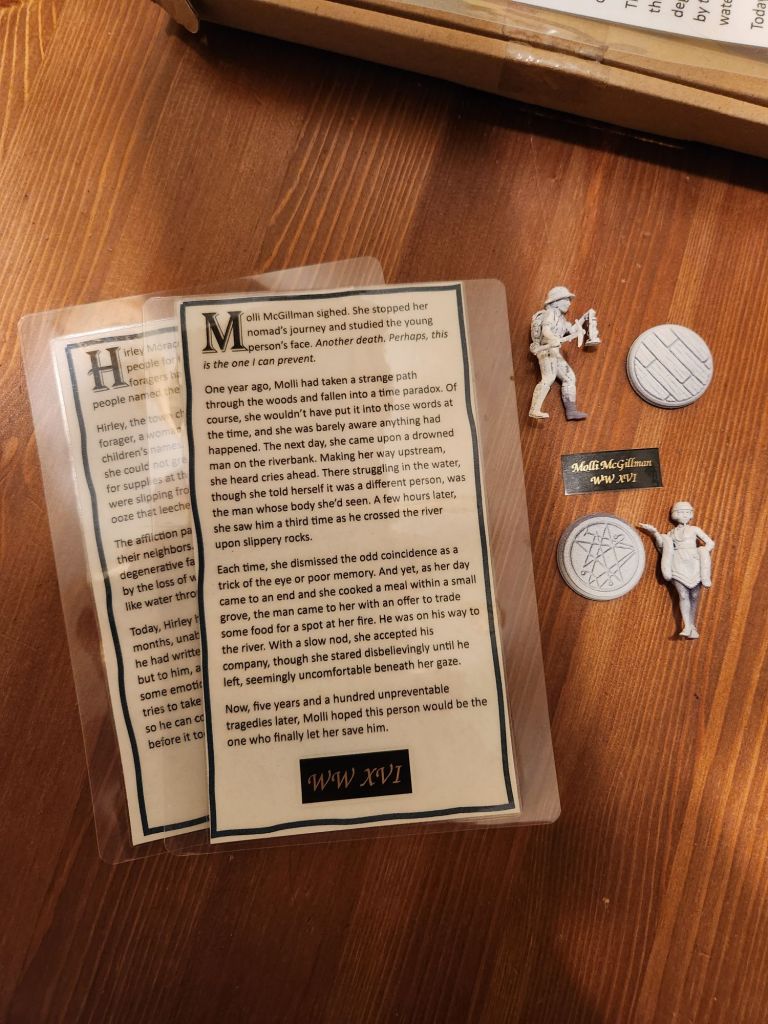
This year, I was no longer the rookie, as we were adding two people to the invitation. I figured it was my turn to bring the swag. So, when the event organizer suggested we take some time to paint tabletop minis, my partially formed idea sprung to full life.

My idea was to not only 3D print some minis in resin, I would also give people the option to choose a custom base and a backstory. The writer should use his skills, right?

3D Models source: Adaevy Creations (except the tall Viking, which was created via Hero Forge)

Within a few hours, I’d whipped up sixteen 200-word stories. I’m never sure whether I should tell people just how quickly I created each one: I worry that their response will be disbelief or a derisive “well, obviously“. Each one sprung to life relatively easily, which is partially due to their nature. They’re not intended to tell a complete story, but to inspire my friends into considering what comes next. Each one centered around a simple concept, like these:

  1. A curse is causing a village to forget their entire spoken language. The town chronicler is trying to choose the last word he’ll think about before it’s also forgotten.
  2. When he sees his doppelganger, a man with a strong regenerative power wonders, “If I can regrow a part, can a part regrow a body?”
  3. She slipped into a time paradox which causes her to see stages of a tragedy in reverse.
  4. He thinks he randomly turns invisible. Often he’s right, but that also means, sometimes he’s not. He can’t tell the difference.

It was a ridiculously fun writing experience, and not just because the stories came effortlessly. No, it was also freeing, a way to re-engage my creativity, which has been dormant a few months. And, it was a gift to friends that I hoped would make their weekend experience better. It worked.

Over the next week or so, I’ll be sharing these stories in a series of posts. It’s partially a way to showcase a project I’m proud of, but also, like the stories themselves, I’m hoping to inspire you to consider how else you might use your writing skills. So, tell us….what comes next?

Mike

Related posts:


Enjoy what you just read? Leave a comment or like the post, and we’ll ensure that you see more like this!

© Michael Wallevand, February 2024
Driven to write by a word

Schmutz.

It’s a word of Yiddish and German origins, and for some reason, it popped into my head this morning.

If it’s a word unfamiliar, it’s often used to describe a bit of unidentified something on a person. Usually their face. For many of us, that’s followed by your mother wetting her thumb with saliva to wipe it away.

Ah, mothers. So loving. So sanitary.

In my part of the world, it’s an uncommon word, which usually means I’m going to work it into my book (and apparently, a blog post).

And then my writer’s brain was off to the races.

In 45 minutes, I whipped up about 550 words, or a page and a half, inspired by the idea that Tildy has schmutz on her face, but due to her ability to unconsciously shapeshift, the schmutz avoids her mother’s efforts to clean it away. It’s actually a pimple, and it disappears and reappears across Tildy’s face.

I immediately fell in the love with the scene, and not just because writers often fall in love with their writing (a PAINFUL truth, except when they hate it). No, it’s because it accomplishes many things in service to the story.

It fits into the first chapter of Tildy’s second book, helping reintroduce our characters to the Reader with things like Tildy’s abilities, her relationship with the witch (her adoptive mother), and a little bit about their personalities. Additionally, we get the melodramatic woes and annoyances of a teenager.

But to me, the best part is the humor. You see, it’s actually an outbreak of acne, but Tildy’s skin is trying to prevent the pimples from surfacing.

“I no longer think it is a simple pimple moving around your face. I believe there are many, but your skin is resisting the outbreak. I wonder what would happen if you stopped doing whatever you are doing?” the witch mused, as she turned Tildy’s face, that way and this, as she looked for the next pimple’s appearance.

Tildy didn’t particularly care, but as the thought entered her mind, her face grew red and itchy.

“Oh ho!” the witch laughed, her face delighted. “Now they are everywhere! You really are a sight.”

I think it also creates some tension for Tildy. She has the ability to fight acne, something that many teens would be jealous of, but she can’t control it. Quite the opposite. Ironically, her efforts only seem to make it worse. Her struggles, however, eventually result in new mastery of her abilities, which is a recurring theme throughout the series. It helps us see Tildy growing up.

Sometimes, inspiration comes as simply as that. A single word demands several hundred in response. If only it was always as easy as that.

It’s a good start to a day, and as I write this, it’s now time to get to my office job. Good luck with your own writing (and that other work that pays the bills).

Mike


Enjoy what you just read? Leave a comment or like the post, and we’ll ensure that you see more like this!

© Michael Wallevand, October 2023

Writing Exercise: Chew.

Last weekend, we were at a park with Benji, enjoying the trails. He kept pointing and giggling, saying “Chew!”, which is his word for his Chewbacca. We didn’t have the stuffie with us, but this isn’t unusual behavior for him. After a few exclamations, my writer brain switched on.

What if he was actually seeing a figure that he mistook for Chewbacca?

A thrill ran through me, and only a little of that feeling was terror. Then The Idea came.

A heartwarming, family story that lies somewhere between Harry and the Hendersons and Gremlins, with a leaning toward the funny PG horror films of the 80s. Chew, which Benji names the monster after his Chewbacca character, is a tall hairy sasquatch kind of creature with an oversized mouth that makes the name “Chew” very apropos.

I worked out some details in my head as we walked. After my wife explained that they’d hidden Chewbacca at that park before and that Ben was remembering it, I shared my idea.

She told me I had to write it out. That means I’m on to something.

In about 2 hours, I had four and a half pages, or about 2,200 words. The work was divided into three parts. First, the treatment, which helped me set the scene, as well as describe the protagonist, whom I modeled after Benji. Second (and bulk of the writing) was the beginning of the story, and finally, a list of foreshadowing items, which any good horror story needs.

Here’s an excerpt from the treatment. It was important to me to show how Ben’s autism impacts the dynamic of the story. Also, representation matters. As Ben’s father, one my responsibilities is to help the world understand what it’s like to be him.

Benji is a young nonverbal teenager with severe autism. He loves stuffed animals and action figures, but his prized possession is a medium-sized stuffed Chewbacca he calls “Chew”. As this the case for many people like him, Benji repeats the known word over and over and again, occasionally adding a “rowr!” to bring his person to life. “Person” is the term his family uses for any stuffie or other character in Benji’s toybox. You see, for a kiddo with a limited vocabulary, you believe you have to choose your words carefully, often using broad terms to ensure comprehension.

Perhaps his family doesn’t give him enough credit for what he does understand, but they are doing the best they can. As is Benji, who doesn’t seem to mind, except when they are too dim to understand what he is communicating, which is a combination of gestures and repeated words. He might have to repeat “Chew” incessantly and with increasing volume to completely convey his message.

But thirty minutes of the word “Chew”, either resulting from playing with his person or because Benji wants something, can try the patience of even the most easygoing person, and Ben’s parents, while not angry people in their nature, do have their limits.

The treatment describes a bit more about the house, Ben’s brother, and some other details. I remember my typing picking up steam at this point, and the treatment suddenly transitioned into the opening of the story.

…Benji often sits at the window, clutching his Chew. Sometimes the Wookiee dances on the sill; sometimes he leans against the glass, staring into the woods with his person, Benji. “Chew” and “rowr!” are usually repeated frequently. Today, there is a new level of urgency, as Benji sees a tall shaggy figure at the forest edge that he thinks is….

Continue reading

Sometimes the universe gives you a sign

I’ve connected with enough writers and other creatives that I know many of us doubt the work we do. It varies from the kind of art we’re creating, the subject, the time we’re devoting to it, or the work we do to promote it. Generally speaking, these are all variations of the question “Is it worth it?”

I suspect that for most of us, if you sat us in a room and grilled us under hot lights, we’d answer “Yes.” Of course we would. But that doesn’t mean doubt isn’t poking its finger into our brains occasionally.

For me, it’s been a rough 18 months, where the doubt was amplified by compounding stresses. Neither are unfamiliar sensations, and while I have mechanisms to cope, it’s been a lot. The writing has taken a backseat. In some cases, it’s gotten out of the car completely.

Recently, the universe seemed to give me a sign. Four of ’em, actually.

  1. The son of an author I loved as a kid emailed. I’d written a post about his mother, posing a philosophical question about taking inspiration from a book and putting it into your own work. He was communicating her blessing. I’m pretty much geeking out about this one.
  2. A friend who owns a bookstore asked when he’d be able to put my book on his shelves.
  3. A colleague stopped me in the hallway and asked for an update on my books.
  4. A friend stopped by my desk and also asked for an update.

This all happened within a week. I suspect my smile grew larger each time as I recognized my good fortune.

I don’t share these examples to brag, though I am proud that my work has elicited responses like this. I share them for those creators second-guessing the work they do. While I love the idea that the universe, or the Muse, sends us signs, I did contribute by putting myself out there. They didn’t happen only because of magic. Sigh. So, let’s take another look at the interactions I described above.

Continue reading

Waiting is the hardest part

We’re sitting in Children’s Hospital this morning while our son Benji has a heart procedure. As medical procedures go, especially ones concerning your child, an invasive cardiac electrophysiology and ablation is relatively straightforward and routine.

And yet, it’s a medical procedure involving the heart. Of your child.

It’s a hard thing to watch him wheeled away, even when you have absolute faith in the medical staff. It feels impossible to let him go. And yet, you do.

Then you sit. Then you wait.

And wait and wait.

I thought I might play games on my Steam Deck to pass the time, either some brainless distraction or immersive experience, but my wife wisely suggested I try writing instead. So, I brought the laptop and left the Deck behind. An easy decision, I had hesitation, nonetheless. You see, writing has been hard for the last, hmmm, 18 months or so as stresses piled upon each other. I was out of practice and easily distracted.

As we sat in the waiting area, I set my phone aside and opened the laptop. I’d recently started an alternate prologue for Tildy Silverleaf and the Starfall Omen that brought the reader into the action sooner. The approach was more Show and less Tell, and based on feedback Trusted Readers had provided, I thought it would be better received. As I read through rough paragraphs, the visuals resurfaced in my mind. Perhaps it is more accurate to say that I submerged into the world I’d created.

And I wrote.

Continue reading

Twenty-four bucks for a quarter turn

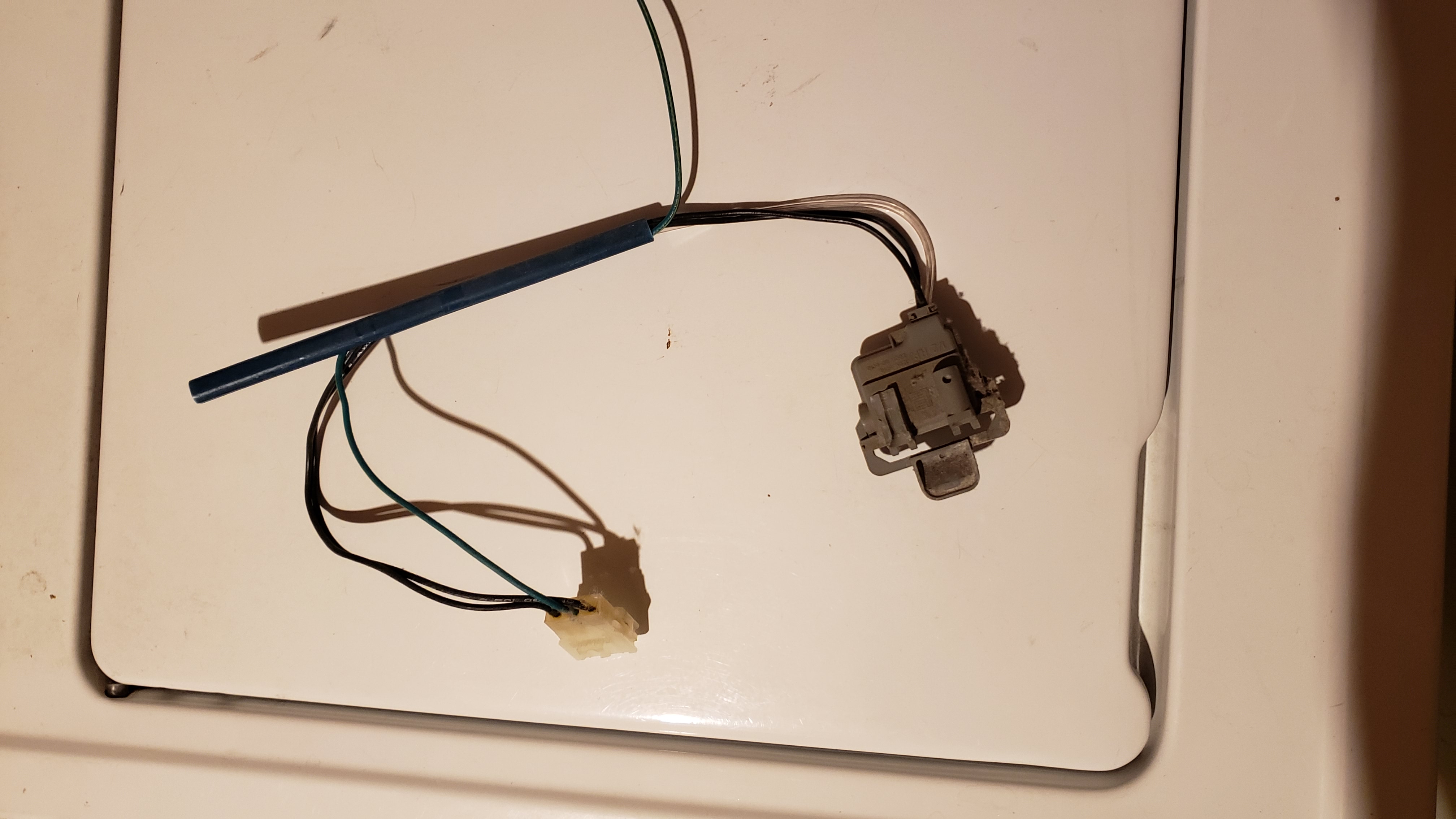
Our washing machine stopped working this week. It wouldn’t proceed to the spin cycle, which meant water didn’t drain. I tried some rudimentary troubleshooting, which led me to believe it was the washer lid switch. I was pretty sure I could figure out how to replace it. Anything more serious, and I’d have to hire someone.

It actually took more time to scoop water from the tub than to replace the part. At least it should have. The ground wire ran to a screw on the underside of the top of the unit, which meant a tight space at an awkward angle. I tried a variety of wrenches and pliers but couldn’t get the grip I needed.

After 30 minutes of frustration, I ran to the hardware store for the right tool. A ratchet socket wrench for $24. I wasn’t thrilled, because that was more than the replacement part, but I wanted to get the project done. Fortunately, it was the perfect fit.

The screw loosened after a quarter turn.

–broken washer lid switch–

And I thought, “a 30-minute round trip and twenty-four bucks for a quarter turn?”

Continue reading

Author’s Journal – I Put Myself In Editing Purgatory

Altar from Franciscan Monastery of the Holy Land in America, Washington, D.C.

In December 2019, I finished the final draft of Tildy Silverleaf and the Starfall Omen. I exhaled, wrote a post, and put the book aside for the holiday season, intent on querying in 2020. I started researching agents over the winter and began querying in earnest in early spring.

Around that time, rumors had begun, followed by vague news reports, about a new disease that would eventually be known as Covid-19. In March 2020, I said goodbye to my office desk and began working remotely for nearly 3 years. In May, riots erupted in Minneapolis and elsewhere over the murder of George Floyd. As the year progressed, the political landscape in America became fraught, then angry, then vicious, and civil discourse became less common.

The world seemed to stop.

And so did I.

I tried to write, and in two years, I had about 100,000 words of my next book, which featured Samor, Tildy’s brother. There was some joy, but the weight of things beyond my control pressed upon me, and the work became more grind than pleasure. I struggled to recapture the magic.

I decreased my blogging output in that time, too. After all, what did I have to write about my process? I wanted to share positive things and my passion for writing, but they were hard to think of, much less give enough attention to bring to life. There seemed to be more important things in the world.

I started Project 3 in that time, hoping a return to Tildy’s familiar story would help me push through. For a time, it did.

It wasn’t enough.

Continue reading

The Synonym Trick: Affect vs. Effect

When I was in elementary school, phonics played a prominent role in the curriculum. Even at that young age, I recognized and appreciated the structure and rules, and I remember being surprised when others struggled. It was a method that resonated with me (heh), and I usually achieved high marks in spelling.

However, there are times when phonics lets me down, especially in the use of similar-sounding words: “appraise/apprise”, “elicit/illicit”, “passed/past”, and “awhile/a while”. Suffixes can also be a pain, such as “-ible/-able”.

“Affect/effect” is another, and I’m not alone in my confusion. They are among the most misused words in English.

While editing my manuscript today, I discovered a pesky “affect” had survived several rounds of revisions. I’m at the point with my writing where I don’t chastise myself for the miss, but I’d still prefer to learn from the mistake. So I decided I would find a way to minimize it happening again.

Continue reading

Exclude your audience or include them?

I’m always reviewing my writing for exclusionary words. In this post, I’ll be taking a discriminating look at a few paragraphs from my book with the intent of removing discriminatory language. Don’t worry – this wasn’t some prejudicial diatribe I needed to cut. I’d found a trite, gender-centric passage, and I decided to shake it up to turn a trope on its head. Painless right? And kinda fun, kid.

Language is both simple and powerful in its ability to bring people together, but it’s also very easy to exclude broad swathes of people with specific words. For instance, using “men” to describe soldiers or “wife” or “husband” instead of “spouse”. If you’re always represented in the language like I am (i.e. a white guy), you’re less attuned to it and less exhausted by it. And even if you want to write differently, these things still unconsciously find their way into your writing because much of what you’ve read is rife with similar language.

The fixes aren’t difficult, but you have to look for them and be willing to change your way of thinking a smidge to include people.

BTW, if you want to complain about political correctness or wokeism, this probably isn’t the website – or book – for you. I’m sorry to see you go. We’ve got a heckuva a wild fantasy ahead of us and there’s room for humans of all kinds.

I’ll start by presenting the passage in its fixed state, hoping that you’ll appreciate how it reads like a perfectly normal piece of writing, not some screed trying to brainwash you.

She shook her head, clearing her thoughts like a dog shakes out waterlogged ears. “Listen, youths are idiots when it comes to impressing someone they like. They get all sorts of notions in their heads. Probably the storybooks they read,” she said with an eye on Tildy. She continued, determined to say her piece. “Some want to be knights, fighting to prove themselves worthy of marriage and titles and lands. It makes them do reckless things.”

Tildy stared, mind reeling. What in the world was she talking about? And like a smack to the head, she understood and laughed. “You think he’s going to fight for my honor or something?”

The witch looked unhappy. “I have seen many young people rushing to battle for honor or some chivalrous reward. Only some returned, and none were the same, regardless of the prize.”

See? Perfectly normal and not brainwashy at all.

Continue reading

Writing Exercise: Memorial Day tribute

I planned to delve into writing this weekend, mixing those responsibilities with other chores around the house. I needed to regain momentum on Project Two, which had stalled during the pandemic; ironically, I was also fighting the lingering effects of my own bout with Covid. I knew I would have plenty of optimism when I finally sat at the keyboard, even if I had no idea where to begin.

That’s when Serendipity paid a visit.

Goodnight, Saigon by Billy Joel came up on my playlist, and his lyrics drew me in like I was watching a movie. I don’t know if you’ve experienced this, but your mind’s eye takes over, even as your body goes through the motions of dressing and pouring coffee. I’m not even sure of the sequence of events: my mind connected the song to Memorial Day and a scene where Samor rejoins his companions after they’ve lost someone. There was nothing; then there was something.

I grabbed the computer, put the song on repeat, and 30 minutes later, I had this.

Samor greeted his companions as they gathered to him. Their welcome was genuine, their words warm. But he read something else on their faces that he hadn’t seen before. Or rather, he realized he hadn’t had the skills to interpret the tragedies that lay there. The worry that creased Hochness’s brow; the crow’s feet that used to merrily step away from the corners of Oafsson’s eyes. Even the betrayer Chork, addled as his mind remained, seemed more sedate against the bonds that held him to the litter. A weight drug at them all, anchoring them to the battle where they’d lost their friend and compatriot. The look of survivors, a mix of gratitude and guilt, made worse by each condemning beat of their living hearts.

His past naiveté angered him, but mostly it saddened him. No words seemed important enough, nor considerate or meaningful enough to break the silence of the moment. And so, he took his cue from his friends, yes, that is what they were now, and he embraced them silently and exchanged knowing looks that would have been inscrutable to the person he used to be. In the strength he gave, he felt more returned. They knew he knew. They accepted him and were grateful that he offered to share the burden.

Samor recognized this understanding wouldn’t have come from a lifetime of study. Simple words upon the page were shallow, going no deeper than the ink that sank into the paper – practically lies for their misinterpretation of the awful reality. The knowledge was horrible, and he wished he’d never acquired it. A small voice between his ears reminded him it was a necessary experience for the future leader of Empyrelia, a land destined for war, but he could derive no comfort from that. He hoped he never would.

Continue reading