Writing Exercise: Use Your College Knowledge

This website is dedicated to my novels and the writing process, as well as advocacy for human rights.

A college buddy recently re-entered my life on Facebook, mocking my alarm at the emboldened fascism of the new U.S. administration.

I didn’t know the Jews r worried Elon and Trump are vicious Nazis who will gas chamber them and other inferior minorities? Man will the hispanics and the blacks be pissed because they sure voted a lot for Trump. Wouldn’t that be ironic?

He probably doesn’t know that I studied so much history during our college days, with a focus on the rise of fascism in the 20th Century, that I accidently got a second major for my bachelor’s degree. I’ve walked through concentration camps. I’ve stood in the gas chambers. Something awful still lingers there, as does a tragedy for which Humankind has no words. So instead of responding with equal sarcasm, and ignoring how he unconsciously described minorities as “inferior”, I put my degree to use.


The quarantine yard at Mauthausen, one of the most sickeningly brutal concentration camps.

It doesn’t start with gas chambers. We all know this.

Like all successful bullies, the Authoritarian is more cunning than intelligent, recognizing that threats, bombast, and lies will be more effective than reason. In this way, he camouflages his weakness and impotence as a strength that people truly believe.

And to be perceived as strong, the bully picks on the weak. They are but the backs that must be trodden on the climb to power. The Undesirables must be identified. The Other. They are named Enemies to give the people something to rally around. It is better to be one of Us than one of Them. And the People buy into it because they respect and fear and covet the Power. More often than not, they are the regular people and the downtrodden, not those marching with torches or hanging nooses from trees. Over and again, they have been told they are powerless – these Enemies have taken their power, their jobs, their money, and the lives of their fellow citizens. The People used to be great, but no longer. Convinced, they actually relinquish power and critical thinking for pretty promises that their lives will improve. Promises without a plan, though like all great salespeople, he’s manufactured a need in people for the thing he’s selling.

And lo, their salvation is at hand.

Continue reading

Writing Exercise – Say Meaningful Things

Writing Exercise – Say Meaningful Things

On May 25, 2020, a police officer murdered George Floyd, a suspect in his custody. As a reminder to Americans, we are all innocent until proven guilty in a court of law.

On May 26, peaceful protests began.

On May 27, peaceful protests continued. Eventually, rioters and outside agitators burned a Minneapolis neighborhood.

On May 28, I wrote this piece. Then I put it aside, unwilling to work further on such a heavy topic.

On November 20, 2024, I rediscovered it. I’m now sharing as part of my month of gratitude and my greater commitment to writing meaningful things.

Sometimes, there are no words.

You want there to be, but they fail.

You hope that you can say that genuine thing to alleviate someone’s pain.

Put an end to suffering.

Quell the madness.

Turns minds away from bigotry.

But there are no words

Tonight as Minneapolis burns.

The writer prides himself on turns of phrase

On vocabulary

On finding the perfect way to state a thing

But the practice, the tools, the tricks

They fail because there are no words.

A word typed

A thought, aloud.

These things are too small for a situation too large.

They are noise.

They are nothing.

Worthless thoughts shouted into the face of the heedless storm.

One day again

The words will come. But today, there are no words

Many of us are grateful that events like this are not part of our world, though we are too ashamed to say it aloud. We need to find our voices. The world becomes a better place when the meaningful things drown out the oppressors’ noise. Please take this encouragement to contribute your own meaningful things.

Thank you for reading. Hug your loved ones this holiday weekend.

–Mike


(C) Michael Wallevand, November 2024

Writing Exercise – Gratitude

It’s very easy in a job – in any job – to get hung up on all the things you’d love to change. Or to get dragged into negativity when simple commiseration with colleagues descends into toxic complaint sessions. Having worked in a wide variety of roles, including food processing, lab assistant, retail, and several corporate jobs, I can attest that it happens everywhere.

My work division (FindLaw, a part of Thomson Reuters) is being sold to another company, and the watercooler talk runs the gamut of perspectives and opinions, which means if we’re not careful, we could spiral into endless negativity. The stress is high, and many have an irrational fear of the unknown.

What’s helpful for me, and what I’m recommending to all my mentees, is a pros/cons list. It perhaps sounds cliché, but it’s still incredibly effective. While pay, merit increases, and advancement opportunities are important, they’re not the reason I stay with a company. For me, a flexible working schedule is paramount.

My younger son, Benji, has severe autism. Sleep is a recurring issue for him. Some nights, he’s just awake. He’s somehow powered through his nighttime meds and can’t fall asleep again. One night becomes two becomes a week or more. There’s a compounding effect to this, meaning some of his behaviors are worsened, which creates difficulties at school or elsewhere in public. There have been days where I have to drop everything and run to school to bring him home.

At a recent social hour at the office, several colleagues asked how our family was doing.

Continue reading

Writing Exercise – Don’t Write Yourself Off

Mike Wallevand on high school graduation day at 135 pounds

I hadn’t worked out in 28 years.

I graduated high school a skinny 5’11”, 135-pound basketball player who’d spent his childhood with a ridiculous metabolism. For many of us, things changed in college. Four years later, I’d gained 30 pounds. It wasn’t muscle. Those size 32 pants were a bit snug.

Fast forward nearly twenty years – around 2015 – I stopped checking my weight. A scale displaying 220+ pounds wasn’t something I wanted to see any more. I had more willpower for that than to make any meaningful lifestyle change, and my weight continued to increase.

Collage of Mike at his heaviest

In fact, the only real change I would make was cutting out soda and trying to walk the dogs more. From 2012-2017, I lost maybe 10-15 unremarkable pounds. I certainly didn’t feel any better, physically, mentally, or emotionally.

My wardrobe also remained the same: layers of bulky clothes to hide rolls, folds, and not-quite-manboobs. My shirts were XL and my pants were 38 waist. The collars of dress shirts were hangman’s knots and suitcoats were sausage casings.

Five years ago, in early 2019, I was invited to a class at a local boxing club. Did I mention I hadn’t worked out in 28 years? I found workouts boring. Or intimidating: I didn’t want to be the fat bald guy in a massive fitness center who was wheezing on a treadmill or struggling under weights. And if that were true, punching something for an hour was certainly far outside my interest, not to mention my personality.

Coming into the class, I didn’t expect anything to change, even if a small voice between my ears told me that I really, really needed an exercise routine. But I’d been ignoring that guidance my entire adult life.

In that first 1-hour class, I thought I was going to die.

Continue reading

Writing Exercise: Monday Positivity

I’ve been trying to work on my positivity.

Correction, I’ve been working on my positivity.

CORRECTION: I have improved my positivity.

It’s tough. I have a pragmatic, neurodiverse, and often all-or-nothing view of the world. I like to identify problems and find creative ways to fix them. I’ve often said that the old Lexus commercials of the 1990s especially resonated with me.

a car with martini glasses stacked in a pyramid on its hood
Lexus: The Relentless Pursuit of Perfection

As I’ve matured, I’ve come to understand that this also creates the relentless pursuit of imperfection. Nothing is ever good enough, which often means, things remain bad until they are. It’s a helluva thing to overcome to publish a book. But if I put my “reason mind” to work (If you want to publish, you have to stop puttering about), it begins to drown out the “emotion mind” that’s often loudest in my head (Just one more edit and it’ll be perfect. Just one more. You’re so close. But just one more.)

This morning, I was looking for a way to start my Monday with a positive attitude, which is tough for many of us. Part of our social contract in America is commiserating over the start of the work week. It’s probably a multi-million dollar industry, when you consider all the merchandise dedicated to grumpy Mondays.

I thought back to how good my Friday was. It started with this: A Day Bright, and Full of Promise. It was a simple writing exercise that got my brain moving, and the creative outlet got those feel-goods coursing through my veins.

Instead of simply jumping into work, with who knows what surprises awaiting me, I took a few minutes to jot this down in a coffee shop.

Continue reading

Writing Exercise: A Day Bright and Full of Promise

It was time for the school bus. Following Benji, I stepped into a beautiful Autumn morning. As though someone spoke to me, this line popped into my head.

A day bright, and full of promise

I stopped in my tracks, my brain beginning to answer the question I no longer had to consciously put into words: “What happens next?” Even after so many years of writing, I continue to be surprised by the amount of creativity sparked by that simple question. Most notably, What if I paused my writing about the lost prince and started a female-centric story about his sister?

It’s a tip I use not only for writing, but in my office job, as well. “OK, we have an issue. What happens next? And then what?” And so on.

The following is about 2 minutes’ work. It’s a minor piece of writing, but I wanted to capture it because it helped inspire me. It’s about having days ahead of you that you want to spend writing. It’s the promise that you’ll create something worthwhile. It’s the power of positive thinking, if you will.

It’s Hope.

Continue reading
I Still Owe Jimmy Jam and Terry Lewis An Apology

I Still Owe Jimmy Jam and Terry Lewis An Apology

It was late 1998. I worked for the Suncoast Motion Picture Company, which sold movies and related merchandise. I’d recently transferred from the flagship Mall of America store to the Southdale Mall in Edina. The commute was longer, but I didn’t mind for a couple reasons. The one I’ll articulate here pertains to the clientele.

The Mall of America location was great for people watching. At the time, tourists came from around the world to see the spectacle of the largest mall in the Western Hemisphere. But Southdale, due to the prestige of Edina, attracted a number of celebrities. I was thrilled to learn Janet Jackson (whom I’ll call Ms. Jackson cuz I’m nasty) shopped there when she was in town. And she bought her movies from Suncoast.

The Suncoast where I was now a manager.

In 1998, I was still that small-town kid who’d grown up in a town so tiny it was technically a village. I’d never met a celebrity, and the prospect of meeting Ms. Jackson, someone whose music I absolutely loved, hyped me to a ridiculous degree. I’m embarrassed to admit that I was on the lookout on many shifts.

I grew up loving her albums Control and Rhythm Nation 1814, the latter of which I owned. Back in 1990, I knew everything about that album. You see, I didn’t have many albums as a kid, so when I got a new one, I poured through the liner notes, sitting cross-legged on my bedroom floor beside my cassette deck. I memorized the lyrics, tracked the music labels, and learned about every musician or other person connected with the production of the album.

If you’re familiar with Janet’s music, the headline of this post is beginning to make sense.

Back to 1998. I’m working the checkout in our third-floor location, when two well-dressed men came in. I offered the usual greetings, made small talk, and helped them as best I could.

These two gentlemen were Jimmy Jam and Terry Lewis. And they were aware that I didn’t recognize them.

It must have been an unusual experience, especially in the Minneapolis area. Here’s why.

When it comes to the Minneapolis music scene, it didn’t get much bigger than this duo. They formed the band Flyte Tyme, which became The Time under the influence of Prince, and the group would go on to help define the Minneapolis sound in the early 1980s.

After being fired from the band, they started Flyte Tyme Studios, and their partnership went on to earn more than 100 gold, platinum, multi-platinum, and diamond albums. Over their storied career, they’ve worked with some of the biggest names in the biz, including Lionel Richie, Herb Alpert, TLC, Michael Jackson, Aretha Franklin, Boyz II Men, Usher, Patti LaBelle, Mary J. Blige, Chaka Khan, Mariah Carey, Bryan Adams, Spice Girls, Vanessa Williams, Rod Stewart, Gwen Stefani, and New Edition. I particularly loved George Michael’s “Monkey” and The Human League’s “Human” songs. But those weren’t the only memorable tracks.

Forty-one of their songs reached the Top 10 of the Billboard Hot 100. They won five Grammys and got an Oscar nom for their work with Janet Jackson on the song “Again” for the movie Poetic Justice.

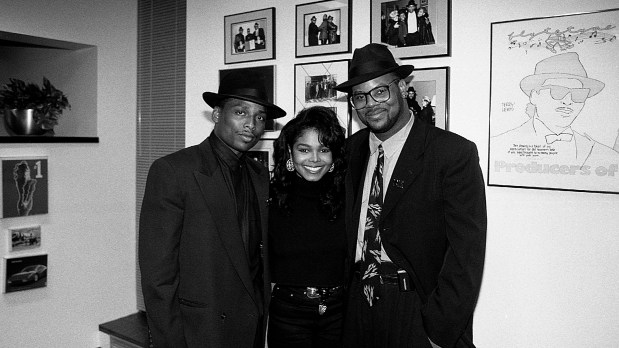
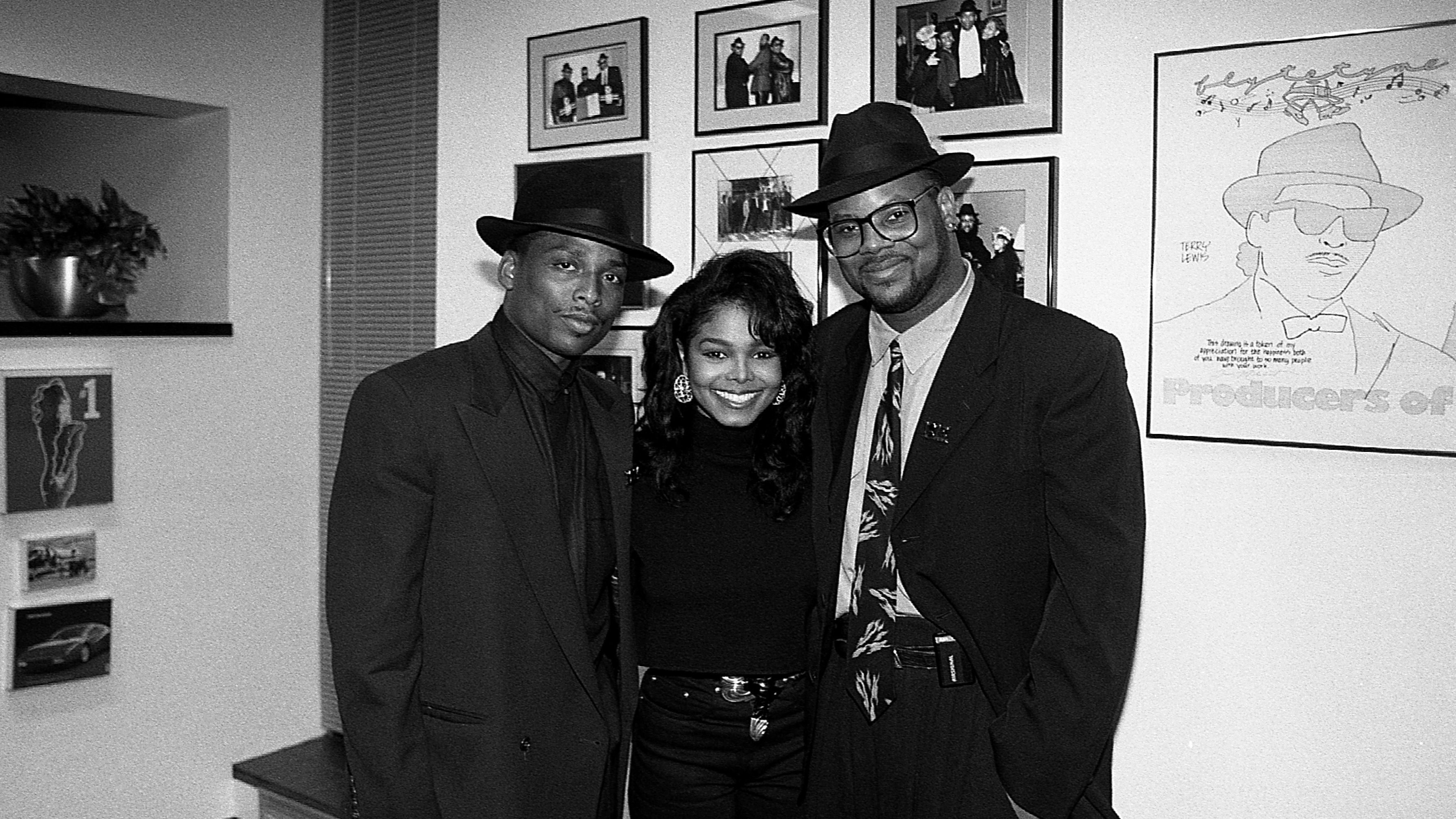
EDINA, MN – SEPTEMBER 1989: Singer Janet Jackson poses for photos with music producers Terry Lewis and Jimmy Jam during the opening of Flyte Tyme Studios in Edina, Minnesota in September 1989. (Photo By Raymond Boyd/Getty Images)

And speaking of Ms. Jackson, they won a Grammy for producing her album Control. Their follow-up collaboration, Rhythm Nation 1814, dominated the charts with seven hit singles and became one of the biggest albums in the world from 1989-91.

Most of that album work had been done at Flyte Tyme Studios, a convenient 5-minute drive from Southdale.

As I look back upon their visit to my store, I like to imagine these world-renown producers were taking a shopping break from their busy studio schedule. Perhaps, the perfect movie would be a nice diversion, or provide some inspiration for the their next movie project. Little did they know they were talking to a guy who knew every beat and could sing every lyric from Rhythm Nation 1814, many of which they’d written.

A guy’s whose memory was about to betray him, despite his brain containing most of the information I just shared.

Continue reading

Driven to write by a word

Schmutz.

It’s a word of Yiddish and German origins, and for some reason, it popped into my head this morning.

If it’s a word unfamiliar, it’s often used to describe a bit of unidentified something on a person. Usually their face. For many of us, that’s followed by your mother wetting her thumb with saliva to wipe it away.

Ah, mothers. So loving. So sanitary.

In my part of the world, it’s an uncommon word, which usually means I’m going to work it into my book (and apparently, a blog post).

And then my writer’s brain was off to the races.

In 45 minutes, I whipped up about 550 words, or a page and a half, inspired by the idea that Tildy has schmutz on her face, but due to her ability to unconsciously shapeshift, the schmutz avoids her mother’s efforts to clean it away. It’s actually a pimple, and it disappears and reappears across Tildy’s face.

I immediately fell in the love with the scene, and not just because writers often fall in love with their writing (a PAINFUL truth, except when they hate it). No, it’s because it accomplishes many things in service to the story.

It fits into the first chapter of Tildy’s second book, helping reintroduce our characters to the Reader with things like Tildy’s abilities, her relationship with the witch (her adoptive mother), and a little bit about their personalities. Additionally, we get the melodramatic woes and annoyances of a teenager.

But to me, the best part is the humor. You see, it’s actually an outbreak of acne, but Tildy’s skin is trying to prevent the pimples from surfacing.

“I no longer think it is a simple pimple moving around your face. I believe there are many, but your skin is resisting the outbreak. I wonder what would happen if you stopped doing whatever you are doing?” the witch mused, as she turned Tildy’s face, that way and this, as she looked for the next pimple’s appearance.

Tildy didn’t particularly care, but as the thought entered her mind, her face grew red and itchy.

“Oh ho!” the witch laughed, her face delighted. “Now they are everywhere! You really are a sight.”

I think it also creates some tension for Tildy. She has the ability to fight acne, something that many teens would be jealous of, but she can’t control it. Quite the opposite. Ironically, her efforts only seem to make it worse. Her struggles, however, eventually result in new mastery of her abilities, which is a recurring theme throughout the series. It helps us see Tildy growing up.

Sometimes, inspiration comes as simply as that. A single word demands several hundred in response. If only it was always as easy as that.

It’s a good start to a day, and as I write this, it’s now time to get to my office job. Good luck with your own writing (and that other work that pays the bills).

Mike


Enjoy what you just read? Leave a comment or like the post, and we’ll ensure that you see more like this!

© Michael Wallevand, October 2023

Writing Exercise: Chew.

Last weekend, we were at a park with Benji, enjoying the trails. He kept pointing and giggling, saying “Chew!”, which is his word for his Chewbacca. We didn’t have the stuffie with us, but this isn’t unusual behavior for him. After a few exclamations, my writer brain switched on.

What if he was actually seeing a figure that he mistook for Chewbacca?

A thrill ran through me, and only a little of that feeling was terror. Then The Idea came.

A heartwarming, family story that lies somewhere between Harry and the Hendersons and Gremlins, with a leaning toward the funny PG horror films of the 80s. Chew, which Benji names the monster after his Chewbacca character, is a tall hairy sasquatch kind of creature with an oversized mouth that makes the name “Chew” very apropos.

I worked out some details in my head as we walked. After my wife explained that they’d hidden Chewbacca at that park before and that Ben was remembering it, I shared my idea.

She told me I had to write it out. That means I’m on to something.

In about 2 hours, I had four and a half pages, or about 2,200 words. The work was divided into three parts. First, the treatment, which helped me set the scene, as well as describe the protagonist, whom I modeled after Benji. Second (and bulk of the writing) was the beginning of the story, and finally, a list of foreshadowing items, which any good horror story needs.

Here’s an excerpt from the treatment. It was important to me to show how Ben’s autism impacts the dynamic of the story. Also, representation matters. As Ben’s father, one my responsibilities is to help the world understand what it’s like to be him.

Benji is a young nonverbal teenager with severe autism. He loves stuffed animals and action figures, but his prized possession is a medium-sized stuffed Chewbacca he calls “Chew”. As this the case for many people like him, Benji repeats the known word over and over and again, occasionally adding a “rowr!” to bring his person to life. “Person” is the term his family uses for any stuffie or other character in Benji’s toybox. You see, for a kiddo with a limited vocabulary, you believe you have to choose your words carefully, often using broad terms to ensure comprehension.

Perhaps his family doesn’t give him enough credit for what he does understand, but they are doing the best they can. As is Benji, who doesn’t seem to mind, except when they are too dim to understand what he is communicating, which is a combination of gestures and repeated words. He might have to repeat “Chew” incessantly and with increasing volume to completely convey his message.

But thirty minutes of the word “Chew”, either resulting from playing with his person or because Benji wants something, can try the patience of even the most easygoing person, and Ben’s parents, while not angry people in their nature, do have their limits.

The treatment describes a bit more about the house, Ben’s brother, and some other details. I remember my typing picking up steam at this point, and the treatment suddenly transitioned into the opening of the story.

…Benji often sits at the window, clutching his Chew. Sometimes the Wookiee dances on the sill; sometimes he leans against the glass, staring into the woods with his person, Benji. “Chew” and “rowr!” are usually repeated frequently. Today, there is a new level of urgency, as Benji sees a tall shaggy figure at the forest edge that he thinks is….

Continue reading

The Synonym Trick: Affect vs. Effect

When I was in elementary school, phonics played a prominent role in the curriculum. Even at that young age, I recognized and appreciated the structure and rules, and I remember being surprised when others struggled. It was a method that resonated with me (heh), and I usually achieved high marks in spelling.

However, there are times when phonics lets me down, especially in the use of similar-sounding words: “appraise/apprise”, “elicit/illicit”, “passed/past”, and “awhile/a while”. Suffixes can also be a pain, such as “-ible/-able”.

“Affect/effect” is another, and I’m not alone in my confusion. They are among the most misused words in English.

While editing my manuscript today, I discovered a pesky “affect” had survived several rounds of revisions. I’m at the point with my writing where I don’t chastise myself for the miss, but I’d still prefer to learn from the mistake. So I decided I would find a way to minimize it happening again.

Continue reading