Homage vs. Plagiarism #1

This post is about 650 words. It should also be noted that book and images discussed below were copyrighted by TSR Hobbies in 1982.

image

This is a book from my childhood, entitled Return to Brookmere. It’s #4 in the Dungeons & Dragons Endless Quest series. As you’ve probably guessed from the worn cover, it is a beloved, multiple-read, go-everywhere favorite. While not high literature, its influence on me as a reader and writer cannot be overstated. It’s likely to make multiple appearances on this site, btw.

As such, I wanted to do it proper homage as a way to say thank you to author Rose Estes, as well as D&D itself.

I hadn’t read the book in a few years, though it had a place of honor on my bookshelf. One element that stuck with me for more than three decades is the magical amulet, named the Mouth of Mimulus, or simply Mim. Shaped like a dragon’s head, this animated charm offered advice and commentary on the adventure. I don’t recall much backstory being written, however.

Mim 1In my own story, I was looking to create another advisor for Tildy, someone to serve as a counterpoint to the witch, Tildy’s adoptive mother. I also wanted a way to have Tildy work through some of her own concerns without always relying on inner monologue. I didn’t want to add another companion on their journey, but if the advisor was also a secret, this could lead to future conflict. When I recalled Mimulus, I knew I had the inspiration I needed.

Thus, the magnificent amulet Mumnambulen came to life. Mum, for short. Continue reading

Excerpt – June 6, 2016

This post is approximately 600 words. A newer version of this section lives here: Spring in Dappledown.

garden example.jpg

I’ve had several requests to start sharing some passages from the book. This is flattering, yet somewhat terrifying due to the personal nature of the work. This might seem counter-intuitive, I mean, isn’t the point of writing a novel to have it published?

Well, yeah.

But since I’m working on the first draft, there’s the challenge of sharing something that’s not quite ready for eyes other than my own. To be clear, the following excerpt needs some polish and additional detail. Many artists, myself included, want to give you a specific experience, something an unfinished work doesn’t necessarily do. Also, if the draft passage sucks (technical term), you might be under-presenting your abilities. Hopefully.

I think that’s enough caveats and deprecation for now. Here is the introduction of the main character, Tildy, the girl who lost her family, her kingdom, and even her name.

Spring in Dappledown

Tildy sat upright so quickly, her head swam. Eyes blinking slowly in the dim morning light, her fuzzy brain struggled to comprehend where she was. Trying to calm her heaving breaths, she closed her eyes. She was in bed. In her room on the second floor of the cottage.

She was glad to be awake. It was the dream again—that shadow in the tall tower. It thrilled and terrified her in a way that meant it was not an unwelcome recurrence. But she always woke up exhausted, as though it were less dream and more reality. She focused on the last image in her mind: had there been a crying baby? As usual, the details scattered like butterflies in a storm. Continue reading

Writing update: June 6, 2016

This post is about 400 words.


Shining 2.gif

If I type any faster, I’ll get a cramp.

It’s been about a month since the last official update. To me, it feels like I didn’t make much progress. Some progress, yes, but not a ton. A quick check of the word count tells me I added about 12,000 words or 24 Word doc pages.

Which surprises the heck out of me.

Many writers will tell you that it’s a struggle at times. You’re practically squeezing blood from a philosopher’s stone. And sometimes, it’s effortless and you’re living the writing dream. I must have been experiencing the latter, which I’ll attribute to three things.

number 1The writing was broken into smaller chunks. I’ve found my frequency increasing, which means I’m finding more opportunities during the day to sit down and do some writing, even if it’s only a few dozen words. Additionally, since the first draft is nearly done, I’m filling in some small holes (e.g. transitions, intro paragraphs, and conclusions). I’d previously been equating progress to the number of marathon writing sessions I’d have. Lesson learned.

number 2It’s getting easier. Not that I know much about working out, but we all know that exercise increases strength and endurance. The same is true for your brain, as well as those nimble typing fingers. I’m quite certain I’m not the first to say something like, “The more you write, the more you write,” but it’s true. Over time, you’re changing the way your brain works, which is both awesome and somewhat unnerving. And perhaps an idea for an interesting short story.

number 3I’m having fun. It’s feeling less like work, which is great because this novel is like a part-time job where I’m not getting paid…yet. I’m getting up early and staying up late. I’m investing so much of my personal time that, were this to feel like a slog of a job, I’d probably never complete the thing. To be a couple hundred hours into this project and having more fun each day, well, I think that says something about the subject matter, as well as the improvements to my work ethic.

For those of you keeping track at home, the first draft is nearly 84,000 words or 173 Word pages. This probably begs the question, “When do we get to see some of this writing?” I’m working on an excerpt right now.

–Michael

Enjoy what you just read? Leave a comment or like the post and we’ll ensure that you see more like this from Michael!

© Michael Wallevand, June 2016; except for the Shining image

Writing As A Parent #1

This post is approximately 200 words.

Sometimes, a writer needs absolute silence. No distractions.

Sometimes, you’re so inspired, the words just flow and you can power through the sounds of kids, wrestling dogs, or the television.

And sometimes, you need the wisdom to hand the computer over to forces greater than yourself.

Capture.PNG

The smart writing parent saves and closes the manuscript, leaving a copy for the child whose artistic inspiration cannot be contained.

Ben was quite cuddly this morning, covered in several blankets, and pressed as close to me as a hibernating baby bear looking for warmth from his mother. He watched me typing for fifteen minutes before becoming interested in the computer himself. He loves drawing, whether with crayons or on electronic devices. I was still waking up – and he’d broken my concentration (though I wasn’t unhappy about it) – so I let him do this thing.

We spent some time together, doodling and such, which was a more enjoyable morning than putting him in front of the tv so I could get back to work. He eventually took a break, and now I’m back on the job, happier than I started the morning.

One additional note, I learned some new functionality, including the discovery of more emojis than I’d ever care to use.

–Michael

Enjoy what you just read? Leave a comment or like the post and we’ll ensure that you see more like this from Michael!

© Michael Wallevand, May 2016

Tighten Up Your Writing #1

This post is approximately 400 words. Originally published by Michael on LinkedIn.

marktwainThere’s a saying attributed to Mark Twain that goes something like this: “I didn’t have time to write you a short letter, so I wrote you a long one.”

The original quote, “I would have written a shorter letter, but I did not have the time.” is attributed to Blaise Pascal, a French mathematician and philosopher.

I like the Twain version better, though perhaps something is lost in the Pascal translation. But the spirit of the message is clear: writing concisely takes time. Today, most of us can pound away at the keyboard at lightning speed, conjuring sentences from seemingly randomly-placed keys. The imperfect text results from something being lost in translation between head and hand.

And that’s OK. Compare that sentence to what I originally wrote:

  • FROM: The result is often less perfect than it sounded in our brain because something has been lost in translation between head and hand
  • TO: The imperfect text results from something being lost in translation between head and hand

I’m not in love with the rewrite, but I’m not targeting perfection for this post. Now review another sentence I just revised (I’m eliminating the FROM/TO labels to better illustrate sentence length).

  • Take a look at how that last sentence was originally written.
  • Compare that sentence to what I originally wrote.

I eliminated several words in my rewrites and I believe the new sentences flow better.

  • Not only are my rewrites shorter, but I eliminated several unnecessary words.
  • I eliminated several words in my rewrites.

writing 2

Here are other examples and possible rewrites:

  • Today may be the day I pursue the creation
  • Today may be the day I create
  • A company with an interest in this subject
  • A company interested in this subject
  • As a way for the customer to explore expansion in this area
  • The customer can explore expansion in this area

Some words were simply unnecessary; some made the sentence drag; and some were too passive. With practice, these things can easily be culled from your sentences. I’m at the point where I often catch these things as I type. But I’m still finding them in my writing.

And that’s OK.

  • Over time, these types of things are easier to identify and can be culled from your sentences.
  • With practice, these things can easily be culled from your sentences.

Yep, still happening.

120ae1f

–Michael

Enjoy what you read? Leave a comment or like the post and we’ll ensure that you see more like this from Michael!

My Wagon Is Draggin’

sleepy.gif

This post is approximately 400 words. Weirdly written, stream-of-consciousness words.

The title is a synonym for being exhausted. Not to be confused with a dragon wagon, which is a concept I’ve been trying to fit into a story for years. But I digress before I’ve begun.

The household was restless last night. My wife caught whatever cold our youngest has. Our big dog, Atticus, seemed to be rotating his body on our bed in time with the hands of the clock. The smaller dog, Scout, scratched her bed regularly, looking for comfort. I’d moved 800 pounds of retaining wall bricks, so I had some complaining muscles that I forgotten were muscles.

This morning, I was in a fog. Honestly, it lasted most of the day. I buried myself in reporting at work, which meant minimal human interaction (i.e. fewer people to question whether I’d been replaced by a malfunctioning mandroid).

Can you tell I’m a bit punchy and sleep-deprived?

So, the point of this post is this: when your brain’s in a fog and you’re in the middle of writing a book, how does a person put forth the creative energy to work on the manuscript? Continue reading

May 14 writing update

This post is approximately 400 words.

Sometimes the writing can be an obsession. You’ve hardly enough brain power or typing ability to keep up with the flurry of thoughts racing across the vision of your mind’s eye.

anigif_enhanced-buzz-23249-1412914210-16.gif

And sometimes, you need a break. Maybe not from writing in general and certainly not from creativity. But another outlet, perhaps.

For me, this occurred in late April. I’d been writing pretty consistently for four months: through the holidays, through one of the busiest and most stressful points in my corporate career, and through those long Minnesotan winter days when we all go a little stir crazy.

I was happy with my progress, which had been more satisfactory than most other writing periods in my life. Still, I needed to take a step back.

KIEV UKRAINE - MAY 12 2015:Collection of popular social media lo

Six out of nine ain’t bad. Wait…is that a MySpace logo? Six out of eight.

I found that starting on the marketing – the social presence – of the book series was an excellent way to keep my writing and creative energy going. I now had outlets for blogging and photography, for sharing inspiring landscapes or thoughts on books. When there are too many distractions or I’m walking a dog, I can still be doing things to promote the project. It also allowed me to put into practice many of the things I’ve learned about digital marketing over the last ten years.

It’s a welcome distraction, but hopefully, not too much of a distraction from the most important part of the project: the book itself. At 72,000 words, that’s quite an investment of time. I’d hate to derail myself by spending too much time away. Believe me, every day away from the manuscript makes it that much harder to return.

Fortunately, the words for the first book are still flowing, as are ideas for the next books in the series. Honestly, that’s the greater danger: the excitement of a new project when the current one has its luster smudged a smidge (more on that in a future post).

For now, my time on the project is split between the manuscript and things like this website, which I’ve soft-launched until I’ve finalized all the details. Expect more updates like this: May 31 is my deadline for the first draft of book one.

–Michael

Enjoy what you read? Leave a comment or like the post and we’ll ensure that you see more like this from Michael!

© Michael Wallevand, May 2016

Reveal Just Enough Detail

This post is approximately 600 words. And if you’re not familiar with these sculptures, there is artistic nudity when you follow the links. 
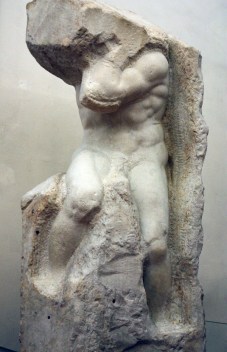
prisoner-atlasTwenty years ago – almost to the day – I was at the Galleria dell’Accademia in Florence, Italy, the museum that famously displays Michelangelo’s “David“. And while I was in awe of this 17-foot masterpiece, it was not his familiar form that stayed with me after I left.

It was this piece, known as “The Atlas”, one of Michelangelo’s four Prisoners done in the non-finito, or unfinished, style. To me, these seemed most representative of his philosophy about sculpture: that every block already contained the figure, he just had to chisel away the unnecessary marble. Some claim these works are the best representation of Michelangelo’s sculpting prowess, though this might not be immediately evident compared to the seeming perfection of David.

But you’re not here for an art history lesson, so let’s segue into the point for this post.

I left the museum with an understanding that Michelangelo revealed only enough of the figure for it to come to life (though whether a tour guide said it or whether I was brilliantly struck with inspiration, I’ll never know. Feel free to guess.). That thought has stayed with me for twenty years and it’s a philosophy that I’ve applied to my writing.

I love to write. I’m often verbose (this is one of the reasons I start each post with a message about word count – it keeps me in check!). If I could indulgently describe a scene or a character in a thousand lush words, I would. But I think that does the reader a disservice. I want to provide just enough detail to bring the story to life in your mind. If I write too much, well, I feel like I’m taking away too much of your imagination, which I think reduces a reader’s enjoyment of a book.

I’m not alone. In his book “On Writing“, Stephen King says something similar about his characters:

…if I describe [my complete mental picture], it freezes out yours, and I lose a little bit of the bond of understanding I want to forge between us. Description begins in the writer’s imagination, but should finish in the reader’s.

As an example, let me describe a mountain range at the edge of sight: its jagged outline and snowy peaks; the evergreen treeline that marks the highest point at which foliage can grow; or the treacherous recesses that are but dark wrinkles upon an ancient gray face. I could go on and on, depicting the clouds that obscured the tallest peaks or the shadows they cast upon the insignificant hills below, but there comes a point where your interest fades. You get it. There are mountains in the background. They are imposing and old and magnificent. You don’t need me to zoom in until we’re so close we can see the shiny flecks of mica in the granite.

Rockies 1

So here’s the deal: you bring your imagination and I’ll bring the right number of words, and we’ll meet in the lands of Empyrelia, each of us with our own vision of the world around us. Work for you?

A picture might be a thousand words, but you don’t need a thousand words to form a picture in the reader’s mind. Sometimes less is more. The successful writer finds the balance.

–Michael

Enjoy what you read? Leave a comment or like the post and we’ll ensure that you see more like this from Michael!

© Michael Wallevand, May 2016

April 30 writing update

This post is about 400 words.

There’s a quote attributed to Anton Chekhov that goes something like this:

  • If there is a gun on the mantle in the first act, it must go off in the third.

mantle

In other words, don’t put in unnecessary details, especially when they seem to promise something that will never be delivered. I’m sure we could endlessly debate the literary merits of this kind of thinking, and we probably should. At a later date. And over beers.

I was reminded of this quote today when I realized that I had my own version of a gun on the mantle and it was never set to go off. At least, not in this book. Writing to resolve this situation would have added at least a chapter, or another couple thousand words. I’m already a bit concerned about the novel’s length, but more importantly, I didn’t want to accommodate this need.

But I really wanted to keep the passage.

I love fairy tales and folklore. I love rhymes and songs, and I partially attribute my affection for Tolkien to these things. Inevitably, they make it into my own writing. I was particularly proud* of a bit of verse I’d written earlier in the week. Besides the fun of writing it and the whimsy it conveyed, like most nursery rhymes, there was a cautionary tale within the words about a particular creature. A creature that never appeared.

Then I had a literary epiphany. You’ve probably experienced the same thing in your own writing: you’ve written yourself into a corner and you’re certain your hero will not escape. And then, the answer comes out of nowhere. The solution to the problem. It’s so simple and effortless, you can’t believe it works. And while you’re happy, a small part of your brain nags you for taking so long to figure it out. That’s OK, because you have a solution and it feels natural.

There’s an element of surprise that the solution creates, so I won’t spoil it. However, don’t forget that, when you’re creating words and creatures, the definitions of those things can be exactly what you want, especially when your story uses general English and made-up languages.

So now, the gun has gone off and I’m very happy with the results.

WaterPistol

Until next time!

–Michael

Enjoy what you read? Leave a comment or like the post and we’ll ensure that you see more like this from Michael!

*”Proud” is usually followed by a feeling of abject despair when, upon reading the passage, I realize it’s rubbish.

© Michael Wallevand, April 2016